

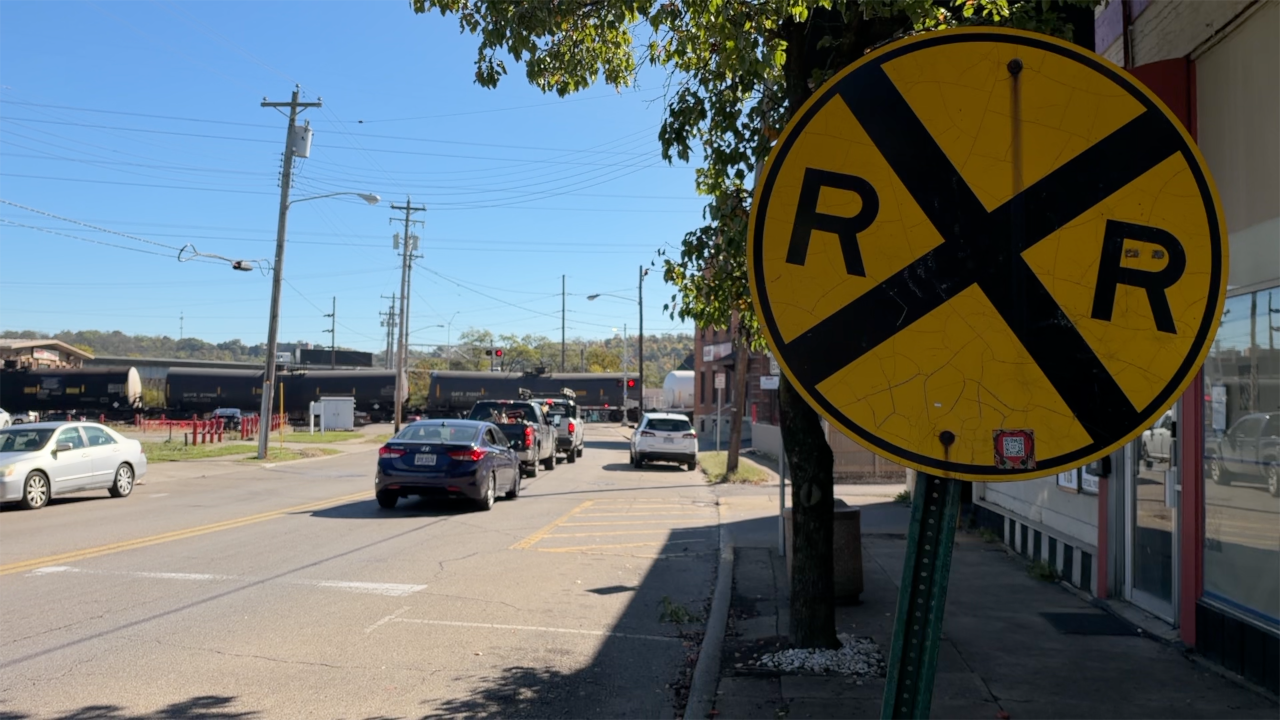


LOCKLAND, Ohio — A deadly fire in Lockland is sparking new calls for action after a stopped train delayed firefighters trying to respond.
Lockland Fire Chief Doug Wehmeyer said a response that should have taken 30 seconds took several minutes because of the stopped train. Eighty-nine-year-old Marian Haefner died in the fire.
Congressman Greg Landsman said situations like that are unacceptable.
"This has got to end," Landsman said.
WATCH: Landsman spoke to us about the solutions he wants to see from the Federal Railroad Administration:
Landsman is now pushing for answers from the Federal Railroad Administration (FRA) about the incident.
In a letter to the FRA, Landsman questioned how the administration is investigating the incident and what it's doing to prevent similar delays in the future.
"This is not something communities should have to deal with anymore," Landsman said.
According to data from the FRA, there have been more than 34,000 reports of blocked railroad crossings nationwide over the past year.
Nearly 22% of those reports involved first responders being unable to cross the tracks.
"It's a staggering number and the first thing that comes to mind is 'Well, how many people lost their lives because of this?'" Landsman said.
Landsman said he's now drafting a bill that would give communities more power to prevent stopped trains from blocking railroad crossings.
"We need to pass something to empower local communities to give them essentially the authority to move the trains," Landsman said.
It's not the first time a local congressman has tried to fix the problem.
Republican Rep. Warren Davidson, who represents Ohio's 8th District, introduced a bill in 2025 that would lift federal preemption and allow state laws to take effect.
However, Davidson said that the bill has not received a hearing in the House subcommittee.
"Unfortunately, the chairman of the committee in the House right now, he fully supports the railroads,” Davidson told us in October. “He feels like there should be federal preemption.”
We reached out to the FRA for comment on Landsman's letter. A spokesperson sent us the following statement:
"The tragedy in Lockland is a reminder that the safest crossing is no crossing at all. Events like this are why Secretary Duffy recently announced $1.24 billion in grants to eliminate key crossings in 37 states, and why FRA continues to work closely with railroads and local municipalities to reduce the occurrence of blocked crossings."
We also reached out to Norfolk Southern regarding Landsman's letter and were sent the following information:
Norfolk Southern (NS) continues working with local officials to reduce the impact of blocked crossings, particularly for emergency responders. Those efforts include discussions around crossing-detection technology that could provide real-time visibility when crossings are occupied.
NS is also participating in the Cincinnati Rail Congestion Mitigation Plan, focused on improving rail fluidity and addressing blocked-crossing concerns across the corridor.
NS is making infrastructure investments in the area intended to help reduce congestion and minimize crossing impacts while maintaining safe operations.
We continue to support efforts to fund installation of crossing occupancy technologies in Lockland, with installation funding commitments at two crossings. NS has also remained in communication with Lockland officials since the incident.
Landsman said he believes a solution is needed now.
"We're not going to stop until it gets fixed," Landsman said.
