

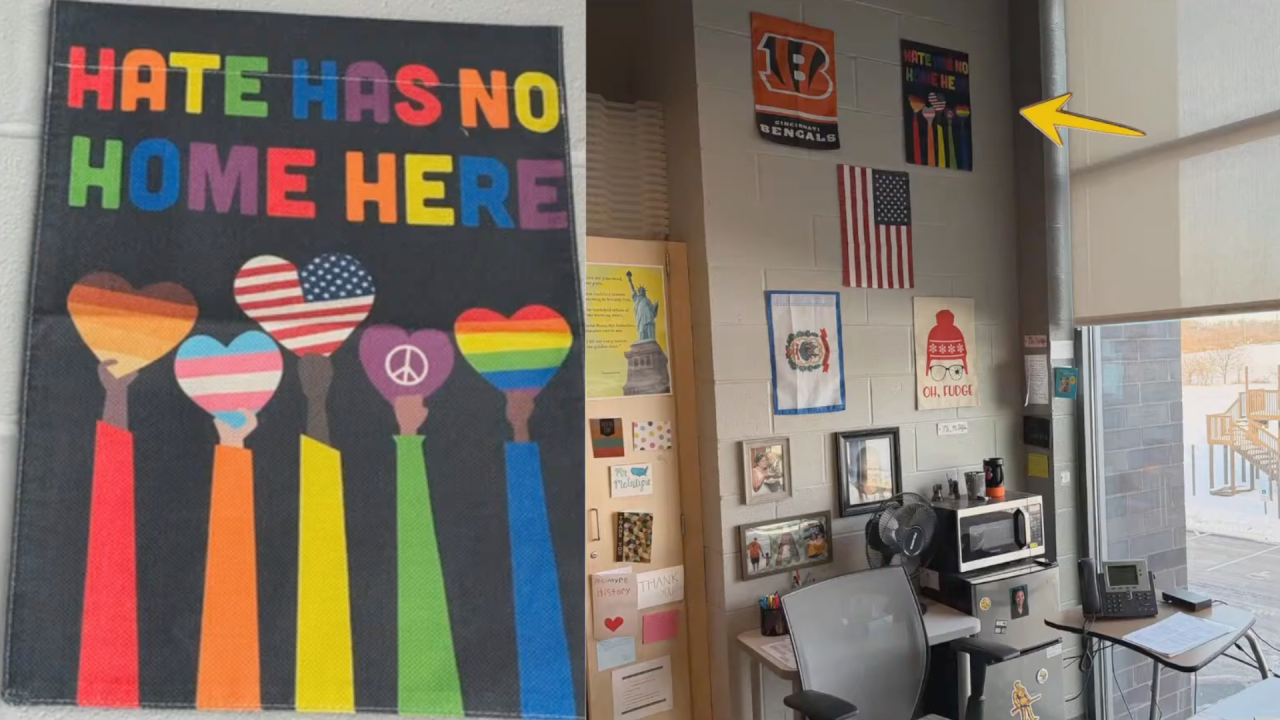


MAINEVILLE, Ohio — A U.S. District Court judge this week sided with Little Miami Local Schools in a lawsuit over a controversial classroom poster, ruling that the display was subject to school board oversight.
Little Miami High School teacher George McIntyre sued the district and school board President David Wallace earlier this year, stating that a February order to remove the poster from his classroom violated his First Amendment rights.
The poster, which had been hanging in the classroom for several years prior to the school board's removal vote, included five hands holding up hearts with images on them. Two of those images appeared to reference the LGBTQ+ pride flag and the transgender pride flag.
WATCH: Judge sides with school district in First Amendment case about controversial poster
Judge Matthew McFarland issued the ruling, stating that because McIntyre displayed the poster in his role as a public school employee, not as a private citizen, the display was subject to school board oversight.
"As McIntyre displayed the Poster pursuant to his official duties, his expression constituted unprotected employee speech," the ruling stated.
The ruling exclusively addresses the First Amendment issue of the case, not whether the school board correctly defined or classified the disputed content.
In a joint statement, Wallace and school board Vice President Mandy Bullock called the ruling a win for district families.
"As board members with children in the district, we know how important it is for parents to look inside their children's classrooms and ask questions," they said. "Our Board will keep parents informed about what their children are taught."
The plaintiff's attorney says they filed an appeal in the case on Tuesday and worry about the ruling's impact on the school district going forward.
"We think there are significant free speech issues presented here," Joshua Engel said in a phone call on Tuesday. "I'm concerned that some in the school district may see this as a green light to continue to discriminate against LGBTQ students."
We reached out to all Little Miami school board members yet to comment on the ruling. Only one, Wayne Siebert, responded. He shared comments in his capacity as a resident of the school district, not an elected official.
"I believe that there is plenty of room for discussion on this matter and plenty of room for appeal," Siebert said. "The 6th District Court of Appeals covers four states and over 3 million teachers."
The school board voted 4-1 in February to remove the poster from the classroom, citing Ohio's Parents' Bill of Rights law in the decision.
The law, enacted in April 2025, directed school boards across the state to adopt policies allowing parents to be notified and given the choice to opt their students out of any instruction that includes "sexuality content."
However, the Little Miami Local Schools policy carved out specific exemptions for the rule, including "incidental references to sexual concepts or gender ideology occurring outside of formal instruction."
The poster in question fell under "incidental references," Wallace said at the time.
You can read Wallace and Bullock's full statement below:
“Parents deserve to know what their children are taught and to have a voice in their schools. Today’s ruling is a big win for the families who count on their elected school board to take responsibility for classroom decisions. The court held that the teacher put up the display in the course of his official duties and that the display was subject to Board oversight.
The plaintiff argued that a teacher’s classroom display is his own constitutionally protected private speech, beyond the reach of the elected board and the parents it answers to. The court rejected that argument, joining federal appeals courts across the country that have reached the same conclusion. Had it succeeded, school boards in Ohio could have lost the ability to oversee what is put in front of students every day. As Judge McFarland wrote, elected school boards ‘are accountable to the public for the choices made on their behalf.
Our Board adopted the policy required by Ohio’s Parents’ Bill of Rights, including its rules for parent notice and review of covered materials. In this instance, the superintendent reviewed the display and reached one conclusion. The elected Board, which makes the final decision under the policy, reached a different one by a 4 to 1 vote at a public meeting. That is how these decisions should be made: in the open, by the people families elect.
As board members with children in the district, we know how important it is for parents to look inside their children’s classrooms and ask questions. Parents should stay involved, attend board meetings, and consider serving on the board themselves, because the final authority over these decisions rests with the board.
Our Board will keep parents informed about what their children are taught. We will work with families and teachers to make every classroom safe, respectful, and free from bullying and harassment for every student, without exception."
This story was reported on-air by a journalist and has been converted to this platform with the assistance of AI. Our editorial team verifies all reporting on all platforms for fairness and accuracy.
