

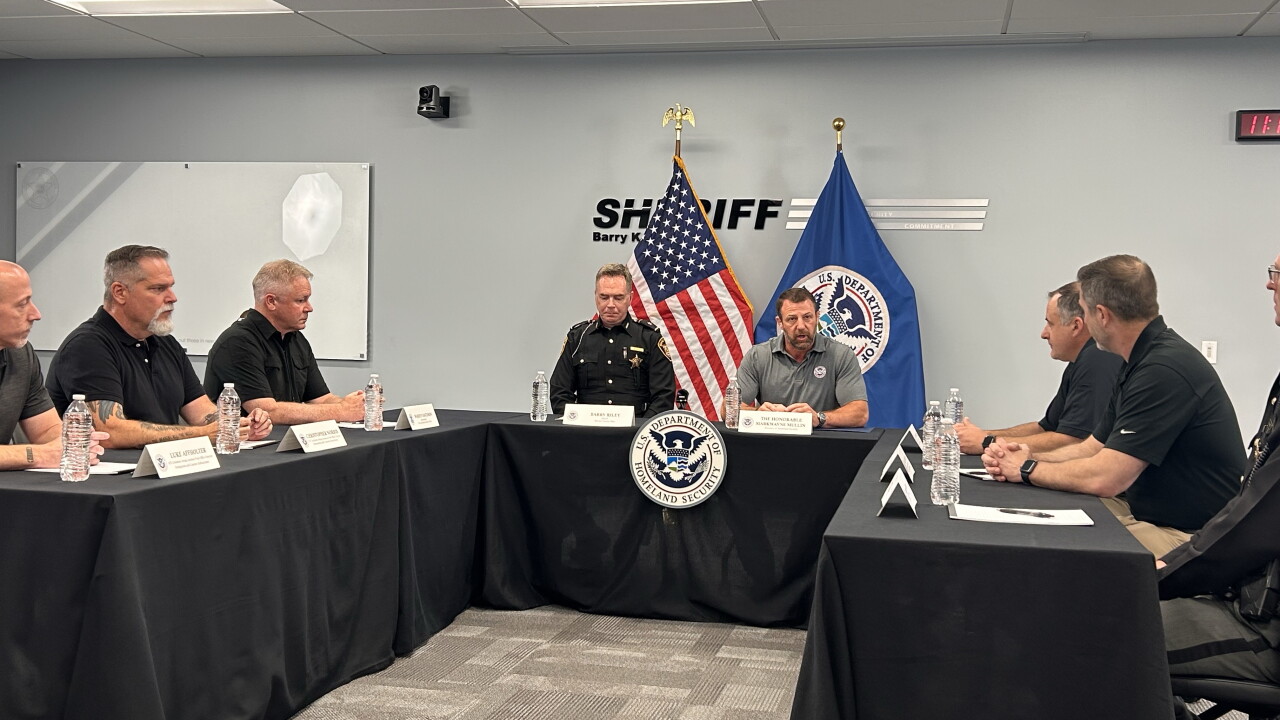


LEBANON, Ohio — U.S. Homeland Security Secretary Markwayne Mullin joined U.S. Immigration and Customs Enforcement (ICE) officials and local law enforcement in Cincinnati on Friday for a roundtable focused on 287(g) partnerships, which are collaborations between ICE and local authorities.
Mullin's roughly 40-minute visit drew the Warren County Sheriff's Office, ICE officials and local leaders. The visit came on the heels of multiple high-profile immigration-related events in the region.
Mullin said federal agents have already made 380 immigration-related arrests in Springfield, Ohio, located about one hour north of Lebanon in Clark County. Mullin made it clear the enforcement push is not slowing down.
"We're going to continue to push," Mullin said. "We encourage everybody to go home."
WATCH: Mullin shares more about ICE operations in southwest Ohio
Mullin also defended the use of GPS ankle monitors for some migrants under Temporary Protected Status. The administration ended TPS protections for many Haitians in July, leaving thousands in legal limbo. Mullin's message to those affected: leave voluntarily or risk deportation.
"We'll give you $3,000 and a plane ticket, go home," Mullin said.
The visit also came against the backdrop of the recent suicide death of 20-year-old Pierre Damas Bel, a Haitian immigrant whose friends say was terrified of being swept up in immigration enforcement and was bullied because he had to wear an ankle monitor. Mullin pushed back against claims that federal policies played a role in Bel's death.
"It breaks my heart for the parents, but we were following our procedures," Mullin said.
When asked whether DHS policy gives preference to a particular type of alternative to detention based on a migrant's offense, Mullin said decisions are made on a case-by-case basis.
"I think it's case by case," Mullin said.
The roundtable also addressed the 287(g) program, a federal initiative that allows local jails and law enforcement agencies to act as force multipliers for ICE. The program operates under three models: the jail model, the warrant service model and the task force model.
Warren, Butler and Clermont counties all participate in the program. The Hamilton County Sheriff's Office and Cincinnati Police Department do not. Mullin did not hide his frustration with non-participating jurisdictions.
"It doesn't stay in that county. It bleeds into counties like Warren County," Mullin said.
The 287(g) program has faced scrutiny over how some agencies use the partnership. Earlier this year, the police chief in Gratis in Preble County was fired after she and another village officer visited Cincinnati schools looking for information under her department's 287(g) agreement.
Officials stressed Thursday that agencies participating in the program are supposed to stay within their own jurisdictions. They also noted that cooperating districts sometimes help locate missing or endangered children.
