




CINCINNATI — An invasive pest that WCPO first reported on last summer is spreading and destroying more and more boxwood shrubs around the Tri-State, threatening one of the most popular landscaping plants in the region.
It is called the box tree moth.
Social media reports show the devastation is becoming particularly bad on the east side of town, in communities including Anderson Township, Loveland, and Blue Ash.
Watch: What you can do if your boxwoods are attacked:
Its leaf-devouring larvae are attacking boxwood shrubs that homeowners have relied on for years because they stay green all winter and are typically almost indestructible, until recently.
Now the moths are traveling fast from garden to garden, to the point where the Ohio Department of Agriculture in April 2026 declared a quarantine in Butler, Clermont, Hamilton, Warren, Greene and Montgomery counties, prohibiting the transport of any boxwoods out of those counties (even if they appear to be fine).
Chris McKeown, who owns the Bloomin Garden Center in Blue Ash, Ohio, has seen the damage firsthand at his own nursery, where several shrubs at the entrance turned brown last summer.
"It's an insect that's very, very invasive," McKeown said, pointing to a brown shrub that should have been green and lush.
The damage happens quickly. When asked if the destruction occurred over two or three weeks, McKeown said it was much faster. "No, less than that. This happened in like a week," he said.
He wasn't kidding. In just a few days last week, I noticed one of my boxwoods start to appear thin and brown.
By the time I was able to get out to purchase a pesticide, it was almost completely defoliated.
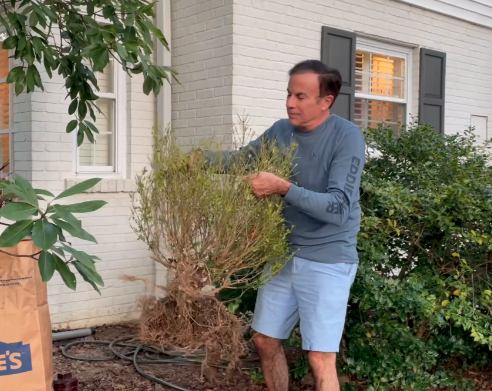
Here is how you know if your shrub has been attacked, or is just brown from drought or some other disease: The box tree moth larvae create distinctive webbing that can be mistaken for spider activity, McKeown explained.
"So you see all this webbing and you might even think that your boxwood has been overrun by spiders but it's not, it's their worms," McKeown said.
Elizabeth, a local homeowner who sought McKeown's advice, discovered the problem when her landscaping began failing.
"I discovered they were turning brown and had a lot of dead leaves," she said.

Treatment options available
McKeown explained the good news is that several insecticides can kill the moth.
He recommends a pesticide called Spinosad as the most effective, though it is one of the priciest, and says cheaper caterpillar and mite sprays such as Bio Advanced Mite Control can work as well.
If you find signs of damage and webbing, you should spray every few weeks until late fall, McKeown said.
"Ideally, you spray it inside the plant," McKeown said. He says plants can recover in 3 to 6 months if all their leaves were not lost.
MIn the meantime garden experts recommend inspecting boxwoods for signs of brown leaves and what appear to be spider webs.
And if you are buying plants for your garden, consider alternatives to boxwoods — such as the Bowling Ball Arborvitae— so you don't waste your money.
____________________________________
This story was reported on-air by a journalist and has been converted to this platform with the assistance of AI. Our editorial team verifies all reporting on all platforms for fairness and accuracy.
_______________________________________
"Don't Waste Your Money" is a registered trademark of Scripps Media, Inc. ("Scripps").
Follow John:
- Facebook: John Matarese Money
- Instagram: @johnmataresemoney
- X/Twitter: @JohnMatarese
Follow Taylor:
- Facebook: Taylor Nimmo
- Instagram: @tnimms
- X/Twitter: @tnimms
For more consumer news and money saving advice, go to www.dontwasteyourmoney.com
