

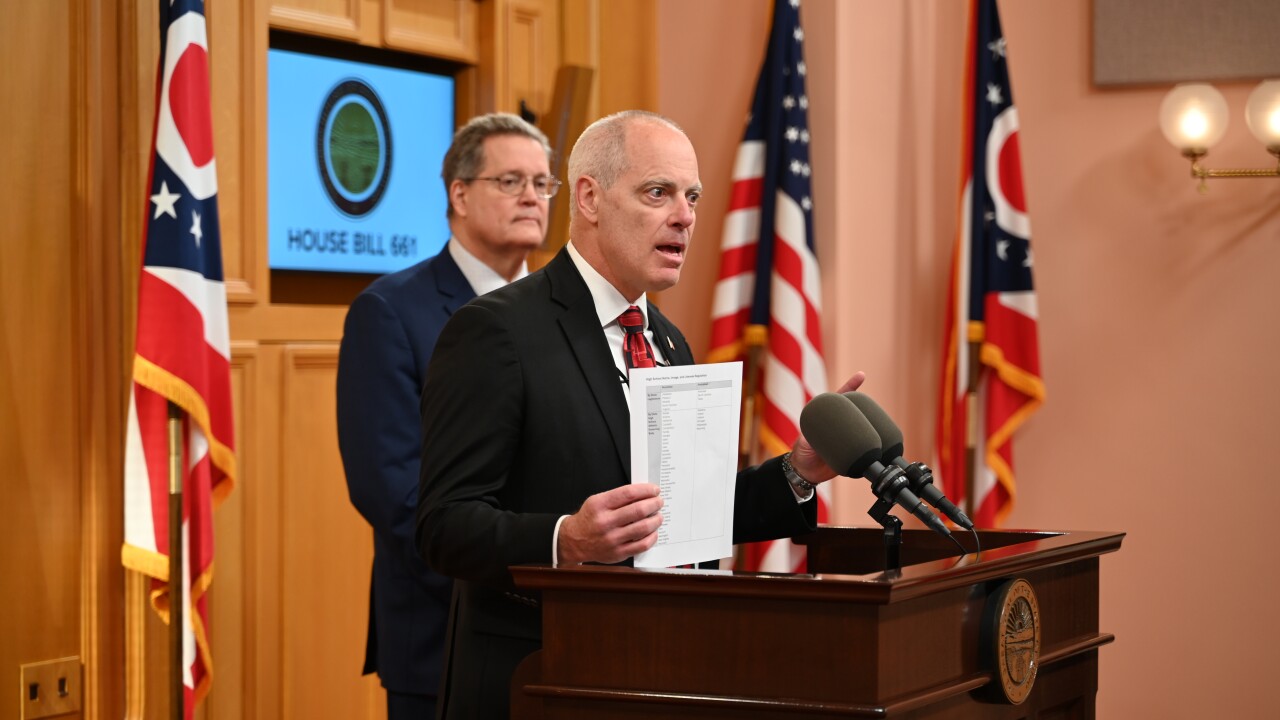


COLUMBUS, Ohio — Two Ohio lawmakers announced legislation Tuesday morning that would prohibit a student who is participating in Ohio High School Athletic Association middle or high school interscholastic athletics from earning compensation from the student’s name, image or likeness (NIL).
State Representatives Adam Bird (R-New Richmond) and Mike Odioso (R-Green Township) hosted a press conference Tuesday morning regarding House Bill 161. The bill, introduced last week, will have its first hearing in the House Education Committee on Wednesday morning. Bird said Tuesday morning there are 13 co-sponsors to the bill.
“In Ohio we used to be able to call our seventh through twelve (grade) athletes amateurs,” Bird said during the press conference. “We can no longer do that now due to OHSAA strong-arming its member schools. Many of whom did not want a bylaw change.”
Under the legislation, a student-athlete who earns prohibited compensation would be ineligible to participate in the specific sport tied to that compensation, while remaining eligible to compete in other sports. The bill also requires athletic governing organizations to adopt clear rules for investigating alleged violations and to establish an appeals process for student-athletes seeking reinstatement.
“The OHSAA is aware of the introduction of House Bill 661 and looks forward to continuing to provide information on the process taken to develop the proposal and safeguards that went to our membership for a vote last fall," OHSAA spokesman Tim Stried said. "It is important to note that NIL at the high school level in Ohio is very different than what we see at the college level, and that Ohio is one of 45 states that allows some version of NIL for high school student-athletes.”
Bird said he expects schools will support the bill.
“We anticipate that there will be varsity coaches from around the state of Ohio who are willing to come and testify as a proponent to this bill,” Bird said. “We anticipate that there will be educational leaders from around the state of Ohio who are going to be willing to come and testify on behalf of this bill.”
Bird said there are public financial reasons for banning NIL in Ohio high school sports.
"We don’t spend public taxpayer money on stadiums and on weight rooms and on gymnasiums in order for them (student-athletes) to be able to earn an employment and earn an income,” Bird said.
Ohio high school student-athletes have officially been permitted to profit from NIL after the OHSAA announced in late November that an emergency bylaw referendum passed convincingly by its 815-member high schools.
The voting period ended the afternoon of Nov. 21, with the final voting results being 447 schools in favor of the referendum and 121 schools voting against, while 247 schools abstained from voting.
The results of the emergency referendum vote resulted in a fundamental change to an amateur bylaw which has been a tenet to the state's high school sports since the OHSAA was founded in November 1907.
“We introduce a bill because we believe in the purpose of Ohio high school sports,” Bird said. “And that that purpose in Ohio high school sports should be about a learning experience that is an extension of the classroom. That’s why we call them co-curricular activities in Ohio. And we believe that co-curricular activities should be about learning health and fitness. It should be about social connection. It should be about discipline, work ethic, character development, leadership and communication skills. These are the reasons why we as a state and as a society invest in the opportunity for young people to participate in seven through twelve sports."
OHSAA student-athletes can enter into agreements and be compensated for their name, image and likeness through appearances, licensing, social media, endorsements and/or the use of branding based on their public recognition or notoriety. The bylaw also establishes reporting procedures and limitations so that students do not jeopardize their eligibility as it relates to the OHSAA’s recruiting and amateur bylaws.
The emergency referendum was conducted due to a lawsuit filed by the family of Huber Heights Wayne (now Sunbury Big Walnut) wide receiver Jamier Brown, the nation’s No. 1 wide receiver in the 2027 class, on Oct. 15 against the OHSAA regarding NIL. A Franklin County judge issued a temporary restraining order.
“We reached this point because of an emergency decision that was rendered by a Franklin County judge,” Bird said. “And rendered a temporary restraining order. We should not be making decisions in the state of Ohio based on one judge in one county. And the state legislature should weigh in on decisions that they support tax dollar revenue. And so it is our intention to influence and to communicate with our colleagues that we need to pass this bill. And we need to pass it in a timely manner so that it can be place for next school year.”
Odosio, who taught at St. Xavier High School for 29-plus years and coached football for 16 years, retired from teaching at the end of 2024.
Odosio said the passage of NIL in Ohio high school sports “shook me in my core.”
“I think high school sports is one of the greatest things Ohio is known for,” Odosio said. “This is something that we are going to fight for and we don’t want to have ruined.”
Odosio believes NIL should be prohibited in Ohio middle school and high school sports.
“What we have rushed here is a rushed bylaws,” Odosio said. “And I understand the fear of them (the OHSAA) getting sued. Or wanting to resolve the lawsuit — I understand that. But, to change the policy of the state of Ohio that will cause so much damage. There needs to be legislative intervention.”
NIL at the high school level has spread rapidly in the last several years since it became permitted at the college level. Ohio is one of 46 state associations (45 states plus Washington D.C.) that allow NIL, according to the National Federation of State High School Associations.
In September 2025, the OHSAA Board of Directors approved language on NIL to go to member schools in May 2026 as part of the annual referendum voting process.
The OHSAA developed the NIL bylaw proposal in consultation with an NIL committee comprised of school administrators, the OHSAA board of directors, which is elected by the member schools, and from member school feedback at regional update meetings.
“Our member schools helped develop this language,” OHSAA Executive Director Doug Ute said in November. “Now the real work begins, because this will be a continually evolving piece of high school athletics. The OHSAA will track NIL deals and make sure that our recruiting bylaws and transfer bylaws are still enforced, which is something our member schools have asked for throughout this process.”
Ohio has the third-largest participation rate in high school sports nationally behind Texas and California, according to the National Federation of State High School Associations.


