

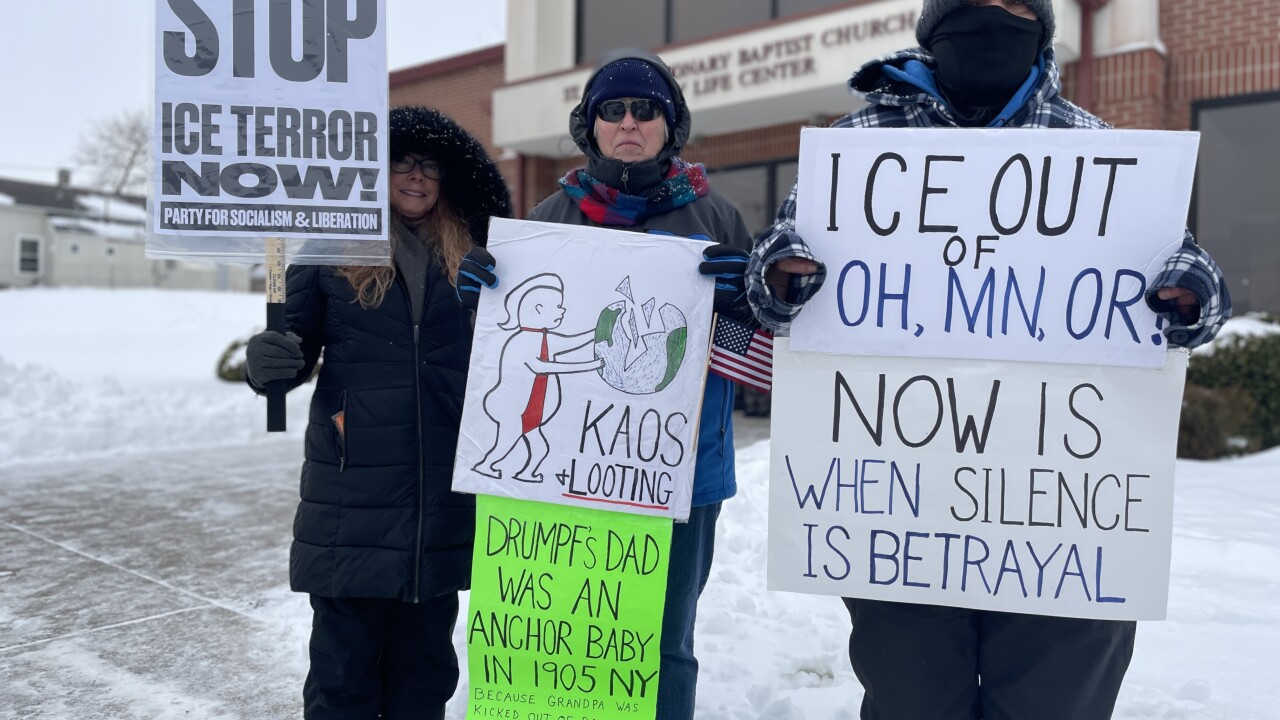


SPRINGFIELD, Ohio — An estimated 15,000 Haitian migrants living in Springfield, Ohio, have been bracing for the potential end of their legal protections this week, with many speculating that federal immigration enforcement could soon arrive in their community. On Monday, people from across Ohio rallied in support of the Haitian community just hours before a federal judge blocked the potential end to Haitians' legal protections.
Temporary Protected Status for Haitian migrants was scheduled to end Wednesday, following an announcement in November by U.S. Secretary of Homeland Security Kristi Noem that Haiti no longer meets the program's requirements. TPS is a program that began in 1990 that allows people from countries experiencing conflict or natural disasters to live and work legally in the U.S. for designated periods.
TPS was extended to Haitian migrants in 2010 under then-President Barack Obama after a devastating earthquake. The protections were extended by the Department of Homeland Security under the first Trump administration, although he subsequently tried to end the protections, prompting court challenges. In June 2024, former President Joe Biden extended TPS through Feb. 3, 2026.
Monday evening, U.S. District Judge Ana Reyes in Washington granted to pause the termination of TPS for Haitians while a lawsuit challenging it proceeds.
Community rallies in support
Earlier on Monday, people from across Ohio packed St. John Missionary Baptist Church for the Here We Stand Community Event to pray and show support for the local Haitian community.
Patrice Mosby, who drove up from Cincinnati, expressed concern about potential family separations.
"The people that have been brought here by our governor to help the economy have done everything right, have helped the community, helped the economy, and now, just for Trump wanting to hurt a country, or a county, they're going to get taken away," Mosby said. "What happens to (the children)? Are they all going to foster home? Many of their children were born here. Are they just going to be taken away? Are they going to be separated?"
WATCH: Springfield residents rally in support of the Haitian community
Mosby said she's worried any federal enforcement actions could have broader implications for all communities.
"It horrifies me, because you all know the poem. We're next," Mosby said. "They're not going to stop just with Haitians. They're not going to stop just with brown people. Eventually, we're all going to be hurt in some way, whether we're taken away or we don't have people around us to help us have a living, you know, survive with neighborhoods and community. So really sad. I hate to see it happening."
Melissa Stevens, a lifelong Springfield resident who works alongside many Haitian migrants, was among the hundreds in attendance Monday.
"Everyone came here legally, so the fact that they're suddenly losing their legal status is very jarring, and it's very heartbreaking, and it's cruel and unusual, really," Stevens said.
Stevens said she feels losing the Haitian community would have significant consequences for Springfield.
"I think that a lot of businesses will be very harshly affected, if not shattered completely," Stevens said. "We will lose a large portion of our community that has really contributed a lot to our community, really given us a lot of amazing food, a lot of amazing culture."
Mayor addresses uncertainty
During the Jan. 27 commissioners meeting, Springfield Mayor Rob Rue addressed community speculation that agents with Immigration and Customs Enforcement could soon begin local operations, acknowledging the uncertainty while emphasizing the city's commitment to safety.
"We do recognize that since the fall of 2024, there has been a significant anxiety surrounding this potential federal immigration policy change," Rue said. "City officials and law enforcement leaders in our community have been actively communicating with one another, as well as with other agencies and organizations to share timely, accurate and verified information whenever possible."
The mayor confirmed the city has maintained communication with federal authorities but lacks specific details about potential enforcement actions.
"At this time, there is no confirmed information regarding immigration enforcement activity in our community, which means we don't have a date, we don't have any information that indicates who and what and how ICE agents could be coming to our community," Rue said.
Rue noted that federal operations could occur with little warning.
"We may not get a phone call that an operation is happening. If we do, it could be the very day it happens. We just don't know," Rue said.
ICE has not responded to our request to comment on potential enforcement in Springfield.
Community divided on issue
Not all Springfield residents support the Haitian community remaining. Mark Titus, a longtime Springfield resident, argues the city has been overwhelmed.
"We were invaded by quite a few people, 20,000, more than 20,000 people, in the city of 56,000. To me, that just goes without common sense. They're here temporarily, and they knew that. They knew it was temporary," Titus said. "I don't think that the people who come here are all necessarily bad people. I do have questions of why there are 330,000 Haitians in this country that won't go back, thinking that they can't make a difference in their own country."
Titus said he believes the influx was economically motivated and has hurt local workers. Titus said Springfield would benefit economically if the Haitian population left.
"I think we'd have less homeless. I think rent would go down to where the people that got kicked out when the greedy landlords raised all the prices. About two years ago, there was just a housing crisis in Springfield that was crazy, and landlords were jacking up prices double," Titus said. "I think you'll see, I think you'll see a better Springfield. I think the manufacturers will have to hire — they laid people off to hire Haitians. You don't do that. They knew they could hire the Haitians at a cheaper rate."
A 75-year-old Clark County resident, who asked to remain anonymous, shared similar concerns about community resources and safety.
"I don't wish bad things on the Haitians, but I think it's time they move on away from Springfield. Too many were dumped on the community too quickly without telling the community," the resident told us. "I feel our seniors and poor have been neglected and put behind the Haitians in line."
The resident described a traffic incident involving their granddaughter that they said changed their previously favorable perspective. The resident claims the driver was a Haitian migrant.
"I was trying to be positive and taking Haitian language classes online until our granddaughter was nearly hit while walking home from school. A Haitian ran a light and hit a student standing next to her in a crosswalk in a school zone," the resident said. "The driver didn't stop, left the scene... the kid spent the night in the hospital."
Safety concerns about Haiti
We previously sat down with Viles Dorsainvil, executive director of the Haitian Community Help and Support Center in Springfield, to talk about the potential end of TPS.
Dorsainvil emphasized that many Haitian migrants fled their home country due to safety concerns and fear that returning could put their lives at risk.
"The weak government cannot control the gang members," Dorsainvil said. "It's a state of lawlessness where somebody can come to you and shoot you, and there is no investigation, there is no follow-up."
The State Department currently maintains a Level 4 travel advisory for Haiti, the highest warning level, advising against all travel due to kidnapping, crime, terrorist activity, civil unrest and limited health care.
Dorsainvil said the anxiety has been compounded by national stories of ICE enforcement actions, including a recent incident in Minnesota where federal agents shot and killed 37-year-old Alex Pretti last week.
"It has been a constant fear," Dorsainvil said. "If you speak in a different accent as me, automatically you are a target."
Dorsainvil noted that many Haitian migrants contribute to Springfield's economy by opening businesses, buying homes and paying taxes. However, Vice President JD Vance has argued that the growing migrant population has strained local resources and pushed up housing costs.
Ohio Gov. Mike DeWine has expressed concern about the potential economic impact of ending TPS protections. Over the past few months, DeWine has repeatedly questioned how the end of TPS could impact a city like Springfield.
"It is not in the best interest of Ohio for these individuals, who are workers and who are working, to lose that status," DeWine said.
Preparing for the unknown
DeWine acknowledged that immigration decisions rest with the federal government and said his office has no indication that federal agents will come to Springfield. He added that local and state law enforcement will cooperate with federal authorities.
The Haitian Community Help and Support Center continues to help community members prepare for the potential end of TPS, offering resources and advice on interactions with federal agents.
"If there is a possibility for them to stay home and call us, we ask of them to call us for any type of service in need instead of putting themselves in danger," Dorsainvil said.
Stevens believes the decision to end TPS is motivated by discrimination rather than policy considerations.
"I just think that there are so many of us that really love and support our Haitian neighbors and all of our immigrant neighbors, and I think there is a small, very loud group that you know is very angry and does not support them," Stevens said. "But I just want that community to know that that is not the majority, that the majority loves them and the majority wants them to stay. And I really hope that they feel that love, and they feel that they are welcome here in our community, and that they are part of our community."
Titus said he supports a federal presence if ICE agents conduct enforcement in the coming days.
"Make Haiti great again. Make Haiti a better country. Let ICE do their job. We don't want to turn this into Minneapolis. That's the last thing anybody in Springfield wants to see," Titus said. "I don't want to see one thing destroyed by anybody. I don't want to see anybody hurt, and there's no reason for it, but I support ICE."
The 75-year-old Clark County resident echoed Titus' support for TPS ending, and said they hope for a peaceful resolution.
"I wish them a peaceful flight home with their families and friends and the opportunity to return properly," the resident said.
A federal judge was expected to rule Monday on a potential temporary pause to the TPS termination, though that decision remains pending. The outcome could determine whether protections for Haitian migrants across the country end this week as scheduled.
This story was reported on-air by a journalist and has been converted to this platform with the assistance of AI. Our editorial team verifies all reporting on all platforms for fairness and accuracy.
