

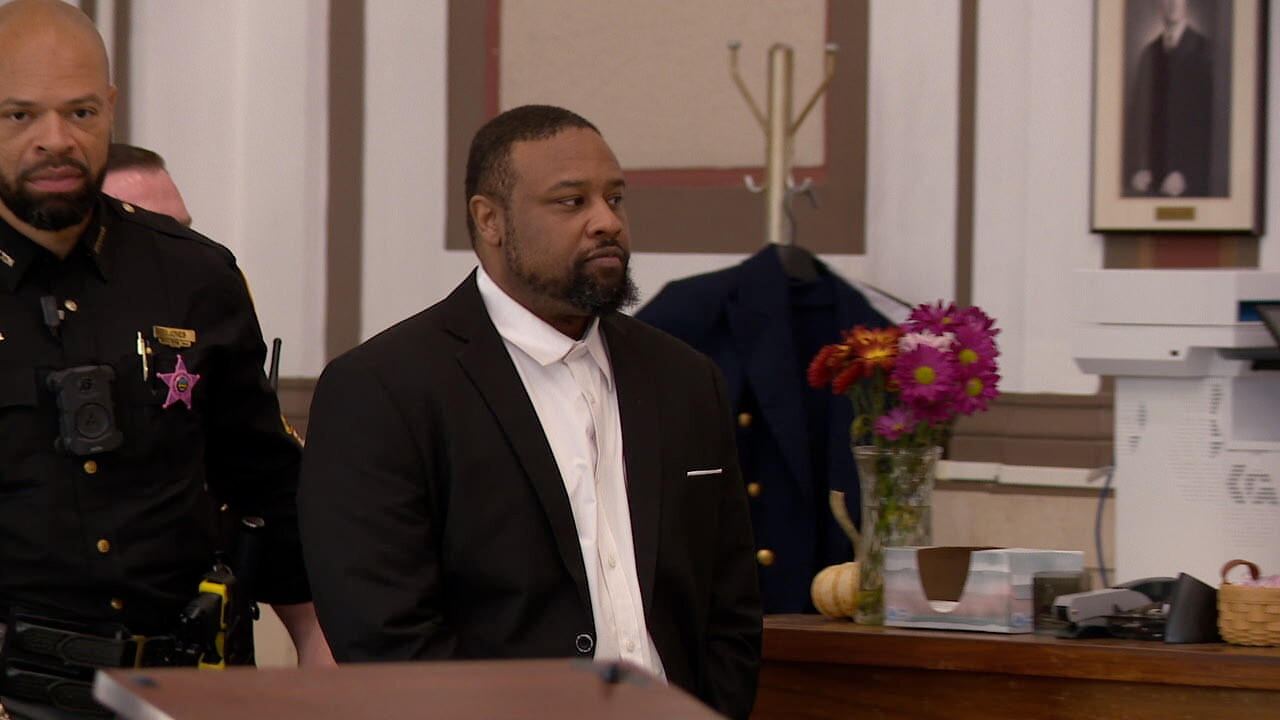


CINCINNATI — After more than a week of testimony, the murder trial of Rodney Hinton Jr. is nearing its conclusion, with jurors soon expected to decide whether he intentionally killed a Hamilton County sheriff's deputy, was legally insane at the time or committed a lesser offense.
Closing arguments are set to be delivered on Tuesday.
WATCH LIVE:
Testimony concluded Friday following hours of questioning of the prosecution's final witness, forensic psychologist Dr. Jennifer O'Donnell.
Closing arguments are expected after Hamilton County Common Pleas Judge Jody Luebbers finishes reviewing jury instructions with attorneys.
The final days of testimony centered on Hinton's mental health and whether he understood his actions were wrong when he drove into Deputy Larry Henderson near the University of Cincinnati on May 2, 2025.
WATCH: Testimony ends in Hinton trial; closing arguments expected Tuesday
Hinton has pleaded not guilty by reason of insanity. His attorneys acknowledge he struck and killed Henderson but argue his severe mental illness prevented him from understanding the wrongfulness of his actions.
Prosecutors maintain Hinton deliberately targeted Henderson after watching police body camera footage of his 18-year-old son, Ryan Hinton, being fatally shot by a Cincinnati police officer the previous day.
Now, jurors will have another option to consider.
In a significant ruling Thursday afternoon, Luebbers granted the defense's request to include reckless homicide as a possible verdict consideration on two aggravated murder counts. The lesser offense carries a substantially shorter potential prison sentence.
WATCH PREVIOUS: State rests in Rodney Hinton Jr. murder trial, defense makes case for insanity
Final witness maintains Hinton knew his actions were wrong
O'Donnell, the final witness originally called by prosecutors Thursday, continued testifying Friday that Hinton has a documented history of serious mental illness but that she found insufficient evidence he was experiencing acute psychosis when he struck Henderson.
She is the second prosecution rebuttal psychologist to conclude that Hinton understood the wrongfulness of his actions.
O'Donnell conducted two court-ordered evaluations of Hinton, interviewing him in September 2025 and February 2026. She also reviewed extensive medical and psychiatric records.
During her testimony, O'Donnell described Hinton's grief following his son's death and his account of driving around Cincinnati before the crash.
Hinton told her he had been listening to music and trying to calm himself. He described feeling angry and devastated over Ryan's death.
"I was hurting," Hinton told O'Donnell, according to her testimony. "It was my first son."
O'Donnell said Hinton's emotional distress was significant but distinguished impaired judgment from the inability to recognize that an action is wrong.
"What does one do with one's knowledge under extreme emotional distress?" O'Donnell testified.
She explained that people with histories of impulsivity or irritability may experience impaired judgment when overwhelmed by emotion.
But Ohio's insanity standard requires more than emotional distress or poor judgment. A defendant must have a severe mental disease or defect that prevented them from knowing the wrongfulness of their actions at the time of the offense.
O'Donnell ultimately concluded Hinton did not meet that standard.
WATCH PREVIOUS: Witnesses recount deadly crash in Rodney Hinton Jr. trial
Defense questions whether a brief psychotic episode was overlooked
Bennett spent hours challenging O'Donnell's evaluation and the certainty of her conclusions.
He questioned whether Hinton could have experienced a brief psychotic episode at the time of the crash, even if he was not exhibiting symptoms in the days immediately before or afterward.
O'Donnell acknowledged that the absence of symptoms on surrounding days would not necessarily rule out a brief episode. However, she maintained that she found no evidence establishing that such an episode occurred when Henderson was killed.
The defense also questioned O'Donnell about Hinton's report of hearing a voice from a nearby vehicle shortly before the collision.
Bennett raised the possibility that the experience was a hallucination, while O'Donnell maintained there was insufficient evidence to reach that conclusion.
During cross-examination, Bennett also highlighted differences between O'Donnell's earlier evaluation of Hinton's serious mental illness and her later report addressing the insanity defense.
He questioned why language concerning atypical psychotic episodes appeared in one report but not the other. O'Donnell acknowledged she could not explain the omission but maintained that it did not change her ultimate opinion.
Despite the lengthy cross-examination, O'Donnell stood by her conclusion that Hinton knew his actions were wrong.
Judge works through instructions ahead of deliberations
With testimony complete, attention shifted to the instructions jurors will receive before deliberations.
Luebbers spent time Friday working through the language with prosecutors and defense attorneys, including how jurors should evaluate Hinton's insanity defense and the newly added reckless homicide option.
The judge acknowledged that the instructions could be difficult to follow, given the multiple charges, potential verdicts and separate legal standards.
"It's a little muddy, and I'm a lawyer and a judge, so I'm thinking the jury is going to be a little muddy too," Luebbers said. "So we're trying to make it clean."
The judge also addressed the use of Hinton's statements to forensic psychologists, clarifying that jurors must consider those statements within the legal limits governing the mental health evaluations.
The instructions are particularly consequential because jurors will be asked to consider whether the prosecution proved the charged offenses, whether a lesser offense applies and whether Hinton has established his insanity defense.
WATCH PREVIOUS: Emotional testimony begins Rodney Hinton Jr. murder trial after jury seated
Why jurors can consider reckless homicide
Thursday's ruling on reckless homicide came after jurors were dismissed for the day, during an extended discussion between Luebbers and attorneys.
Bennett argued Hinton may have been attempting suicide when he drove toward a utility pole near Henderson.
He cited Hinton's history of mental illness, previous suicidal thoughts, testimony that relatives feared he might harm himself after watching the video of Ryan's fatal shooting and one eyewitness's testimony that Hinton's car hit a utility pole before hitting Henderson.
According to the defense, jurors could reasonably conclude Hinton intended to crash into the pole to kill himself but recklessly caused Henderson's death in the process.
"So it's up to the jury to decide whether or not he was trying to commit suicide or intentional homicide," Bennett argued.
Prosecutors strongly opposed the request.
Assistant Prosecutor Kip Guinan argued the evidence showed Hinton intentionally steered toward Henderson rather than losing control or recklessly endangering people around him.
"He knew exactly what he was doing. He knew exactly how to do it. He knew he had to turn the wheel a little bit to accomplish his goal," Guinan told the judge.
Guinan also argued that the defense had not presented sufficient evidence to allow a reasonable jury to reject aggravated murder in favor of reckless homicide.
Luebbers disagreed.
The judge explained that the legal standard requires sufficient evidence for jurors to reasonably acquit on the greater offense while convicting on the lesser offense, with the evidence viewed in the light most favorable to the defendant.
She concluded that the eyewitness account of Hinton driving toward the pole, considered alongside other evidence, could reasonably support the defense's theory.
Luebbers emphasized that jurors are free to believe all, some or none of a witness's testimony.
"They could find the lesser included, so it comes in," she ruled.
The ruling does not mean Luebbers found Hinton was attempting suicide or that he acted recklessly. It allows jurors to consider that possibility.
Reckless homicide is a third-degree felony punishable by up to three years in prison. Aggravated murder carries a potential life sentence.
WATCH PREVIOUS: Jury selection underway in Rodney Hinton Jr. murder trial
Hinton's statements to another psychologist
Before O'Donnell took the stand, jurors heard extensive testimony from Dr. Jaime Adkins, the prosecution's first rebuttal psychologist.
Adkins testified that Hinton described driving through Clifton after watching the body camera footage of Ryan's fatal shooting.
"I came to a light and heard somebody say something in the car next to me because the window was down, and I looked over," Hinton told Adkins, according to her testimony. "Then I looked back and seen that officer."
Hinton then described steering toward Henderson.
"And that is when I drove the car over in his direction and hit the officer," Adkins quoted him as saying.
Adkins testified that Hinton also volunteered another detail about the crash.
"No. I had to turn a little bit to hit him," Hinton said when asked whether he knew the officer, according to Adkins.
But his response was less definitive when questioned about his intentions.
"Sort of, kinda, not really," Hinton told Adkins. "Like I said, I wasn't really thinking, not rationally. Like I said before, if I was thinking right, I wouldn't have done that."
Hinton also described being in an emotional daze and experiencing intense anger, grief and guilt over his son's death.
Adkins concluded that his behavior was connected to those emotions rather than an acute psychotic episode.
She acknowledged Hinton's schizoaffective disorder but testified that a serious mental illness does not automatically mean someone was legally insane at the time of an offense.
During cross-examination Thursday, Bennett challenged Adkins about whether Hinton's failure to flee or conceal his actions suggested he did not understand they were wrong.
Adkins rejected the idea that any single behavior could determine whether a defendant understood the wrongfulness of an act.
"It's not that simple," she testified.
She also acknowledged that forensic evaluations cannot eliminate every uncertainty about a person's mental state.
Nevertheless, Adkins maintained that Hinton understood his conduct was wrong.
Competing expert opinions now in the jury's hands
The prosecution's two rebuttal psychologists reached conclusions that directly contradict the defense's mental health expert, Dr. Maria Espinola.
Espinola testified Wednesday that Hinton's longstanding psychiatric illness, combined with the trauma of seeing his son's death on video, caused him to experience psychosis and dissociation.
She concluded Hinton was so disconnected from reality that he could not understand the wrongfulness of his actions when he struck Henderson.
Prosecutors challenged that assessment, arguing Hinton's grief and anger did not establish legal insanity.
The disagreement among the experts became one of the trial's central issues.
Jurors have also heard from Hinton's relatives, eyewitnesses, investigators and crash reconstruction experts, whose testimony offered competing interpretations of his actions leading up to the collision.
What happens next?
With the final witness excused, the trial is approaching its last major stages.
Attorneys are expected to deliver closing arguments Tuesday before Luebbers provides final jury instructions and the case is submitted for deliberations.
Jurors will be tasked with evaluating the aggravated murder charges, the possibility of reckless homicide on two counts and Hinton's claim that he was not guilty by reason of insanity.
RELATED | Emotional testimony begins Rodney Hinton Jr. murder trial after jury seated
WATCH PREVIOUS: Judge removes possibility of death penalty in Rodney Hinton Jr. case
This story was reported on-air by a journalist and has been converted to this platform with the assistance of AI. Our editorial team verifies all reporting on all platforms for fairness and accuracy.
