

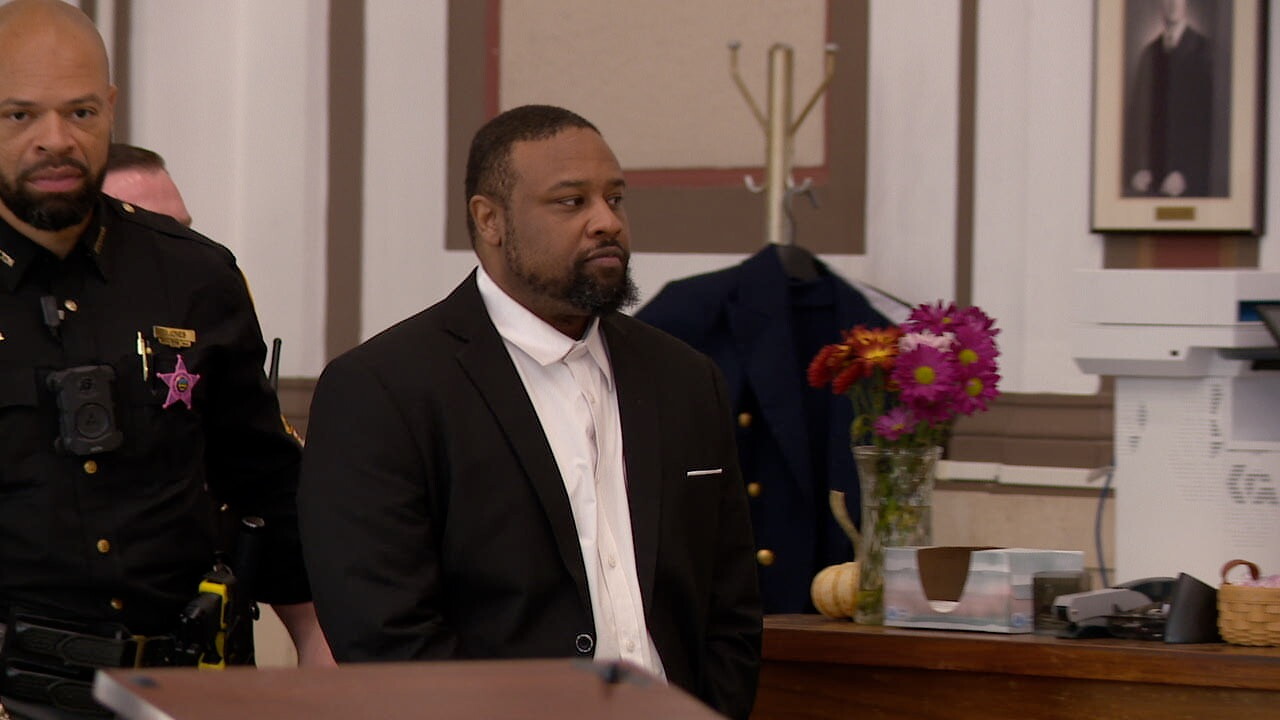


CINCINNATI — Day eight is underway in the trial for Rodney Hinton Jr., the man accused of intentionally driving into and killing Hamilton County Sheriff's Deputy Larry Henderson.
WATCH LIVE:
On Wednesday, Hinton told a forensic psychologist he turned his car toward Henderson before striking and killing him. Still, he gave an uncertain answer when asked whether he intended to hit the deputy, according to the testimony.
Dr. Jaime Adkins, a forensic psychologist, was called by prosecutors as their first rebuttal witness on the seventh day of trial.
Adkins testified that she interviewed Hinton twice and questioned him about what happened May 2, 2025, when he drove into Henderson near the University of Cincinnati.
Reading from her interview with Hinton, Adkins recounted his description of driving through Clifton after watching police body camera footage of his 18-year-old son being fatally shot by Cincinnati police the previous day.
"I came to a light and heard somebody say something in the car next to me because the window was down, and I looked over," Hinton told Adkins, according to her testimony. "Then I looked back and seen that officer."
He then described what happened next, according to the interview transcript read in court.
"And that is when I drove the car over in his direction and hit the officer," Adkins quoted Hinton as saying.
The testimony offered jurors a new account of the crash from Hinton himself, as the prosecution and defense continued presenting competing explanations for his state of mind.
Hinton has pleaded not guilty by reason of insanity. His attorneys do not dispute that he struck and killed Henderson but argue he was legally insane at the time and that severe mental illness prevented him from understanding the wrongfulness of his actions.
Prosecutors contend Hinton deliberately targeted the deputy out of anger over his son's death and understood what he was doing.
Hinton told psychologist he had to turn to hit deputy
Adkins testified that Hinton volunteered another detail about the crash when she asked what he remembered.
"No. I had to turn a little bit to hit him," Hinton said when asked whether he knew the officer, according to Adkins.
The psychologist emphasized that Hinton offered the detail about turning without being specifically asked whether he had steered toward Henderson.
She also questioned him about his intentions. Asked whether he meant to hit Henderson, Hinton gave a less definitive answer.
"Sort of, kinda, not really," he told Adkins. "Like I said, I wasn't really thinking, not rationally. Like I said before, if I was thinking right, I wouldn't have done that."
Adkins also asked Hinton what he was thinking when he saw the deputy.
"I can't say my thoughts for real," Hinton responded, according to her testimony. "I was still emotional, and I was still in an emotional daze."
Hinton acknowledged being angry with the officers involved in his son's fatal shooting, but said that anger was not directed at Henderson specifically.
When asked whether he knew Henderson was not one of the officers involved in Ryan Hinton's death, he responded, "I don't know."
WATCH PREVIOUS: State rests in Rodney Hinton Jr. murder trial, defense makes case for insanity
Hinton also told Adkins he did not believe he applied his brakes before the collision and recalled hitting a pole.
He said his next memory was waking up in an ambulance and that he understood what had happened afterward.
Hinton denied planning the crash.
Adkins also testified that Hinton described leaving Cincinnati police headquarters after watching footage of his son's fatal shooting.
"I watched the video a few times, and I left," Hinton told her.
He said his family did not want him to drive, so he rode with relatives to his cousin's home, where he rested.
"When I woke up, I couldn't sit still," Hinton said, according to Adkins. "I had her take me to my car."
He then drove around Cincinnati before ending up near UC, where Henderson was directing traffic during commencement activities.
Adkins testified that she met with Hinton twice: once in November 2025 for an evaluation involving serious mental illness and again in February 2026 for an evaluation related to his insanity defense.
WATCH PREVIOUS: Thursday's witnesses described acceleration without braking
She also reviewed records and video evidence and spoke with Hinton's wife.
Adkins told jurors she has worked full time in forensic psychology for 16 years and estimated she has conducted between 1,500 and 2,000 evaluations involving pleas of not guilty by reason of insanity.
Her testimony began Wednesday afternoon after the defense's forensic psychologist completed two days of questioning.
Court adjourned for the day before Adkins finished testifying. She had not yet presented her ultimate opinion on whether Hinton met Ohio's legal standard for insanity at the time of the crash.
Defense psychologist rejects revenge as explanation
Earlier Wednesday, Dr. Maria Espinola, a forensic psychologist called by Hinton's defense, maintained that Hinton's actions were the result of serious mental illness rather than retaliation.
Espinola diagnosed Hinton with schizoaffective disorder, bipolar type and post-traumatic stress disorder.
She testified that Hinton was experiencing symptoms of psychosis and dissociation when he struck Henderson, leaving him disconnected from reality.
"I think at the time he was experiencing symptoms of dissociation and symptoms of psychosis that basically disconnected him from reality and prevented him from knowing the wrongfulness of his actions," Espinola testified.
Her conclusion remained unchanged despite hours of questioning by prosecutors.
Prosecutors challenged her assessment by examining Hinton's history of violent behavior, including incidents involving anger over his son. They suggested Hinton's actions were motivated by a desire to retaliate against law enforcement after Ryan's death.
At one point, assistant prosecutor Kate Burroughs challenged Espinola directly.
"He only cared about one thing, and that was taking out an officer that day. Is that right?" Burroughs asked.
"No," Espinola responded.
During questioning by defense attorney Clyde Bennett, Espinola acknowledged considering retaliation as a possible explanation. But she rejected it.
"My opinion is that that wasn't the reason this happened," she testified.
Espinola said the death of Hinton's son, followed by watching video of the shooting, was different from previous experiences involving Ryan.
She described the loss as devastating for someone already struggling with serious psychiatric illness.
"So this is the ultimate," Espinola testified. "I mean, it's just a very final moment for him because he will never be able to do that again."
She added that the experience was crushing for any parent, but for Hinton, "it basically destroyed him."
WATCH PREVIOUS: Emotional testimony begins Rodney Hinton Jr. murder trial after jury seated
Prosecutors question expert's evaluation
Prosecutors also scrutinized how Espinola reached her conclusion, including her acknowledgment that she never personally watched video of the crash or video leading up to it.
Espinola testified that she requested the footage but did not receive it.
She said she reviewed other evidence, including investigative reports and descriptions of the crash, and maintained that watching the video would not change her opinion.
Another point of contention involved whether Hinton was taking psychiatric medication at the time of Henderson's death.
Espinola discussed medical records indicating Hinton had stopped taking prescribed psychiatric medication and that his wife had encouraged him to resume treatment.
She testified that she found no indication in the records she reviewed that he was taking anti-psychotic medication in April or May 2025. But when challenged by prosecutors, she said she could not definitively say whether Hinton was or was not on medication at the time.
That issue could become significant as the prosecution continues its rebuttal.
Adkins testified that Hinton told her he believed he was taking psychotropic medication at the time of the crash.
Crash evidence remains central to prosecution's case
The psychological testimony follows days of evidence about the hours and moments before Henderson was killed.
On Tuesday, Cincinnati police crash reconstruction specialist Mike Flamm testified that Hinton accelerated his car from a stop to nearly 50 mph in approximately five seconds.
He also testified that Hinton made steering adjustments toward the deputy as Henderson attempted to escape.
"The defendant puts a steering input, turns it in the same direction, not towards the pole, but towards Deputy Henderson," Flamm told jurors.
Bennett challenged that interpretation, pointing to evidence that Hinton's car struck a utility pole near Henderson before hitting the deputy.
The defense raised the possibility that Hinton intended to crash into the pole rather than target Henderson, including whether he was attempting to take his own life.
Flamm rejected that explanation, calling it "laughable" and maintaining that the vehicle's movements supported his conclusion that Henderson was the intended target.
Other witnesses previously testified that they heard the vehicle accelerate and did not observe evidence of braking.
Hinton's cousin, Monique Gilliam, testified that she was concerned he might harm himself after watching footage of his son's death. She and another relative followed him as he drove toward Clifton.
Gilliam described Hinton becoming increasingly agitated before accelerating near the intersection where Henderson was working.
She testified that she saw his vehicle strike a pole but did not see the moment it hit Henderson.
WATCH PREVIOUS: Jury selection underway in Rodney Hinton Jr. murder trial
Trial centers on what Hinton understood
The defense began presenting its case Tuesday after prosecutors rested.
Hinton's father and sister testified about his history of mental illness and concerning behavior before and after he watched video of Ryan's death.
His sister, Keyaira Hinton, said she warned police that her brother was struggling with his mental health and should not watch the footage alone.
His father, Rodney Hinton Sr., described years of psychiatric symptoms, including a 2023 episode in which he found his son walking naked in the street.
Espinola testified that Hinton's mental health history included psychiatric hospitalization, previous diagnoses and treatment with antipsychotic medication. She concluded that his serious mental illness prevented him from understanding the wrongfulness of his conduct when he killed Henderson.
Prosecutors have challenged that conclusion, arguing that the evidence shows Hinton understood his actions and deliberately targeted a law enforcement officer.
Under Ohio law, a diagnosis of mental illness alone does not establish a defense of not guilty by reason of insanity. Jurors must determine whether a severe mental disease or defect prevented Hinton from knowing the wrongfulness of his conduct at the time of the offense.
Adkins' testimony is expected to continue as the state presents evidence rebutting the defense's insanity claim.
For jurors, the central question remains whether Hinton's actions were driven by a mental illness so severe that he could not understand they were wrong — or whether he knowingly targeted Henderson following his son's death.
RELATED | Emotional testimony begins Rodney Hinton Jr. murder trial after jury seated
WATCH PREVIOUS: Judge removes possibility of death penalty in Rodney Hinton Jr. case
This story was reported on-air by a journalist and has been converted to this platform with the assistance of AI. Our editorial team verifies all reporting on all platforms for fairness and accuracy.
