

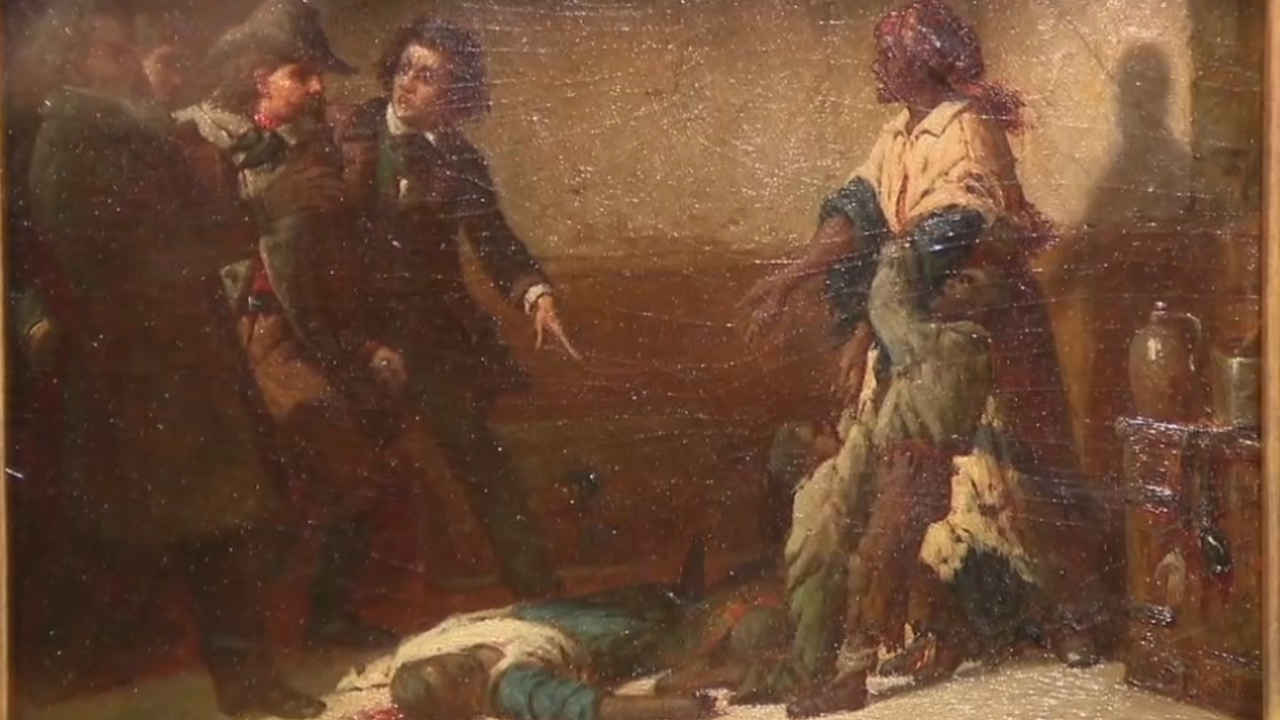


CINCINNATI — Inside the National Underground Railroad Freedom Center, stories of survival, strength and sacrifice come alive. For Black History Month, one of the most high-profile trials in state history reveals the desperate lengths a mother would go to protect her children from the horrors of slavery.
Margaret Garner's story began in 1833 at a plantation in what is now Walton, Ky., owned by Archibald Gaines and his wife. Born to enslaved parents, George and Priscilla Gaines, Margaret was considered a mulatto, suggesting her father was likely John Gaines, the original owner of the property.
"Margaret was a very, very beautiful woman, and the mother was afraid of what would happen to her, knowing that what happened to her," said Novella Nimmo-Black, community engagement docent and special projects coordinator at the National Underground Railroad Freedom Center. "And so she married her off to Robert, who lived on another small farm."
WATCH: We sat down to learn more about Margaret Garner's story and trial
The marriage couldn't protect Margaret from Archibald Gaines, who had taken over the plantation from his brother. During that era, white women in their third trimester had the right to refuse their husbands, but this permitted men to seek satisfaction elsewhere.
"The first place that he would go is into the slave pens," Nimmo-Black said.
Gaines repeatedly sent Robert, a horseman who cared for the plantation's horses, to work in Covington for months at a time. Each time Robert returned, Margaret was pregnant.
"Women were dying in childbirth, and for some reason they thought it was because of the relationship during that time, but her saying no to her husband gave him a right to go elsewhere," Nimmo-Black said.
Margaret gave birth to four children during this period. Her first son, Robert Jr., was listed as Black in records, indicating Robert was the father. The next three children — Samuel, Priscilla and Mary — were all listed as mulatto.
"He comes back. His wife is pregnant again. She gives birth to baby Mary. Now, Mary was the spitting image of Archibald Gaines. And he loved Mary because it looks like, it looked just like him," Nimmo-Black said.
When Margaret became pregnant a fifth time, Robert had reached his breaking point. In 1856, he gathered his family, including his parents, and they fled toward Ohio, crossing the frozen Ohio River to Little Bucktown, where Paycor Stadium now stands. Margaret had a freeman cousin there who could provide refuge.
But Gaines tracked them down before Underground Railroad conductor Levi Coffin could transport them to safety in Canada.
"Robert does have a gun and he tries everything he can do to make sure that they don't catch him," Nimmo-Black said. "She realizes that and when she sees that there's no hope, she runs and gets a butcher knife and grabs young Mary and cuts her throat."
Margaret then grabbed a shovel and went after her daughter, Priscilla, before being stopped.
"She did not want them to be raped like she and her mother was," Nimmo-Black said. "Because as a mother, you know, you're supposed to protect your children, but to me that was her way of protecting her daughters, you know, I'm gonna send them back to God. You know, it was a hard choice. That was a very hard choice."
The family was arrested and brought to Cincinnati, but Margaret wasn't charged with murder. Instead, they were charged with running away.
"In Cincinnati, if you get caught as a runaway, you would have one hour to find a white man that could identify you as being free," Nimmo-Black said.
The trial lasted three weeks, drawing international attention.
"This trial went on for three weeks. You had people coming from other countries wanting to know what was going on in America. That these women would rather see their children dead than see them enslaved," Nimmo-Black said.
During the trial, abolitionist Lucy Stone spoke out during a recess, despite women being forbidden to speak in court.
"Looking at the babies under the table plan, the faded faces of the Negro children tell too well the degradation that the Negro woman has to face in her despair, if she feels that it is better to send her children back to heaven," Stone said, according to Nimmo-Black. "Who among you has the right to say that she didn't have the right to say so?"
Margaret was found guilty and returned to Gaines, but Cincinnati officials wanted to retry her for murder — not to punish her, but to grant her freedom.
"They really wanted to give her her freedom because they thought anybody that desperate needed to have their freedom, and Archibald knew that," Nimmo-Black said.
To prevent this, Gaines sold Margaret to a cousin in Tennessee. During the steamship journey, the vessel collided with another boat. Margaret and her newborn baby were lost — some say she jumped, others say she fell.
"These are two babies that are now gone," Nimmo-Black said.
Robert was allowed to visit Margaret in Tennessee as she lay dying of typhoid fever in 1854. She made him promise never to remarry until he reached freedom.
Margaret died at age 21, having given birth to five children, only one with her husband.
"I would say it's the most famous case in Cincinnati's history during that time," Nimmo-Black said. "It shows the desperation that a mother would go to to save her child from the brutality of rape. That she would rather see her dead than to see her abused."
Margaret's story inspired Toni Morrison's 1987 novel "Beloved" and an opera that helped usher in the Freedom Center in 2005. However, Nimmo-Black believes both missed the mark.
"All of the stories that they tell about Margaret Garner, who you see lying dead, is Robert," she said, referring to artistic depictions that show Robert dead instead of baby Mary.
The story reveals a harsh reality about freedom in the antebellum north. The Fugitive Slave Act required African Americans to prove their freedom with papers costing $500 — equivalent to $5,000 today. True freedom meant reaching Canada or Mexico.
"Freedom coming north was Canada, going south was Mexico," Nimmo-Black said. "People were saying, you know, why should I go all the way to Canada when I'm in a free state, and so they would hide among the people here in Little Africa, Little Bucktown and Big Bucktown."
Margaret Garner's desperate act of love continues to resonate as one of the most powerful examples of a mother's determination to protect her children from the horrors of slavery, even at the ultimate cost.
This story was reported on-air by a journalist and has been converted to this platform with the assistance of AI. Our editorial team verifies all reporting on all platforms for fairness and accuracy.
