

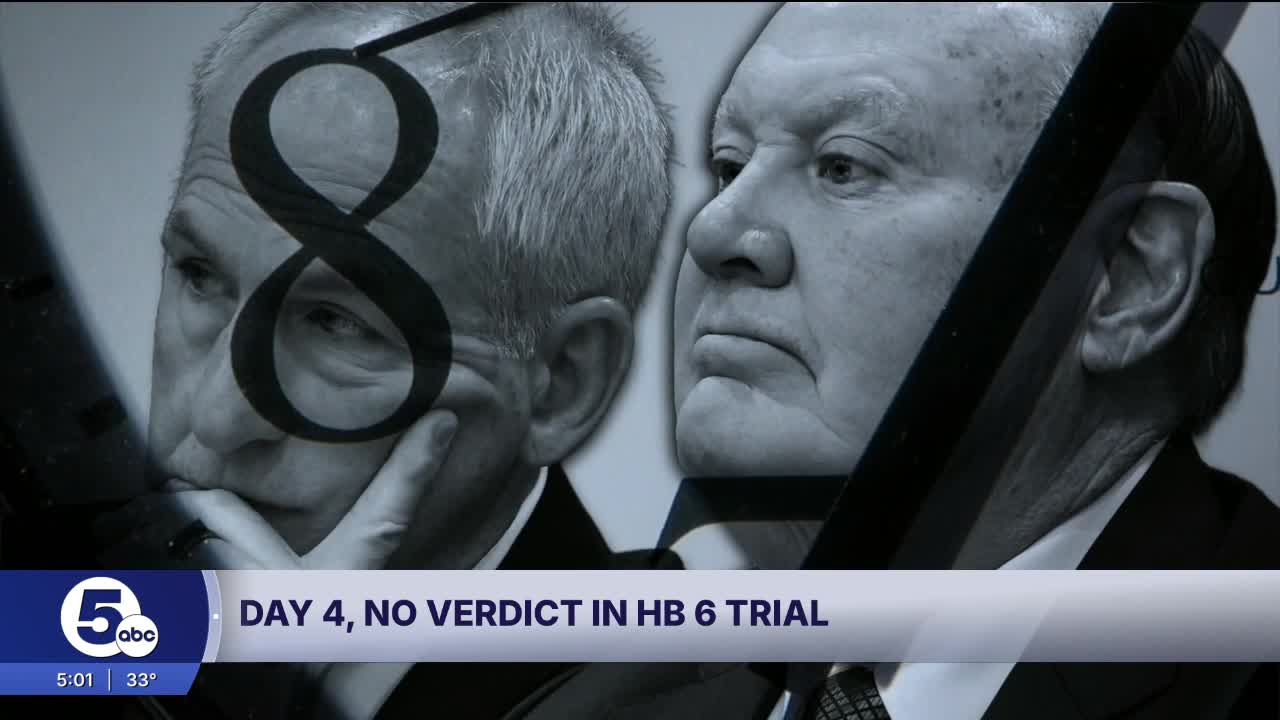


AKRON, Ohio — The jurors in the FirstEnergy corruption trial are stuck, telling the judge Monday that they can’t agree on whether former executives committed bribery. Some other key details weren’t told during the trial, ones that some attorneys say could have made it easier for them.
The Summit County jury has been deliberating for four days, trying to decide on whether former FirstEnergy CEO Chuck Jones and former SVP Mike Dowling are guilty of bribing former Public Utilities Commission Chair (PUCO) Sam Randazzo with $4.3 million to get beneficial rulings.
The defendants have also been accused of spending $61 million to help create and pass House Bill 6. H.B. 6 was legislation to provide a billion-dollar bailout for the struggling company.
Charges
The jury will decide on charges for each man. All are different levels of felonies.
Jones
- Engaging in a pattern of corrupt activity — Felony 1, up to 11 years in prison
- Bribery — Felony 3, up to three years in prison
- Telecommunications fraud — Felony 1, up to 11 years in prison
- Conspiracy — Felony 2, up to eight years in prison
Altogether, it could lead him to 33 years in prison if convicted.
Dowling
- Engaging in a pattern of corrupt activity — Felony 1, up to 11 years in prison
- Bribery — Felony 3, up to three years in prison
- Two counts of telecommunications fraud — Felony 1, up to 11 years in prison (22 if convicted of both)
- Two counts of tampering with records — Felony 3, up to three years in prison (6 if convicted of both)
- Conspiracy — Felony 2, up to eight years in prison
If convicted of all charges, he could face 50 years in prison.
Monday
On Monday, the jury asked two questions. The first was asking for clarification on a meeting that took place in 2018. The judge responded that the jury needed to use their "memory."
In the second, the jury asked Judge Susan Baker Ross, "If they cannot agree" on the bribery charge, should they still evaluate the others. She responded yes, according to a defense attorney.
Later, the judge called the media into the courtroom to request that the press not publish the jury's second question. Citing fears that the jury would be scrutinized, she said she would not be putting the publicly recorded question on public record until after the verdict came out.
Reporter Jake Zuckerman with Signal Ohio and I stood up to express that a defense attorney repeatedly read it out loud to us, and I defended that the bailiff acknowledged it, as well. The judge backed down. Baker Ross ended up saying that she can't control what the press does — but said that she wouldn't be publicizing it.
For the sake of transparency
There were 14 facts that the jury was prohibited from hearing, all of which may have bolstered the prosecution’s case.
"Trying to make sure that the fact of these other circumstances doesn't taint this criminal trial of Jones and Dowling," Case Western Reserve University criminal law professor Mike Benza said.
In order for the jury to remain unbiased, attorneys and witnesses weren’t allowed to mention certain topics that could be deemed as prejudicial, Benza said.
The jury can't know the "manner or method" in which Randazzo died. The jurors are allowed to know that Randazzo died, but they aren’t allowed to know that he killed himself in April 2024 in his warehouse, while facing 22 state and 11 federal corruption charges.
They also aren’t allowed to know about “The arrest, indictment, prosecution, trial, or conviction of Larry Householder or any other defendant in United States v. Householder.”
Former Ohio House Speaker Larry Householder was sentenced to 20 years in prison for accepting $61 million in bribes from FirstEnergy, specifically the executives.
"Can't bring in Householder's conviction as evidence that Jones and Dowling committed the crime with Householder," Benza said.
Even if jurors find the executives not guilty, the men are facing federal charges — ones they don't know about. Jones and Dowling have another corruption trial in the coming years.
And the most telling — FirstEnergy, as a company, already admitted to bribing Randazzo and Householder.
"There has been a big legal fight between the parties over whether or not First Energy's admission of bribery can come in during this trial," the professor said.
In 2021, FirstEnergy took a deferred prosecution agreement, like a plea deal, and agreed to pay $230 million.
Despite all of this evidence being withheld, Assistant Attorney General Matthew Meyer remained optimistic during his closing argument.
"The State of Ohio trusts you to get this right," he said.
Follow WEWS statehouse reporter Morgan Trau on Twitter and Facebook.
