

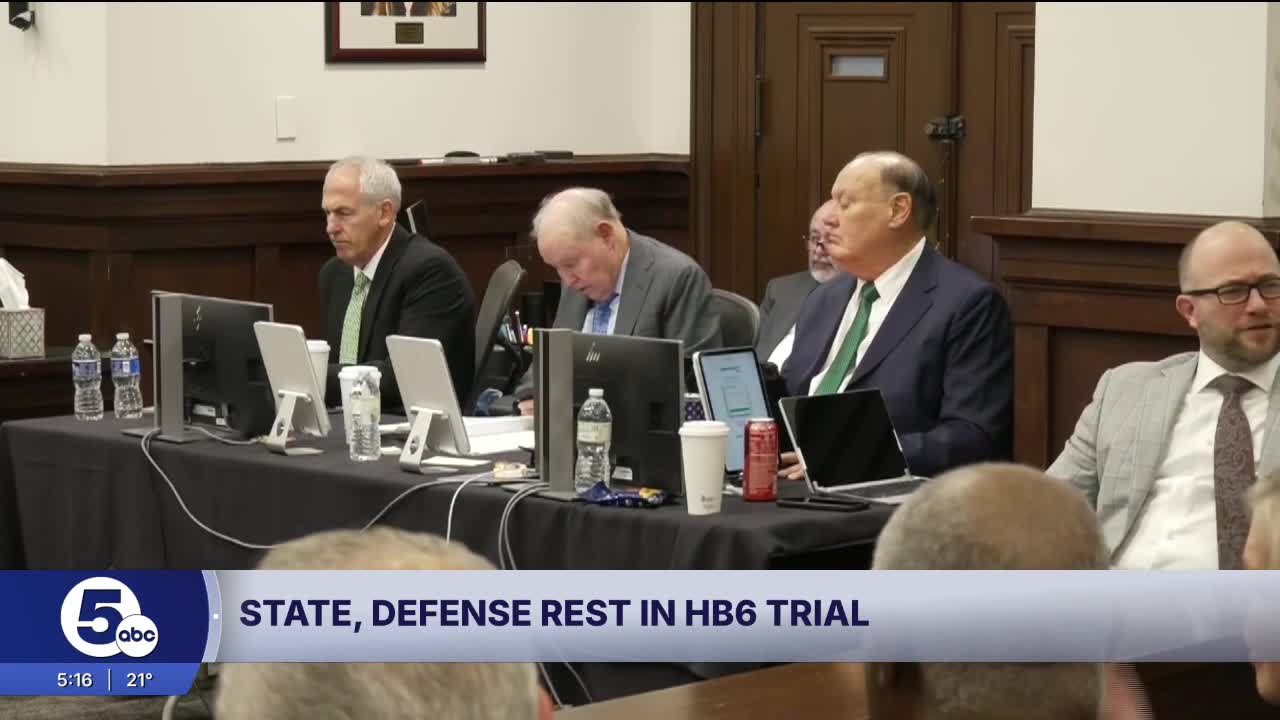


AKRON, Ohio — The jury has begun deliberating whether or not two former FirstEnergy executives are guilty of bribery for their role in the largest public corruption scheme in Ohio history.
In a Summit County courtroom on Tuesday, tensions ran high as defense attorneys and the state's prosecutor made their final pleas to the 12 jurors.
For six weeks, Assistant Attorney General Matthew Meyer explained why former FirstEnergy CEO Chuck Jones and VP Mike Dowling are guilty of bribing former Public Utilities Commission Chair (PUCO) Sam Randazzo with $4.3 million to get beneficial rulings.
The defendants have also been accused of spending $61 million to help create and pass House Bill 6. H.B. 6 was legislation to provide a billion-dollar bailout for the struggling company.
Charges
The jury will decide on charges for each man. All are different levels of felonies.
Jones
- Engaging in a pattern of corrupt activity — Felony 1, up to 11 years in prison
- Bribery — Felony 3, up to three years in prison
- Telecommunications fraud — Felony 1, up to 11 years in prison
- Conspiracy — Felony 2, up to eight years in prison
Dowling
- Engaging in a pattern of corrupt activity — Felony 1, up to 11 years in prison
- Bribery — Felony 3, up to three years in prison
- Two counts of telecommunications fraud — Felony 1, up to 11 years in prison (22 if convicted of both)
- Two counts of tampering with records — Felony 3, up to three years in prison (6 if convicted of both)
- Conspiracy — Felony 2, up to eight years in prison
Arguments
On Monday, Meyer and Dowling's defense attorney Steve Grimes gave their closing arguments.
RELATED: Clear-cut corruption or misunderstanding? Closing arguments begin in FirstEnergy bribery trial
Tuesday, Jones' attorney Carole Rendon got her turn.
"The state of Ohio upended and tried to destroy Chuck Jones's life and his family, and his reputation and the collateral damage from these false charges is hard to measure," Rendon said.
Throughout the trial, the defense had several main arguments.

Settlement payment
The crux of the defense's case is that the payment was not a bribe, but rather a settlement agreement.
"He made that legitimate business decision for one very simple reason," she said. "It was in FirstEnergy's best interest, plain and simple."
Jones’ team argued that it was Randazzo, who is now dead, who was corrupt.
The former utility regulator, facing dozens of charges in federal and state court, became the second defendant in this scheme to kill himself. He died by suicide in 2024, after his joint arraignment with Jones and Dowling, and after pleading not guilty.
Before Randazzo was the top regulator, he was a consultant for clients who worked with FirstEnergy and wanted to get a better deal from them (he was also a consultant for FirstEnergy, as well). Randazzo ran the books for the Industrial Energy Users-Ohio, a legitimate trade group.
The defense said that FirstEnergy was simply paying the former PUCO chair settlement funds owed to IEU-Ohio clients, but Randazzo stole that money.
"If Randazzo had not secretly stolen that $4,333,333 on his client settlement money, we wouldn't be here," Rendon said.
Meyer said that the Randazzo argument was getting old.
"We spent the better part of six weeks where these guys have blamed a dead man for everything that happened," Meyer said. "Every bad thing — they want to put it on Dead Man Randazzo's back and send him out in the wilderness, so you don't focus on what they did."
The state reminded the jury that throughout the trial, they went through dozens of texts between the defendants, showing their awareness of the scheme, warnings they ignored and how excited they were to financially benefit.
"The evidence is simple: money, soon to be public servant, influence policies, get richer," the prosecutor said.
They were able to get away with the bribe thanks to what Meyer calls the "magic" consulting agreement. The settlement deal was a sham document "designed to confuse and conceal" money to flow from FirstEnergy to Randazzo's shell companies. It was a relatively blank document that no one had signed, the prosecution said.
But the judge weighed in on Meyer's persistent drawing of attention to the agreement.
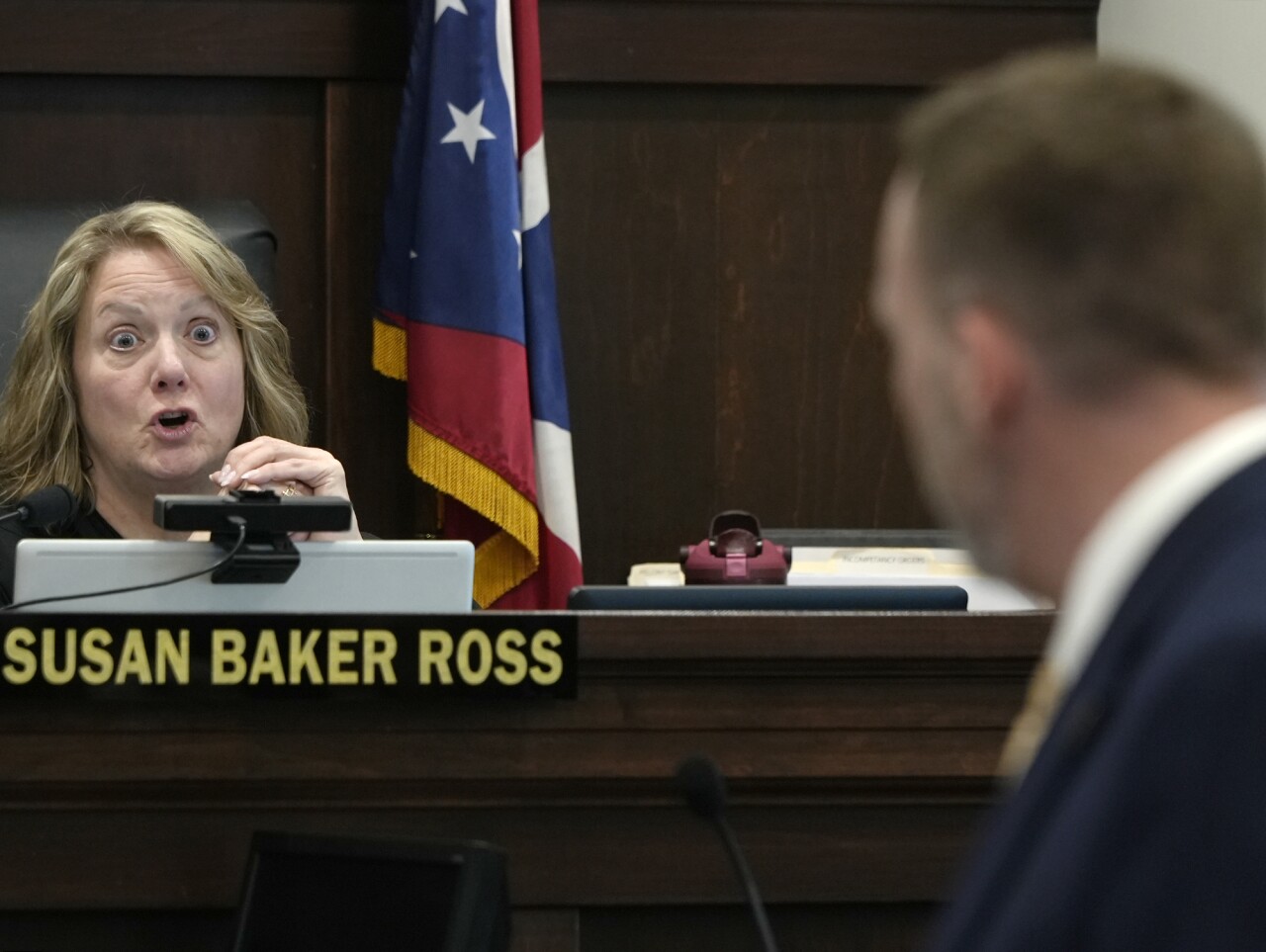
"No one has said that it was not signed, not one witness," Judge Susan Baker Ross said. "If you want, I'll continue to misstate — state — what I think the evidence is, which I'm sure you don't want me to do so."
It was unclear whether the judge was saying that Meyer wouldn't like her take on the evidence or whether he wouldn't want her to be incorrectly referencing it.
This settlement was fine because Jones and Dowling relied on their attorneys and got good-faith legal advice, Rendon said. That argument is moot, Meyer said, because the legal advice said not to go forward with the settlement.
One of the benefits that FirstEnergy received was not having to file a new rate case before the PUCO due to the 2024 numbers. Meyer explained that the company was seemingly overearning through their current electricity rates, and the PUCO would likely have ordered it to lower the costs. Jones, after bribing Randazzo, told his team not to worry about this, Meyer said.
"I can almost guarantee you we will not have to go in for a rate case in May of 2024,” Meyer said, quoting a comment Jones had allegedly said to a colleague.
This is a case about greed, Meyer said. Rendon disagreed.
"The CEO of First Energy can manipulate and influence the chair of the PUCO to make favorable decisions, so Chuck Jones can buy his retirement home in Naples, Florida," Meyer said, referencing an email Jones sent where he explains his plan to sell 200,000 FirstEnergy shares once Randazzo's decisions help bring the stock up.
Painting Jones as a benevolent CEO, the defense argued that he couldn't be greedy, since he declined to lay off employees while the company was struggling.
"Chuck Jones turned down the opportunity to get a raise year after year after year, a raise in both his base salary and his incentive compensation," Rendon said.
He earned $20 million in 2019, Meyer responded.
"The stock price goes up, his wealth goes up. That's undispitued," the prosecutor said. "This was about juicing the stock price."
Randazzo wasn't first choice
The executives never even wanted Randazzo in a position of power, showing how they were originally pushing another chair.
"They continued to back [Jason] Rafeld, even though the state says we had Randazzo corrupted," Grimes said. "That doesn't make any sense. If you've got your guy, push for him — or at least don't get in the way."
Prosecutors said when it was clear Randazzo was the top candidate, FirstEnergy moved quickly to back him, but knew they had to pay up.
"Plan B, Plan Bribe," Meyer said.

Technicality that would prevent Randazzo from even being eligible to be bribed
Rendon went with a bold strategy, using a technicality to get Jones off for bribery he allegedly didn't commit.
"Only a public official or a candidate can be bribed," Rendon said. "In other words, you can bribe someone once they become a candidate... But you cannot bribe someone before they even become a candidate."
Randazzo hadn't even applied for the PUCO chair when the alleged bribe took place, she said.
Meyer seemed flabbergasted by this argument.
"What Miss Rendon is arguing is, 'As long as you get your bribes into this man before he formally declares, it's okay,'" the prosecutor said, to an objection from the defense.
That's not what the law is, Meyer said.
In high-level Statehouse politics, it is more common than not for a possible candidate to work on gaining support and money before publicly declaring their interest.
Pointing fingers
But the closing shifted tone — when the defense started to attack the state.
"I'm not going to have the chance to point out all of his lies and all of his half-truths and all of his misrepresentations," Rendon said.
While seemingly choking up, Rendon made an impassioned plea to the jury not to think that Jones is guilty because he chose not to testify.
"And Chuck Jones, he knows that you already know that he didn't do this, and he doesn't have to testify to tell you that he knows it," she said.
She also urged the jurors not to believe Meyer.
"This is what a pattern of corrupt activity is," Rendon said, referring to Meyer. "You violate the rules day after day, week after week, witness after witness, and then in closing argument, you get up and you lie about what the evidence is."
Meyer did not take kindly to this accusation.
"What you just saw was a sign of desperation," the assistant AG said. "The people I prosecute, particularly the powerful ones, don't like being hauled into court and forced to sit in those defendants' chairs."
He said that this case was simple.
"Don't fall for the excuses," he said. "Look at what's right in front of you."
He also lambasted Rendon for her jovial nature in discussing memes sent between the defendants and colleagues.
"There's nothing to laugh about," Meyer said. "Any laughing that you heard in this courtroom absolutely inappropriate."
Rendon had a whole slide during her closing titled 'Memes are not crimes.'
One of the most well-known memes from the H.B. 6 scandal is a poorly photoshopped version of Mt. Rushmore. The faces now contain Dowling, a FirstEnergy lobbyist named Ty Pine, Randazzo and another utility executive, Matt Evans. Likely created by Evans, it was meant to show how each man would benefit financially from the corrupt H.B. 6.
It shows "HB 6" at the top of the photo and "F*** ANYBODY WHO AIN’T US" at the bottom.

Next steps
Despite their continued fighting, each side had the same message:
"You are the deciders of the truth," Rendon said. "In this case, the deciders of the facts."
The jury, “deciders of facts,” has some long hours of deliberation ahead of it. They decided to leave right after the instructions from the judge and start fresh on Wednesday morning.
The jury will go into deliberation without key pieces of evidence that could bolster the prosecution's case, ones that weren't allowed to be brought up during the trial. Not only were they not told that FirstEnergy, as a company, already admitted to this bribery, but they weren't informed that former Ohio House Speaker Larry Householder is currently sitting in prison due to accepting FirstEnergy's bribes.
Even if Jones and Dowling are found not guilty in the state case, they still have federal racketeering charges to face revolving around the $61 million given to Householder.
Follow WEWS statehouse reporter Morgan Trau on Twitter and Facebook.
