

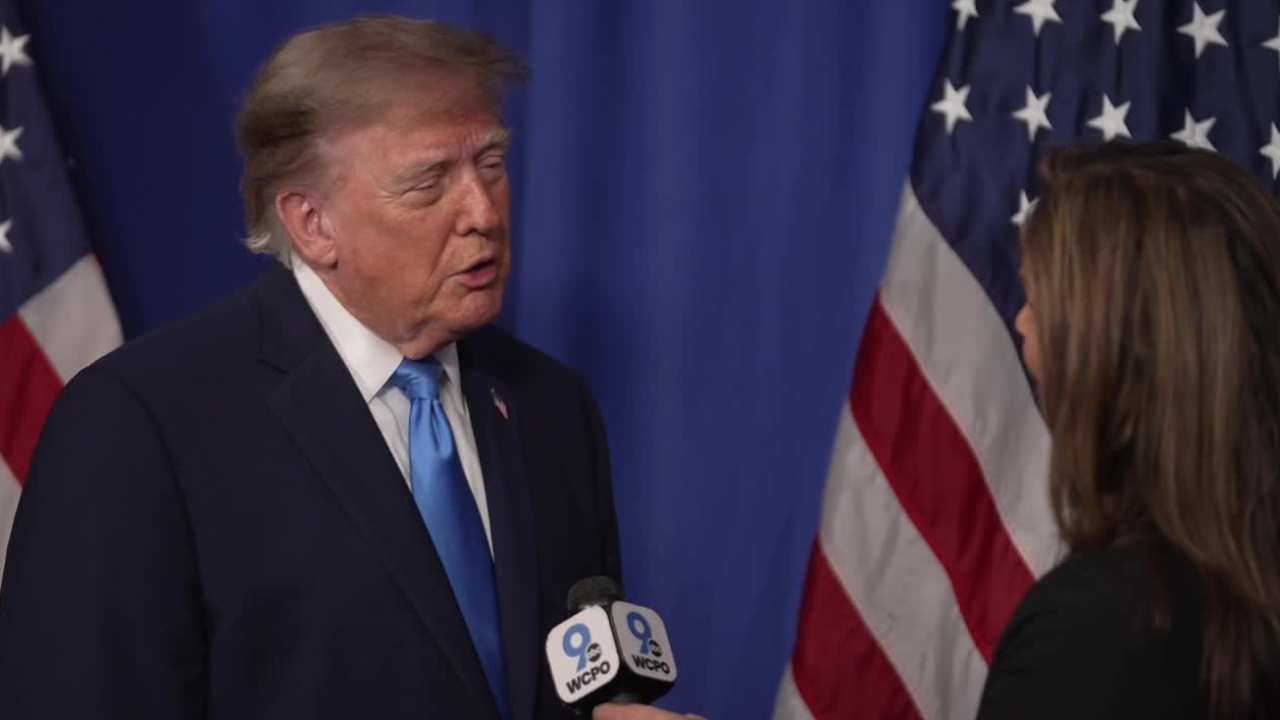


VANDALIA, Ohio — President Trump traveled to Vandalia, just north of Dayton, Saturday night to campaign for Senate candidate Jon Husted and gubernatorial candidate Vivek Ramaswamy ahead of the midterm elections.
I sat down with Trump for an exclusive 11-minute interview on issues facing Ohio voters, the upcoming midterms and more. Trump also spoke about his connection to the state.
"So I love Ohio, and I used to work in Ohio," Trump said.
Watch our full exclusive interview with President Donald Trump:
Midterm election
Trump addressed polls showing Husted and Ramaswamy statistically tied in their respective races, expressing confidence in both candidates despite the tight numbers.
"Well, I'm not sure I believe that poll because they're very good. Uh, John Husted is fantastic, and Vivek is Vivek. I mean, he's a very talented guy, loves the state, all of those things, and, uh, I see they're sort of even, but they're just great. I think they're gonna end up coming, and I'm here now to do that, and I won by a lot, all three times, so we have to put some of that, whatever it is into their system, and I think they're gonna do very well," Trump said.
Issue 3 is on the ballot in Ohio this November. It would enshrine in the state constitution a requirement to show ID to vote. Detractors say it is just bait to get people to vote this fall. The measure is similar to the federal SAVE Act. Trump has expressed support for Issue 3 on social media.
When asked why he supports the measure, Trump pointed to voter ID and proof of citizenship.
"Because of voter ID, we want voter ID and we want uh proof of citizenship, and you're gonna do that. You're gonna put it in and John Husted's been fighting it very, fighting for it very hard, and so is Vivek," Trump said.
When asked how he would respond if the midterms did not go as he hoped, Trump said he would use his position to push back against what he described as harmful policies.
"I don't know. I mean, I'll become a blocker, I guess. I'll be blocking communist agendas and, uh, policies. I'll be blocking things that, you know, will be very unfortunate. They want big tax, tax increases. I'll be blocking that. I won't let the people do that. Uh, I'll be fighting for the people," Trump said.
Gas prices
When asked when pump prices would come down, Trump compared current prices favorably to those during the Biden administration and tied relief to ending an overseas conflict.
"Well, they're actually lower than Biden, and he didn't get rid of a nuclear weapon from Iran, so Iran's not going to have a nuclear weapon. You're going to see the war is going to end very quickly. It's, it's almost over. We totally control the Strait of Hormuz and all of that, but beyond that, it's going to be over very quickly. As soon as it ends, you're going to see gas prices and almost all prices drop like a rock," Trump said.
Trump has made that prediction before. When I pressed him on it, he pointed to the military situation on the ground.
"Well, because I know how we're doing. They have no Navy. They have no Air Force. They have no radar. They have no anti-aircraft equipment. Their leaders have been wiped out," Trump said.
Data centers
On the topic of data centers — a major flashpoint in Ohio politics and in the campaigns — Trump defended them, arguing they can be a financial benefit to host communities.
"If I were a community in Ohio, I'd like to have it because the money is incredible to the people that live there," Trump said.
He pointed to examples of companies paying communities directly for hosting data centers, while noting that placement still matters.
"One of the things I saw where Meta offered the community $10,000 apiece. In Louisiana, they're paying teachers $50,000... let people negotiate with these people, and also pick the right location. You don't want them to be right next to a community or something, but there's tremendous space in Ohio," Trump said.
Trump went further, calling much of the opposition to data centers a hoax.
"There really is no inconvenience. It's a lot of it, I really believe, is a hoax," Trump said.
But the concerns raised by Ohio residents are real. A statewide push to limit large data centers was organized in part by residents from Clermont County, not national activists.
What comes after the White House?
When asked whether he ever thinks about what comes next after leaving the White House, Trump said his focus is entirely on the present.
"I don't think about that. I only think about what I can do during the presidency. Maybe I'll do something wonderful after, but I don't think about that. I think about what I can do during my presidency. We have 2.5 years left. That's a long time. That's like an eternity. And we're gonna do some great things," Trump said.
This story was reported on-air by a journalist and has been converted to this platform with the assistance of AI. Our editorial team verifies all reporting on all platforms for fairness and accuracy.
