

HAMILTON, Ohio — The City of Hamilton rolled out a plan to silence roughly 1,800 train horns per day in the city's center with the announcement of a "Quiet Zone" plan.
Engineering director Alan Messer presented the plan to Hamilton City Council.
Currently, the Federal Railroad Administration's (FRA) Train Horn Rule says "locomotive engineers are required to sound train horns at least 15 seconds and no more than 20 seconds before reaching a public highway-rail grade crossing." The rule includes additional requirements for horn patterns, faster trains and more.
Read more about the rule here.
The plan in Hamilton would see the city invest millions into 24 at-grade intersections, where rails meet roads. Messer said this would improve physical safety infrastructure, so horns are no longer a legal requirement of the FRA.
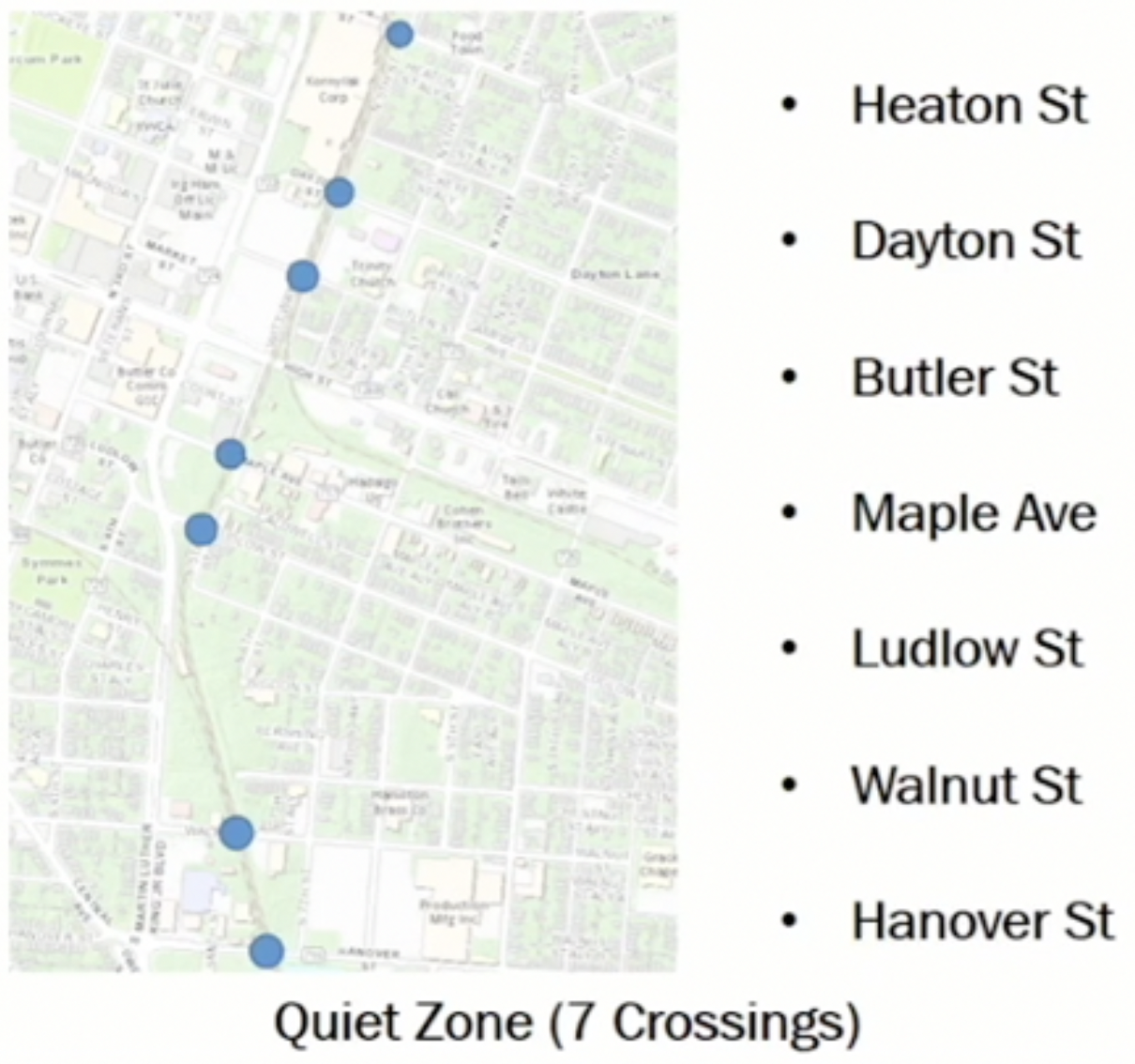
A stretch of railway between Hanover Street and Heaton Street would be the first targeted for infrastructure upgrades under Messer's plan. We visited homes along that stretch of rail to see what they thought of a quieter neighborhood.
WATCH: We visited the proposed "Quiet Zone"
Winton Ray, who lives on Chestnut Street near where the CSX trains regularly cross Walnut Street, was one of several people who told us he was excited about the plan.
"It's loud," he told us. "Whenever my friends come over, that's the first thing they ask, like, 'You ever get tired of hearing the trains?' ... I've been here for 18 years. I'm kind of used to it."
Those who've lived next to the tracks for decades may have become numb to the blaring horns, rumbling sounds and screeching brakes, but Messer said a quiet zone would improve mental health, quality of life and property value for people living in the zone.
The plan would include roughly $3 million invested into five intersections between Heaton Street and Hanover Street, with the intersections at Butler Street and Ludlow Street being closed.
Messer said it would take $1.5 million to add safety infrastructure to Ludlow St., increasing the total construction cost by at least 50% to $4.5 million, and suggested that wasn't worth the investment.
"You could choose to spend a million and a half dollars to keep it open with the four-quadrant gates and the updated signals, but, in my perspective, if we had a million and a half dollars to spend somewhere, I could think of a couple dozen other uses," Messer said.
Messer said the traffic impact of closing both intersections would be negligible, with Dayton Street's proximity to Butler Street and Maple Avenue's proximity to Ludlow Street.
24 CROSSINGS PROPOSED FOR QUIET ZONE:

The presentation got a warm reception at council, with councilman Michael Ryan calling it a plan to improve the quality of life in traditionally underserved sections of the city.
"This initiative, if we can get it done, will lift the quality of life for Riverview, Jefferson, North End and Dayton Lane," Ryan said.
Any proposal would need federal approval before work on new infrastructure could begin.
According to a timeline presented to the city, an application for changes at the crossings at Heaton Street, Dayton Street, Butler Street, Maple Avenue, Ludlow Street, Walnut Street and Hanover Street would be submitted in early 2026.
INITIAL CROSSINGS PROPOSED FOR UPGRADES/CLOSURE: