

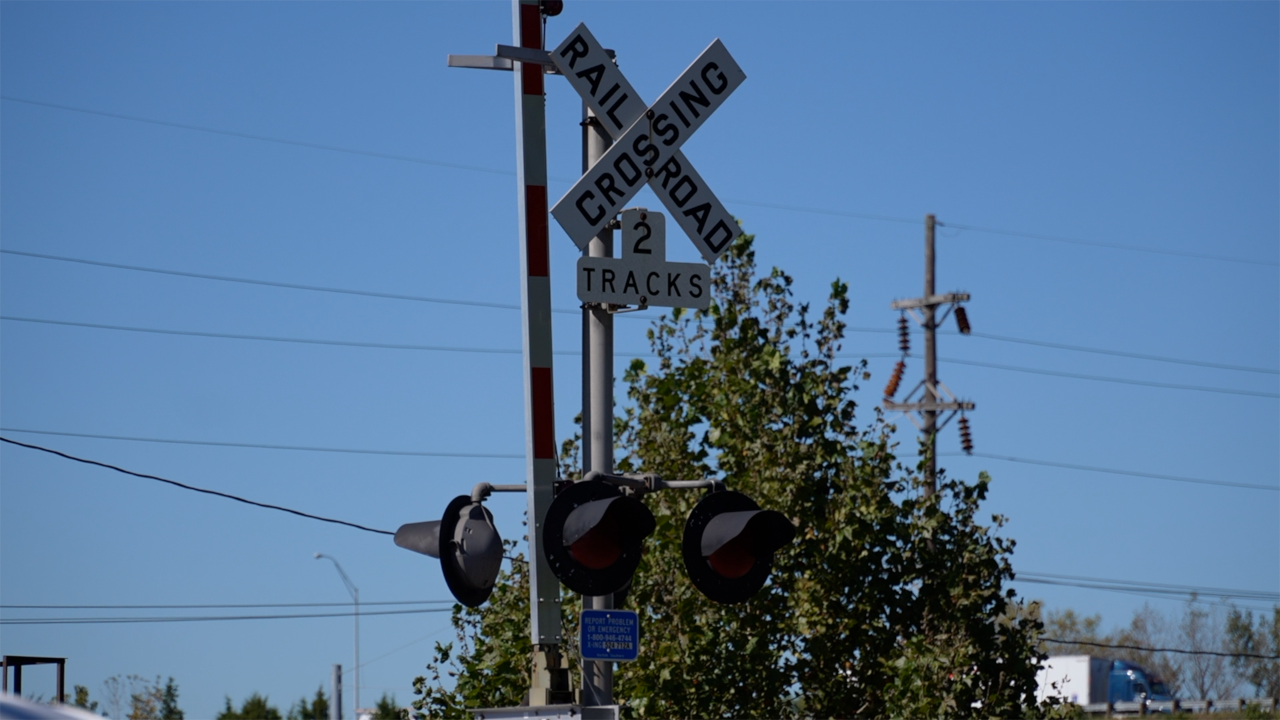


LOCKLAND, Ohio — Calls for change are growing after a deadly Lockland fire response was delayed by a stopped train, according to the fire department, in which a senior citizen lost her life.
So far in 2026, Ohio ranks third in the country for the number of reported blocked railroad crossings, according to data from the Federal Railroad Administration. Hamilton and Butler counties have each had 26 reported instances this year where first responders found themselves unable to cross railroad tracks. Delays lasted anywhere from less than 15 minutes to more than one day.
Republican Representative Warren Davidson, who represents Ohio's 8th District, called the situation in Lockland tragic.
"When you see the Lockland Fire Department say, 'We think we could have been there under a minute, but we were blocked by a train.' I mean, that's horrific," Davidson said.
WATCH: Ohio is among the top states for reported railroad blockages. Can anything be done about it?
So what can prevent train stoppages from impacting first responders in the future? Davidson said states have tried to act but keep running into a legal barrier.
"They've passed laws at the state level to try to deal with this, but they keep losing in federal court because there's federal preemption. I disagree with that, and because of that, I've introduced the Railroad Responsibility Act," Davidson said.
The bill, currently HR 341, would lift federal preemption and allow state laws to take effect.
"I think there's an appetite [for it]. Hopefully, I'll be able to address this with Vice President Vance on Wednesday," Davidson said. "Unfortunately, the chairman of the committee in the House right now, he fully supports the railroads. He feels like there should be federal preemption."
We also asked Davidson's Democratic opponent this November, Dr. Vanessa Enoch, what she would do about the issue if elected.
"There needs to be regulations in place that would enable incidents like this not to occur by having the trains not be able to stop on some of those critical crossings," Enoch said.
Enoch said federal action should also address infrastructure and research.
"Any regulation that would be put in place should have to also fund that type of infrastructure to ensure that cars and emergency vehicles can still move about safely," she said. "There should be some type of study to determine whether this has been a problem in other areas and to what extent."
Sharonville Fire Chief Dan Sunderman said the problem has grown sharply in recent years in the city.
"In the last five or six years, clearly the trains are getting longer. We're seeing more stopped trains, and the crossings are being blocked for a longer period of time," he said.
Sharonville first responders use a system called TRAINFO to track blockages, monitoring data captured from sensors at five crossings in the city. The department has used it for about 18 months.
"Some of the crews have it actually on their phone. We have onboard computers in the ambulance and fire trucks, and it's on there. And then status boards in the station, so the status boards will go literally at the bay door," Sunderman said.
Sunderman said stopped trains add measurable time to emergency runs.
"The trains that are actually stopped can add you know five, six, seven minutes to response time," he said. "On average, we're about three to four minutes. With some of our new fire reporting software, it is actually a category in the fire report, so we can track that data a little bit better."
He said those minutes carry real consequences.
"Fires will double in size about every minute. And when it comes to our medical runs, for example, if somebody is not breathing, doesn't have a pulse, and they're under CPR, the chances of survival drops about 10% every minute that we're not on scene," Sunderman said.
Sunderman said surrounding departments report the same trend and rely on a countywide agreement.
"In all of Hamilton County, there is a very strong mutual aid agreement. So any department will run into any other municipality in the county. So that does help with response times, whether it's for tracks being blocked or any other reason," Sunderman said.
This story was reported on-air by a journalist and has been converted to this platform with the assistance of AI. Our editorial team verifies all reporting on all platforms for fairness and accuracy.
