



CINCINNATI — First it was a bank, then a Kroger, then it bore the name "U.S. Chili" for decades. Now, there are new plans to breathe life into an historic building in the heart of Camp Washington.
The former U.S. Chili building, which housed Uncle Steve's Chili for decades, is still a renovation work in progress right now, but when it's done it will be a mixed-use building with apartments on the top floors, while businesses occupy the street level.
The Camp Washington Urban Revitalization Corporation (CWURC) and the 8K Company announced the "Camp Washington Scattered Site Development" plan at the end of 2025, which includes the U.S. Chili building and a second building that will become CWURC's headquarters in the future.
I met with Michael Chewning, principal at 8K, and Sydney Prigge, executive director of the Camp Washington Urban Revitalization Corporation to walk through the former U.S. Chili building with them.
The space has been unoccupied since Uncle Steve's Chili vacated it in 2019, and Prigge told me it's been a blighted site that's fallen victim to crime in the years it's been empty.
On the upper floors, Prigge told me several areas were damaged when thieves broke in and took all they could carry — including pulling off some of the doors, and dismantling at least one fireplace.

"It just goes to show you how problematic a vacant building in a prominent location can become," Chewning said.
"Yeah, that showcases a little more on the importance of getting these buildings back to life," Prigge said.
Since that break-in, the building has been made more secure, and it's gotten new windows and a new roof.
The goal is to turn it all back into something residents of the area can use and enjoy.
"When you're coming into Camp Washington, this is the first building you see," Prigge said. "It's a huge staple of the business district and the neighborhood as a whole. So by putting something and getting this building back to life, you're really bringing life back into the community and so the goal is that by activating this space, it's a trickle-down effect and other buildings start to kind of come to life and revitalize."

CWURC acquired the U.S. Chili building through funding from the City of Cincinnati. In all, the project comes with a $4.5 million price tag, but promises to bring 15 new apartments and two commercial spaces to the neighborhood.
Prigge said exactly what kind of commercial business will occupy the building is still unknown, but CWURC hopes to find tenants that will generate activity in the community.
She told me they're open to many kinds of businesses, but they do have goals in mind.
"It would have to be street-facing," Prigge said. "So we don't want someone to come in here that's not bringing people and activity. It doesn't need to be just storage. It doesn't need to be an office that's rarely used, but anything that's bringing people to the business district to support the other restaurants and bars and activity."

She also said that business should be something residents in Camp Washington can realistically support on low to moderate incomes.
The residential spaces on the upper floors will be a mixture of units ranging from studios to two-bedroom apartments that will all be rental properties.
"They're going to be mixed income, which means that some will be a market rate, some will be available to people making certain income increments," Chewning said.
Preserving history while making way for something new
The former U.S. Chili building wasn't always the U.S. Chili building. Completed in 1895, those upper floors that will become apartments were once boarding rooms for rail workers.

The spaces were single-bed occupancies with wash bins tubs, but no private toilets.
Instead, shared water closets were located off the main hallways.
Work on those floors will involve adding in modern plumbing, HVAC, kitchens and other facilities not available to those workers at the turn of the century.
But Chewning said 8K is working to make those changes while still preserving the history of the original building.

"We think historic preservation is important, because we're all here because someone else was here first, right?" Chewning said. "So really, in a broad sense, it's connecting us to our humanity. The people who built these buildings had a vision that we're living out today. So that's the emotional reason why, I guess."
Prigge said it's hard to ignore the building's history, because it's literally built in — beneath the floors.
"When you go up to the upper floors on the ground, there's this laminate," Prigge said. "Under the laminate are newspaper articles from the year it was done, like actually put in place and when you pull it up, you can read the articles."


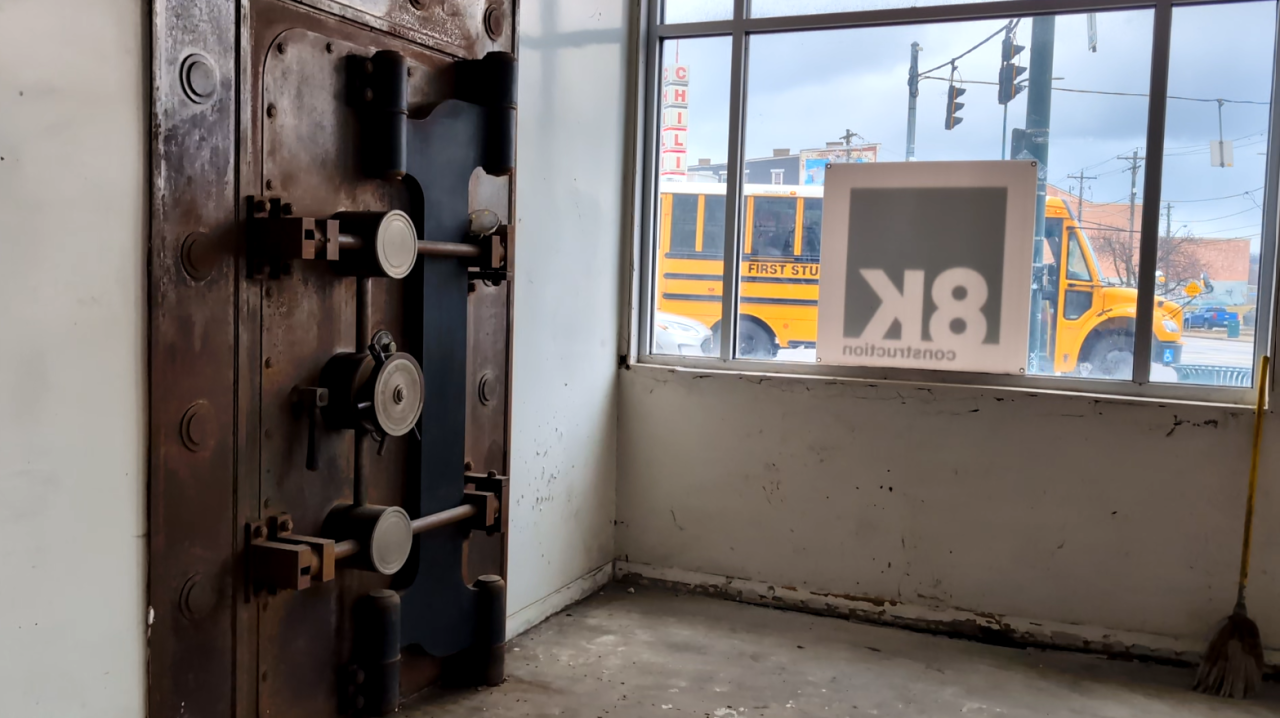
When the building was first built, the ground floor housed a bank, which is apparent from the giant vault door that dominates a portion of one wall to this day.
Prigge told me she had no idea how to open that door — but we didn't have to, to get a look inside.
"At some point, if you look this way, they cut into the safe," Prigge said, leading me down a hallway where bathrooms had once been built into the space behind the vault door.
A second Colerain Avenue space will also get a new lease on life
At 2908 Colerain, a currently empty building will be rehabilitated to contain seven residential units and one historic commercial storefront. The building will serve as CWURC's headquarters and create a public-facing space for services, events and partnerships, according to CWURC.
CWURC's current headquarters is a few blocks away, on Sydney Avenue.
"We're trying to move to Colerain so we can be more public-facing and utilize that space for more start-up and artist space," Prigge said. "So, artists currently rent on the second floor of our building and we will be able to open up that whole space to artists, studios or writers, authors — really anyone that needs an office — and we will move to a smaller space on Colerain and be more forward-facing."
When it's ready, Prigge said the new CWURC headquarters will operate like a visitor's center, where anyone can walk in off the street to ask questions about the neighborhood, or purchase merchandise like a Camp Washington flag.
The new space will position CWURC to be more front-facing to the community, rather than its current location, tucked away on a dead-end street.
Construction on both sites is expected to begin in 2026.
