

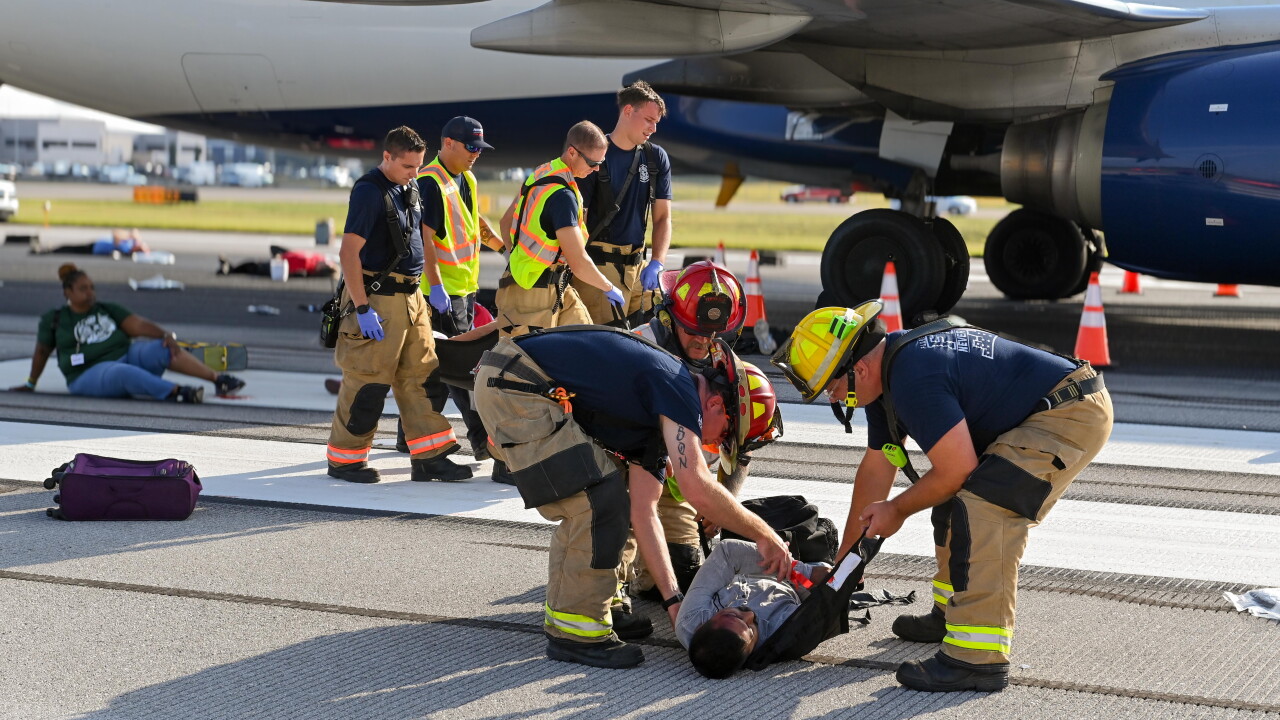


HEBRON, Ky. — The following describes a planned drill at Cincinnati/Northern Kentucky International Airport. Air traffic continued as usual and passengers were not impacted.
Cincinnati/Northern Kentucky International Airport held an FAA-required full-scale disaster drill Friday on a temporarily closed runway.
During the drill, 150 volunteers were staged at two simulated crash sites with pretend but realistic injuries.
More than 700 people from 100 agencies responded to the airport. They assessed and treated pretend victims on the scene.
WATCH: Take a look at the drill featuring hundreds of first responders and more than 100 pretend victims
First responders then took 140 pretend patients by ambulance to nine participating hospitals in Northern Kentucky, Cincinnati and Indiana, where hospital staff treated them for simulated injuries.
CVG CEO Larry Krauter said the scenario was intentionally complex, simulating a collision between a cargo aircraft and a passenger aircraft.
"We have a number of different objectives occurring inside of that scenario. Obviously, the treatment, triage, transport of victims from the incident that are on the passenger aircraft," he said. "Then we also have the complexity of dealing with the cargo aircraft. What's on that aircraft? How do we interact between the cargo side and the passenger side?"
Krauter said runway incursions — instances where an aircraft enters a runway without proper clearance while another aircraft is landing or taking off — are among the most significant scenarios airports train for nationwide.
"We've seen those events reported in the media, and thankfully we haven't had any significant recent situations where we've actually had collisions," he said. "But certainly that's on our minds because of that environment."
Lori Lacey, a stay-at-home mom, volunteered as a mock victim for the second time Friday. She's done two other similar emergency drills outside of CVG. Her simulated role had her portraying a passenger who had been in a collision and was suffering from smoke inhalation, labored breathing and chest pains.
"I try to think about how I would feel in that time if I couldn't really breathe very well. I probably wouldn't be able to walk very well, and so I tried to just lean into that and make them have to listen to me. And I wasn't speaking very loud or anything," Lacey said.
Lacey described the scene as quiet at first, with volunteers waiting in silence for the drill to begin before it gradually grew louder and more chaotic.
"The fire trucks from the airport were the first ones there, so it wasn't actually like as loud and chaotic as you would have thought," she said. "Then like it slowly started to get busier, and then it just picked up speed as more of the EMTs and firemen came."
She said the drill gives first responders a chance to work through their plans before a real emergency occurs.
"You really want them to make the right decision the first time, so if they can make the wrong decisions as they're working out the kinks of their plans, this was a good time for that, for them to do that, and it makes me feel better because I know that they'll be more ready when it really counts to be able to help people," Lacey said.
The FAA requires airports to conduct the simulation once every three years.
This story was reported on-air by a journalist and has been converted to this platform with the assistance of AI. Our editorial team verifies all reporting on all platforms for fairness and accuracy.
