

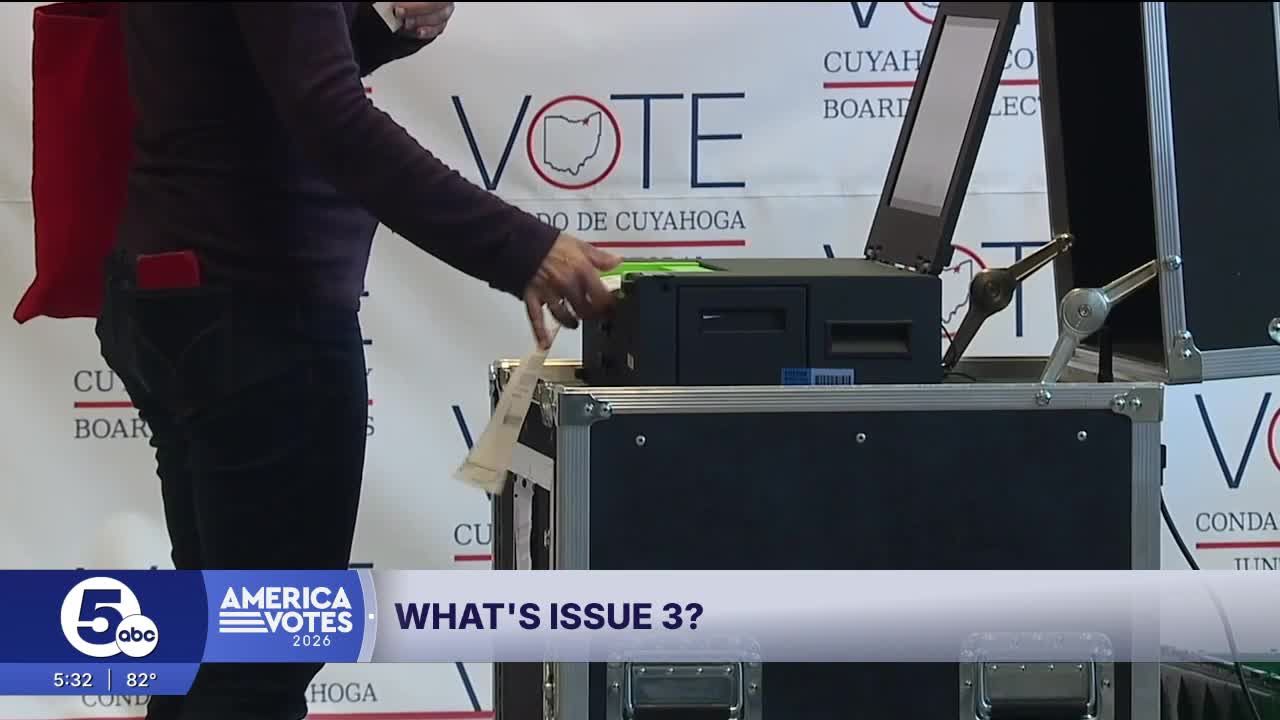


COLUMBUS, Ohio — Issue 3 asks Ohioans if the current voter photo identification requirement should be enshrined in the state constitution. While Republicans say this is good policy, Democrats and Libertarians argue the constitutional amendment is just meant to rally the GOP base.
The three candidates for Ohio secretary of state are split on the amendment.
What is the current law?
Ohio requires that voters show photo ID when casting a ballot in person. Acceptable forms are a valid Ohio driver's license, a U.S. passport or a military ID. You may no longer use bank statements or utility bills.
The IDs must have an expiration date that has not passed, a photograph of the voter, and the voter’s name, which must substantially conform to the voter’s name as it appears in the Poll List or in the Poll Book.
Other acceptable forms of ID are a state of Ohio ID card, an interim ID form issued by the Ohio BMV, a U.S. passport card, an Ohio National Guard ID card and a U.S. Department of Veterans Affairs ID card.
What does a yes vote on Issue 3 mean?
Voting yes on Issue 3 means you want to make the current voter ID requirements more difficult to change.
RELATED: Voter photo ID amendment on Nov. ballot in Ohio
"We should be protecting elections here in the state of Ohio," Robert Sprague, the Republican nominee for secretary of state, said.
A future General Assembly could reverse the law, unless it's in the Constitution.
The Constitution is the main governing document that supersedes any other state policy. It is typically unchanging.
The Ohio Revised Code has all current statutes that Ohio lawmakers pass and get signed into law. It is constantly getting updated and changed.
"I would like to see us go back to in-person voting — that way everybody has to show their photo ID," Sprague said in an interview. "We know that people are who they say they are."
It is significantly more difficult to get a policy into or change the Constitution. For the most part, it either has to be done by getting hundreds of thousands of valid signatures from all over the state or by 60% of each chamber's members to sign off on it. The revised code either needs significantly fewer signatures or a simple majority in the legislature.
If the lawmakers pass a bill that conflicts with the Constitution, it is up to the judicial branch to uphold the Constitution.
"It's fundamental to election security in the state of Ohio," Sprague said.
Both President Donald Trump and GOP candidate for governor Vivek Ramaswamy have campaigned for Issue 3 to get passed.
RELATED: Ohio Senate passes resolution to put voter photo ID amendment on Nov. ballot
"I think the people of the state of Ohio are gonna support it," Sprague said.
Trump has been advocating for years to tighten up election laws across the country. He is now advocating for Congress to pass the SAVE America Act, legislation that would require a photo ID to vote.
To be clear, there is no evidence of widespread voter fraud in Ohio, even when photo ID wasn't the law. Thousands of audits have proven that.
What does a no vote on Issue 3 mean?
Voting no on Issue 3 means you don't want to add the current requirements into the state Constitution, keeping them, instead, in the Revised Code.
Allison Russo, the Democratic nominee for secretary, thinks the amendment is on the ballot for political reasons.
"It speaks to the desperation that we see from Republicans in this state," Russo said in an interview. "Clearly, they are concerned about the November election."
Republican strategists have admitted that there are concerns for the GOP this year.
"We may have a turnout problem," GOP strategist Bob Clegg said, adding there could be 'depressed turnout.'
It's not the first time the GOP has put on a "ballot juicer," some opponents said. In 2022, another midterm year, Republicans put a proposal on the ballot that bans noncitizens from voting in all Ohio elections. Noncitizens already couldn't vote in state or federal elections.
"Rather than actually deal with and address the real concerns of everyday Ohioans, they're turning to these red meat issues that may or may not have any effect come November," Russo said.
She is supportive of photo ID, but it's already the law, so she said this is a waste of time.
"Our photo ID requirements that we have currently are the strictest in the country," she added.
Republicans deny this is an effort to increase turnout, saying it is just good policy.
Tom Pruss, the Libertarian secretary of state candidate, is opposed to the amendment, calling it "political theatre."
"Our election laws should not be written in response to national fear-mongering, cable-news talking points, or unsupported claims intended to keep voters angry and afraid," Pruss told me. "Ohio should make election policy based on facts, evidence, and the real experiences of our voters and county election officials—not the political agenda of Washington personalities."
Some conservative activists also oppose the proposal, arguing it doesn't go far enough since it doesn't require voter ID for absentee ballots.
When trying to get Issue 3 passed out of the legislature and onto the ballot, Republicans couldn't get enough votes. In order to get the 60 they needed, the GOP amended an unrelated bill to require photo ID for absentee ballots. Gov. Mike DeWine vetoed it, noting it had many errors and could disenfranchise voters.
RELATED: Will Ohio Republicans override Gov. DeWine's voter photo ID veto?
Pruss brought up the fact that the constitutional amendment doesn't address absentee or mail-in voting, citing fears of what a future General Assembly may do.
"That gives partisan lawmakers significant power to restrict mail voting later, potentially affecting seniors, military personnel, voters with disabilities, rural residents, shift workers, and others who cannot easily vote in person," Pruss said.
RELATED: Ohio sec. of state candidates split on mail-in voter ID bill DeWine considering veto on
Why is it 'Issue 3?'
Starting in November 2024, Ohio started renumbering state ballot proposals. Instead of restarting numbers every election, numbers won't repeat until after the state reaches Issue 500.
This had originally been a problem in 2023. Issue 1 of the 2023 August special election asked voters if Ohio should take away majority rule. The supporters, mainly Republicans, wanted people to vote yes. But then, in November 2023, Issue 1 asked voters if the right to reproductive freedom and abortion should be protected. The opponents, mainly Republicans, wanted people to vote no.
So for the GOP, it was "Yes on 1" in August, "No on 1" in November, and vice versa for Democrats.
Under this new plan, Issue 1 was the redistricting proposal from November 2024. Issue 2 was the bond proposal from May 2025. Now, Issue 3 is the voter ID amendment in November 2026.
Follow Statehouse and Columbus bureau reporter Morgan Trau on X, Instagram and Facebook. Email her at Morgan.Trau@wews.com.
