

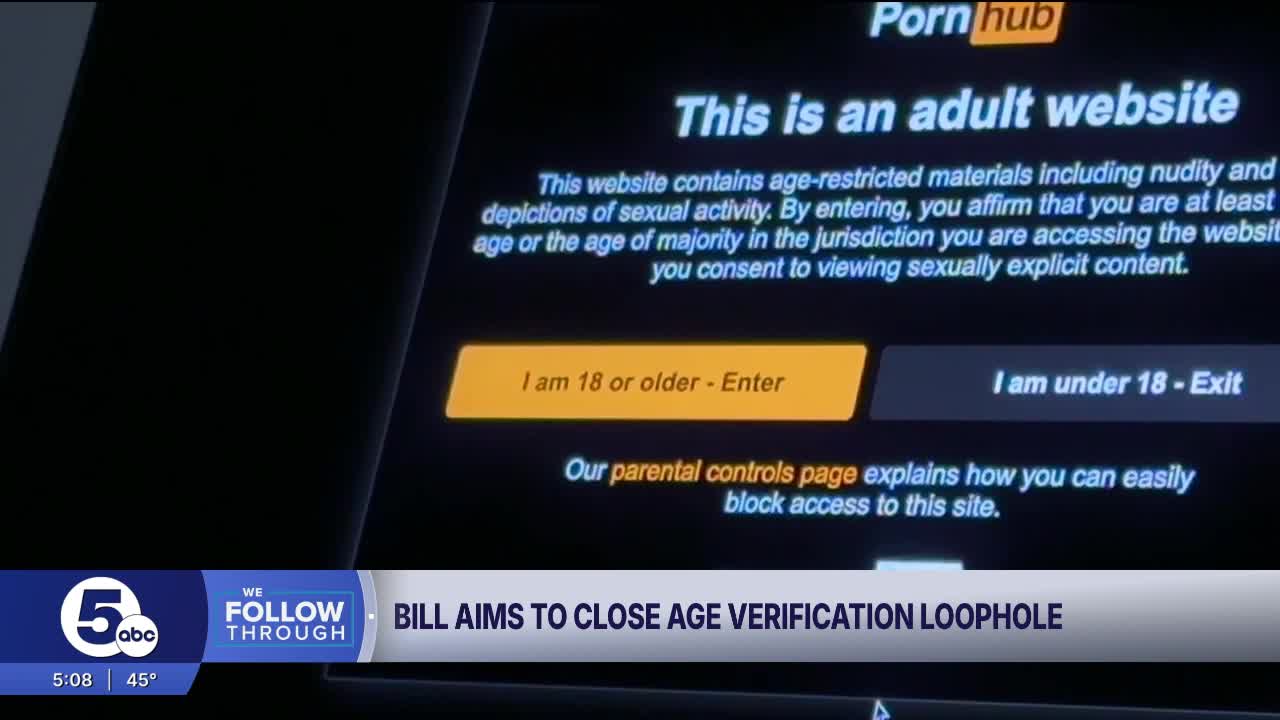


COLUMBUS, Ohio — Amid mounting pressure, Ohio legislative members are working to plug a loophole that allows pornographic websites to get around the state's new age verification requirement.
Sexual expression is something that is typically behind closed doors, or at least that's what Mallory McMaster thinks it should be.
"Pornography can be healthy," McMaster said. "It can help us figure out what we like and what we don't like."
For years, we have been talking to her about proposals to restrict access to explicit content.
"Creating a log of the pornography that we watch is not a direction that we want to go in as a country," she said.
She was not thrilled last summer when Ohio lawmakers passed legislation requiring every porn watcher to provide age verification.
Age verification would be done by submitting a photo of your state ID or by entering your personal information into a third-party system that will then run your details through other online or government databases — it could also use facial recognition technology, capturing photos of users.
The law also has a provision that uses geofences and geolocation to block users, with Cosponsor Rep. Josh Williams (R-Sylvania Township) saying this will make it harder to use virtual private networks, or VPNs, which mask your IP address and let you bypass firewalls.
The "location-based tech provider" would "dynamically monitor" a user attempting to access a website. If the provider determines the individual lives in Ohio, they must block them.
News media organizations, cable and streaming providers have an explicit exemption. Williams said that this won't impact social media sites like X and Reddit.
CLICK HERE to learn more in-depth about the porn age requirement.
RELATED: Porn will get harder to watch in Ohio soon
But users shouldn’t have noticed a difference in their internet habits.
"They poked some holes in our original legislation," state Rep. Steve Demetriou (R-Bainbridge) said.
PornHub, the most visited explicit content provider in the country, and other major distributors have been ignoring the law.
In a statement, PornHub's parent company Aylo explained that, under federal law, it is classified as an “interactive computer service,” a category that is directly exempt from Ohio’s age verification law.
"As a provider of an 'interactive computer service' as defined under Section 230 of the Communications Decency Act, it is our understanding that we are not subject to the obligations under Section 1349.10 of the Ohio Revised Code regarding mandated age verification for the 'interactive computer services' we provide, such as Pornhub," a spokesperson for Aylo said. "We have publicly supported age verification of users for years. However, we believe that any law to this effect must preserve user safety and privacy and must effectively protect children from accessing content intended for adults. Unfortunately, the way many jurisdictions worldwide have chosen to implement age verification is ineffective, haphazard, and fails to meet these basic requirements."
This is unacceptable, Demetriou said.
"I'm pissed off," the lawmaker added. "I'm a dad, right? I have three little boys. I think this sort of content is harmful to boys and girls."
He is putting forward amendments to the law, ones that he said will help prevent minors from accessing explicit content.
"We put some financial penalties in there for not complying," he said.
Pornography companies would be charged $100,000 per violation. These civil violations could help bring Ohio laws closer to Texas, where Pornhub has removed its site due to the age verification’s financial burden.
The civil penalties in the bill don't actually fix how PornHub is using federal law to get around it, I brought up to Demetriou. Unfortunately, he said, there is nothing the state can do about those provisions.
"Obviously, there are a number of issues that we'd love to continue to work with our federal partners on," he said.
We are waiting on a response from PornHub about the amendments to the legislation. In their original statement declining to follow the law, they went more in-depth into how to safely provide age verification.
"We continue to believe that, to make the internet safer for everyone, every phone, tablet, or computer should start as a kid-safe device. Only verified adults should unlock access to things like dating apps, gambling, or adult content. This is the core premise of device-based age verification, which we believe is the safest and most effective option for protecting children and maintaining user privacy online," Aylo said.
Previously, PornHub told us that Ohio’s legislation will backfire, and people will just find sites that don’t “even moderate content.”
"Is there validity to what PornHub is saying about people going to a darker website that doesn't have any controls?" I asked Demetriou.
"Well, of course, they want to say they're going to say that, Morgan," he responded. "Their business model is to get as many eyeballs in the easiest way possible on their content that they're distributing."
While working on the bill, Demetriou said he heard concerns from people like McMaster, and he has added even more safeguards to age verification so that information is protected.
"Immediately deleted after they verify their age," he said.
McMaster has never been convinced by the lawmakers that information won't leak.
"Nothing that you put on the internet is safe," she said.
McMaster fears that data could be leaked. In 2024 and 2025, hackers have stolen medical, financial, and legal data from at least hundreds of thousands of Ohioans at both the state and local levels. Many of the reported cyberattacks do not state how many consumers have been impacted.
She also fears that local law enforcement would get access to search histories, since some third-party companies secretly provide facial recognition data to police, according to The Brookings Institution.
RELATED: House Bill 84 or 1984? Ohio lawmakers want to require state ID to watch porn
The bill will likely be passed out of the House on Wednesday.
Follow WEWS statehouse reporter Morgan Trau on Twitter and Facebook.
