

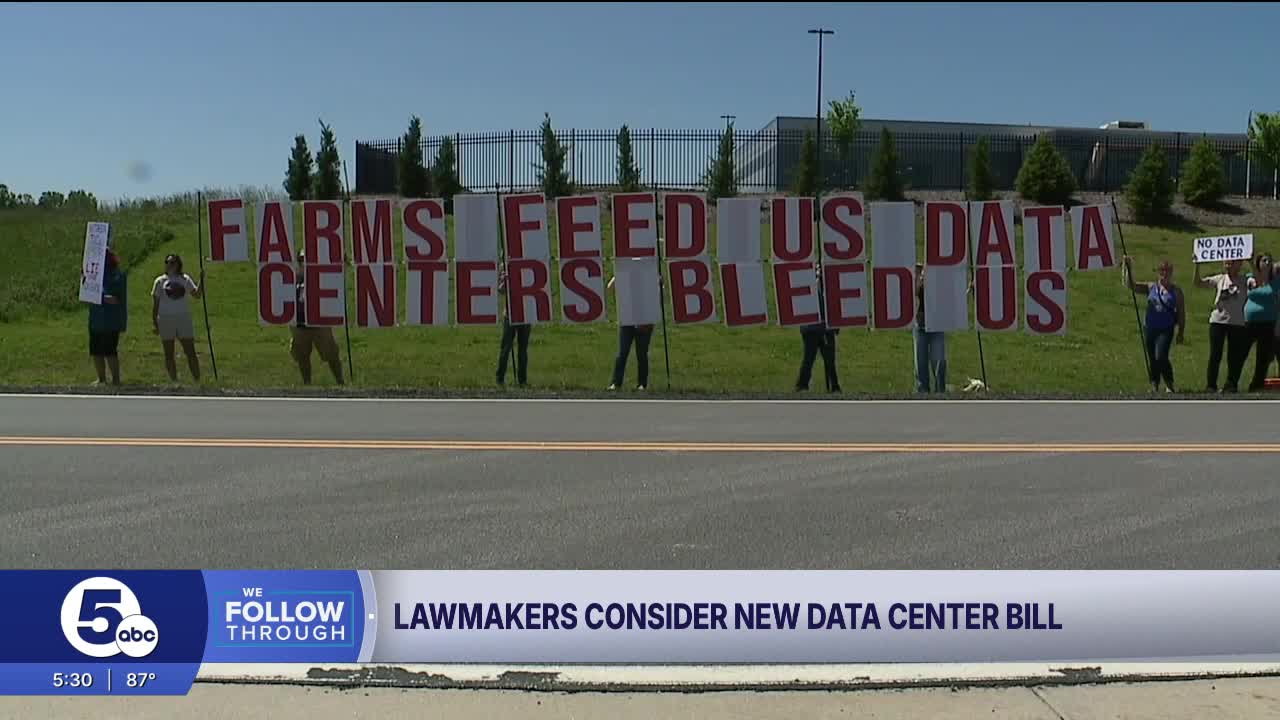


COLUMBUS, Ohio — Ohio lawmakers have unveiled legislation aiming to regulate the state's consistently growing data center development.
Substitute House Bill 646, which is now nearly fifty pages, was created after just a few weeks of committee hearings.
"The Joint Data Center Study Committee has done its job," Senate Finance Chair Brian Chavez (R-Marietta), who is also the co-chair of the data center committee, said.
Among many provisions, the legislation creates an electric rate class for data centers, trying to ensure that the cost of generation, transmission and distribution is paid by the companies.
"Make sure the ratepayers are kept harmless, held harmless, and that data centers pay for whatever they're causing," Chavez said.
It also requires electric distribution utilities to file a data center tariff before the Public Utilities Commission. This allows the PUCO to consider grandfathering current contract agreements while reviewing the tariff case. It also creates a collaboration surety bond that data centers must deposit with the tax commissioner.
RELATED: The data center battle continues at the Ohio Statehouse
It also limits the size of new sales tax breaks for projects. Currently at 100%, it would go down to 50% generally. If the projects are built on brownfields and can power themselves, they could receive 75%.
However, this won’t apply to any of the companies with existing contracts, like Meta, Google and Amazon, ones that state Sen. Kent Smith (D-Euclid) says go for decades.
"If we pull the tax percentage back from 100% to 0%, 76% of the market is not affected because of these deals that those three signed in the Kasich administration," Smith said.
House Speaker Matt Huffman (R-Lima) has been trying to eliminate the sales tax exemption for a year now.
Figures from the Ohio Department of Taxation show the state provided almost $1.57 billion in sales-tax exemptions on purchases of data center equipment and construction materials last year.
That’s nearly 12 times what state officials initially expected, according to estimates produced by the tax department in late 2024 as part of Ohio’s budgeting process.
This tax break has to end," he said. The general assembly actually passed an elimination of the data center sales tax exemption in the last budget. But Gov. Mike DeWine vetoed it.
For months, the lawmakers have been debating overriding his decision.
I asked Huffman if moving to 50% or 75% was enough for him, or if he wanted to still push for an override.
"Well, I don't think it's practical and perhaps even possible at this point to get a veto override," Huffman responded.
He said that the labor unions don't want an override, and that is preventing enough members from voting to supersede the governor's veto. He seemed to accept a 50% exemption, as long as data centers comply with regulations, and to "incentivize good behavior."
"I think 75% is too high," Huffman said. "We'll hopefully get a good product out that will benefit the public, but it will begin collecting taxes from folks who can afford to pay them, obviously."
One of the major complaints from environmental groups was the water usage. The bill requires that facilities utilize a closed-loop water system or use “best practices for water conservation and efficiency.”
Additionally, date centers are required to report any "anomalies" detected through their water quality monitoring systems.
Another big topic is transparency, and companies asking public officials to sign non-disclosure agreements.
"The bill has nothing really about NDAs, doesn't outlaw that, does nothing to make public officials accountable to their constituents," state Sen. Bill DeMora (D-Columbus) said.
I brought this up to Chavez.
"Why not provide a little bit more transparency with the NDAs?" I asked.
"Well, we're not really doing anything about the NDAs other than saying you have to follow the law... We want to make sure that we're not inhibiting the development of projects, but we also wanna make sure that disclosures are revealed in a timely manner."
Each of the leaders we spoke to said this is just the first step in legislation regulating data centers, and more will come in the fall.
RELATED: Ohio farmers fear new proposal would allow data centers to take property
At an unrelated event, we asked DeWine about the bill.
"The House and the Senate, God love them, they come up with bills all the time," the governor said.
He didn't want to comment on the legislation yet because bills "change constantly," he said.
Follow WEWS statehouse reporter Morgan Trau on Twitter and Facebook.
