



COLUMBUS, Ohio — Ohio Democratic lawmakers have proposed legislation to make Election Day a state holiday.
The state's voter turnout varies per election, ranging from 70% for the 2024 presidential election to 10% in 2025.
"Democracy works better when we all participate," Catherine Turcer, voting rights advocate at Common Cause Ohio, said.
When it comes to elections, every vote counts — especially in local races, Turcer said.
The Cuyahoga County Board of Elections data shows 10 races were within about 20 votes, with six being within 10, and there were even several ties.
RELATED: Only 7 votes separate candidates in Cleveland Council race
In Cincinnati, the Hamilton County BOE results show that at least 12 races were within 20 votes, with eight being within 10.
"We can’t all participate if we don't have good access," Turcer added.
Research from Tufts University found that of people who didn’t vote in the 2024 presidential election, about 25% said they had conflicting work or school schedules.
State Sen. Kent Smith (D-Euclid) proposed a solution.
"If elected officials in Ohio really respect voters, we should respect them enough to allow them to get to the ballot on election day," Smith said in an interview.
He introduced, alongside several Democratic colleagues, Senate Bill 335, which would make a general election a public holiday. The first Tuesday after the first Monday in November would be "Democracy Day."
"Holidays are considered special days, and that's one of the things that I think we need to always be doing — trying to educate the young people in Ohio about the importance of voting," the lawmaker said.
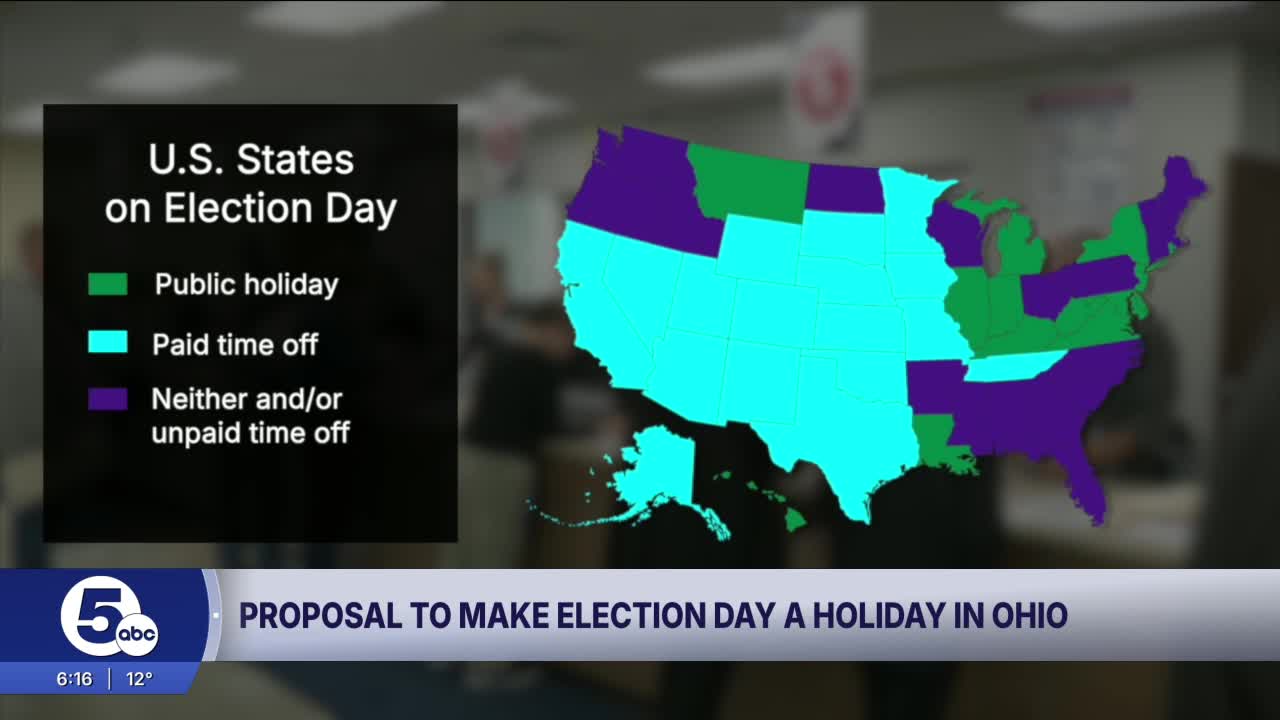
At least 14 states have Election Day as a holiday, according to the Movement Advancement Project, with five of them also requiring employers to give voters paid time off. Seventeen other states, ones that don't consider it a holiday, mandate paid time off. Ohio is one of the remaining states that doesn't require either. However, Ohio does allow for voters to get a "reasonable amount of time" off during the day to do their civic duty.
Turcer isn’t convinced this will actually fix low voter turnout, as many industries still work holidays. Also, childcare could be an issue if people aren’t able to bring their kids to the polls. She said a better option would be to mandate paid time off.
"It could also leave a lot of lower-income and essential workers behind," Turcer said.
Sec. of State Frank LaRose's team doesn't think a holiday is necessary.
"Ohio has one of the most accessible election schedules in the nation, with nearly a month of early voting, including evening and weekend hours. Every day’s a holiday when you can return your ballot from the comfort of your own home. We also have a very generous 13-hour voting window on Election Day itself, and we encourage all employers to give their employees time off, if needed, to engage in their civic duty," LaRose's spokesperson Ben Kindel said.
But just months ago, Ohio changed its election laws. Senate Bill 293, now signed into law, could make it harder to have your vote counted.
The new law, which goes into effect in mid-March, requires nearly every ballot to be counted on election night. Previously, the state had a four-day grace period for ballots to be received and counted by Ohio's 88 boards of elections. Ballots will still be counted as long as they are returned within four days of the election, if they are postmarked before election day.
This legislation came as Republicans had made so-called "election integrity" a priority over the past few years, as President Donald Trump baselessly claimed that there was massive fraud in the 2020 election.
Turcer fears that politicians could try to reduce other voting options, like early and mail-in, if Election Day is a holiday.
"We should be thinking about ensuring that we have better access to a diversity of ways to vote," Turcer said.
The bill will be heard in the coming months, and Smith is confident that, despite the legislature having a GOP supermajority, his idea is bipartisan and can succeed.
Future Sec. of State
We reached out to the declared Republican and Democratic candidates for secretary of state for their takes on the legislation.
"I fully support making Election Day a holiday. Voting should be an engaging, rewarding experience, celebrating our democracy and citizenship. Why does it just have to be send in a ballot or stand in a line? It should be a day to celebrate our democracy and our right to participate in deciding who governs and how we move forward as a society. So it’s more than just convenience. It’s about making a statement. There may be ideas and actions as important, but there is nothing more important than voting," Democratic candidate and former House Minority Leader Allison Russo said.
Democratic candidate Dr. Bryan Hambley also agreed that it was a good bill.
"He has spoken previously with Leader [Nickie] Antonio about this idea, and is very supportive. As Secretary of State, he would champion making it easier and more fair for Ohio citizens to vote, and this would be a positive step in that direction," Hambley's spokesperson Alissa Riessinger said.
Republican candidate and current state Treasurer Robert Sprague is in favor.
"In-person voting on Election Day, where IDs are checked and eligibility is easily verified, is the most secure form of voting, and it should be both a federal and state holiday. At the same time, we should look closely at no-fault absentee voting, as voting by mail is significantly more vulnerable to fraud, chain of custody lapses, and postal errors," Sprague's spokesperson Dalton Throckmorton said.
I asked further about whether this meant that Sprague would consider taking away the ability for the majority of citizens to vote by mail if elected, and I also requested evidence for the claims that mail-in voting is "significantly" more vulnerable to fraud. Sec. LaRose has continued to assure skeptics that Ohio is the "gold standard" and elections are wholly safe.
Sprague's team didn't comment on my additional questions.
Update: After this story aired and was published, Republican candidate Marcell Strbich provided a comment.
"On this bill, I can see its utility if Ohio law changed to same-day in-person voting, but with 28 days, there’s no point. It’s an optics bill to score political points now that S.B. 293 passed, eliminating the 4-day post election grace period," Strbich said.
Follow WEWS statehouse reporter Morgan Trau on Twitter and Facebook.
