

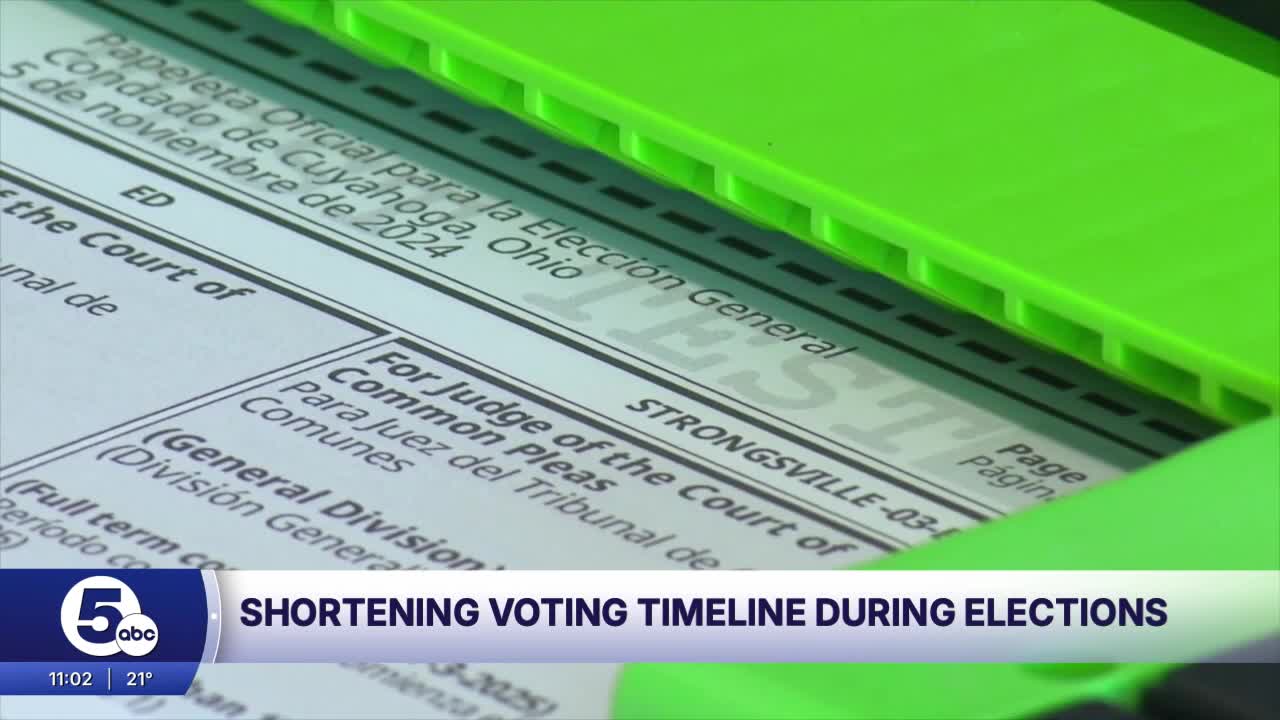


COLUMBUS, Ohio — Ohio Gov. Mike DeWine has signed a bill into law that would require nearly every ballot to be counted on election night. The governor wishes he could have vetoed it, he said.
Every vote counts, which is why DeWine supports the state's current four-day grace period for ballots to be received and counted by Ohio's 88 boards of elections. Ballots will still be counted as long as they are returned within four days of the election, if they are postmarked before election day.
"It makes a lot of sense," the governor said on Friday.
But now, Ohioans will need to start voting earlier if they vote by mail.
DeWine signed a controversial elections bill — one that could make it harder to have your vote counted. Voting rights advocate Jen Miller explained that S.B. 293 reduces the voter timeline. The bill requires the vast majority of ballots to be returned by the close of polls on election night.
"Senior citizens, people with disabilities, rural Ohioans, students — these are all populations that are more likely to need to vote absentee, but may also be affected by a slower mail service," she said.
There is a small exception for members of the military, which was added in after we first reported on the introduction of the legislation in October. In the original bill, veterans shared concerns about active-duty military members being disenfranchised since their mail can take much longer. Following our coverage, the lawmakers made an exemption for uniformed and overseas absentee voters.
RELATED: Ohio GOP proposes restrictions on mail-in ballot deadline, prompting concern from veterans
Each of Republican Secretary of State Frank LaRose’s election audits has shown no proof of widespread voter fraud, but Senate President Rob McColley (R-Napoleon) said that this bill could help reassure skeptics.
"You still see people losing confidence in their election officials and the election systems in those states when there's uncertainty that extends beyond election night," McColley said.
For years, President Donald Trump and some GOP leaders have insisted, without evidence, that mail-in ballots are fraudulent. Following his lead, red states have started restricting access.
DeWine didn't want to do this.
"I normally would veto a repeal of this four-day grace period," the governor said. "And frankly, that's what I wish I could do."
He is blaming the U.S. Supreme Court for his having to approve the legislation.
SCOTUS is set to decide whether or not ballots can be counted after election day, as the RNC is suing Mississippi, which has a similar law to Ohio.
If the court decides that Mississippi can’t have a grace period for its federal elections, DeWine says it could throw Ohio into “chaos.”
"We would have one set of rules for state candidates, one set of rules for federal candidates," he said. "In state elections, their absentee ballot could come in within the four days after the election and be counted, but that would not be true for federal elections."
He was forced to conform to the Supreme Court's possible ruling, he said.
"Reluctantly, I signed this bill," DeWine said after attempting to defend himself at the Friday press conference.
It's the right decision, according to House Speaker Matt Huffman (R-Lima), despite data showing that thousands of ballots would be thrown away each election.
RELATED: 3,000 Cuyahoga County ballots would have been thrown out if this Ohio bill was law
"The large majority of mail-in ballots were received by Election Day, so it's only these folks who are going to be, if you want to put it, inconvenienced enough that they're going to have to mail their ballot four days earlier," Huffman said.
Sec. LaRose has been critical of past stories on this subject, stories that showed 3,000 valid Cuyahoga County ballots from the 2025 November election wouldn't have been counted if this law had been in place during that time period.
He had posted on social media that when the law changes, he expects voters to get their ballots in earlier — thus the 3,000 ballots that came in after the deadline would somehow never have existed.
Miller argues that this is true disenfranchisement and another provision hurts election workers, as well.
The law also requires monthly citizenship checks using BMV and other data, as well as monthly reports to counties on deceased voters. It also mandates election workers to challenge anyone flagged as a non-citizen and requires corrections to any "mismatched" voter registration data.
“The provisions added at the end will lead to voters being mistakenly removed from the voter rolls and a dramatic increase in voters having to vote using provisional ballots, which makes election workers’ jobs harder and longer lines for everyone on Election Day," Miller said. "Voters deserve policies that support smooth, efficient election administration, not unfunded mandates that serve no one.”
Next steps
SCOTUS is not expected to decide until this summer.
But what happens if they allow Mississippi to still have its grace period? Since Ohio has already preempted the case, lawmakers would have to reverse the law to bring back the four-day grace period, which isn't at all likely to happen.
