

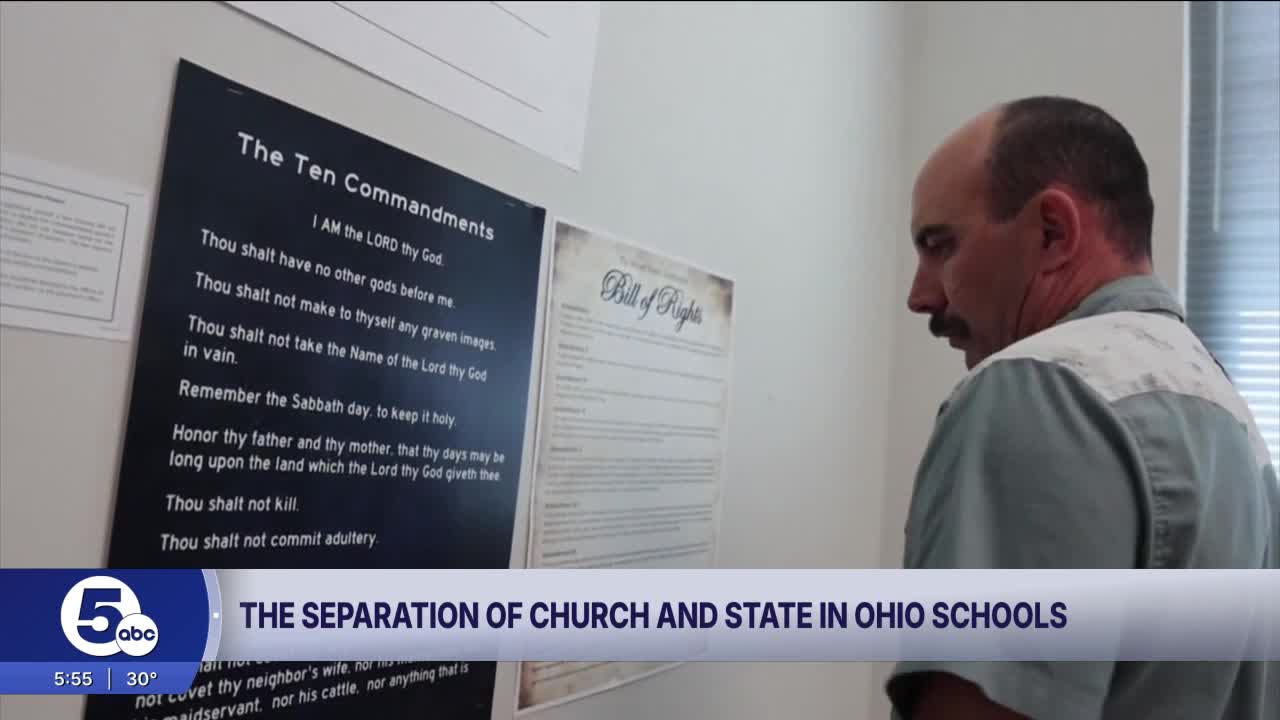


COLUMBUS, Ohio — Ohio Republican senators have passed a bill that would allow and put a display of the Ten Commandments in public school classrooms. This is just one of the recent pieces of legislation that would add more Christianity to the education system.
One of the longest battles of all time: how involved should religion be in the government? For some state lawmakers, it hasn’t been enough.
"It is inexcusable that more focus has not been shown towards these historic texts," state Sen. Terry Johnson (R-McDermott) said.
The majority of GOP senators passed S.B. 34, which would require public schools to display "historic" texts in classrooms. The list includes the Declaration of Independence, U.S. Constitution, the Bill of Rights, the Articles of Confederation, the mottoes of both the U.S. and Ohio, the Magna Carta, the Mayflower Compact, the Northwest Ordinance and the Ten Commandments.
"This bill will expose our students to the documents which have, in America, served as the backbone of our legal and moral traditions," Johnson said.
Of the nine documents listed, school districts only have to choose four. But Democrats argue it's a mandate.
"Did you notice that little piece in there — if someone gives [documents], if someone donates them, that they need to then display them?" Senate Minority Leader Nickie Antonio (D-Lakewood) said.
Antonio, a former educator, said it's unconstitutional to put religious texts in public school classrooms.
"To present to those children that a document from a religious practice is above all others is inappropriate," Antonio continued. "It's not what the founders intended, it goes totally against the separation of church and state, and I think it's an abomination."
Retired Case Western Reserve University constitutional law professor Jonathan Entin said the legislation does raise First Amendment concerns.
"The idea has been that you wanna keep the government out of the religion business," Entin said.
But he referenced three U.S. Supreme Court rulings from decades ago.
Decided in Stone v. Graham in 1980, justices said that Kentucky's display of the Ten Commandments in schools violated the First Amendment's establishment clause. In 2005, justices extended the 1980 ban to Kentucky's courthouses.
However, SCOTUS decided Van Orden v. Perry in 2005, which allowed the Ten Commandments in a public space in Texas, since it wasn’t the only “historical document” displayed.
"The court said, because the Ten Commandments is part of a larger message or a larger set of items, it's a less clearly religious message than the 10 Commandments standing alone," Entin said.
In recent years, other states have pushed for the religious doctrine to be put in schools. Most recently, a court ordered Texas school districts to remove the Ten Commandments from classrooms with a deadline of Monday.
However, Entin said that the makeup of SCOTUS is different now, and Republican states may feel the justices would be more inclined to rethink these cases.
"[The Court is] more conservative and the majority seems to be more sympathetic to public displays of religious objects," the professor said.
Another bill that recently passed the House would allow K-12 public schools and college professors to provide instruction on the “positive” impacts of religion on American history. The GOP has titled H.B. 486 the "Charlie Kirk American Heritage Act."
"Many of our adults don't actually understand the roots of America and our founding principles that are rooted in Christianity, and that's why we have our liberty, that's why we have our freedom," state Rep. Gary Click said (R-Vickery). "I think we need to be able to be free to teach that."
RELATED: Ohio Republicans move to include more 'positive' impacts of Christianity in public schools
He said that the bill doesn’t allow people to proselytize — converting or attempting to convert students — but does include how Christianity positively benefited policies like the “treaty with the Native Americans” and how the Ten Commandments shaped federal law.
"There's a movement in this country to make us a Christian national country, and these are the beginning steps of doing so," Antonio said.
House Minority Leader Dani Isaacsohn (D-Cincinnati) warned against promoting religious ideology.
"A wise friend down in Texas said something that my people, the Jewish people, know well to be true from our history, which is that 'A government powerful enough to impose religion is powerful enough to take it away,'" Isaacsohn said.
The House has also passed H.B. 485, which would require fifth graders and older to watch “Meet Baby Olivia,” a GOP-supported fetal development animated video created by anti-abortion organization Live Action.
"Children are a gift, and we're hoping that we can change the culture to be celebrating life instead of destroying life," state Rep. Melanie Miller (R-Ashland) said.
The development cycle and graphics shown in the video conflict with the American College of Obstetricians and Gynecologists' research.
When urging passage of the bill on the House floor, Miller quoted the Bible.
"They want to be able to impose their views, their religious views — let's be clear — on everyone else," abortion rights advocate Kellie Copeland said, adding that the video was medically inaccurate and offensive.
Each of these bills will be heard in the opposite chamber in the coming months.
Follow WEWS statehouse reporter Morgan Trau on Twitter and Facebook.
