

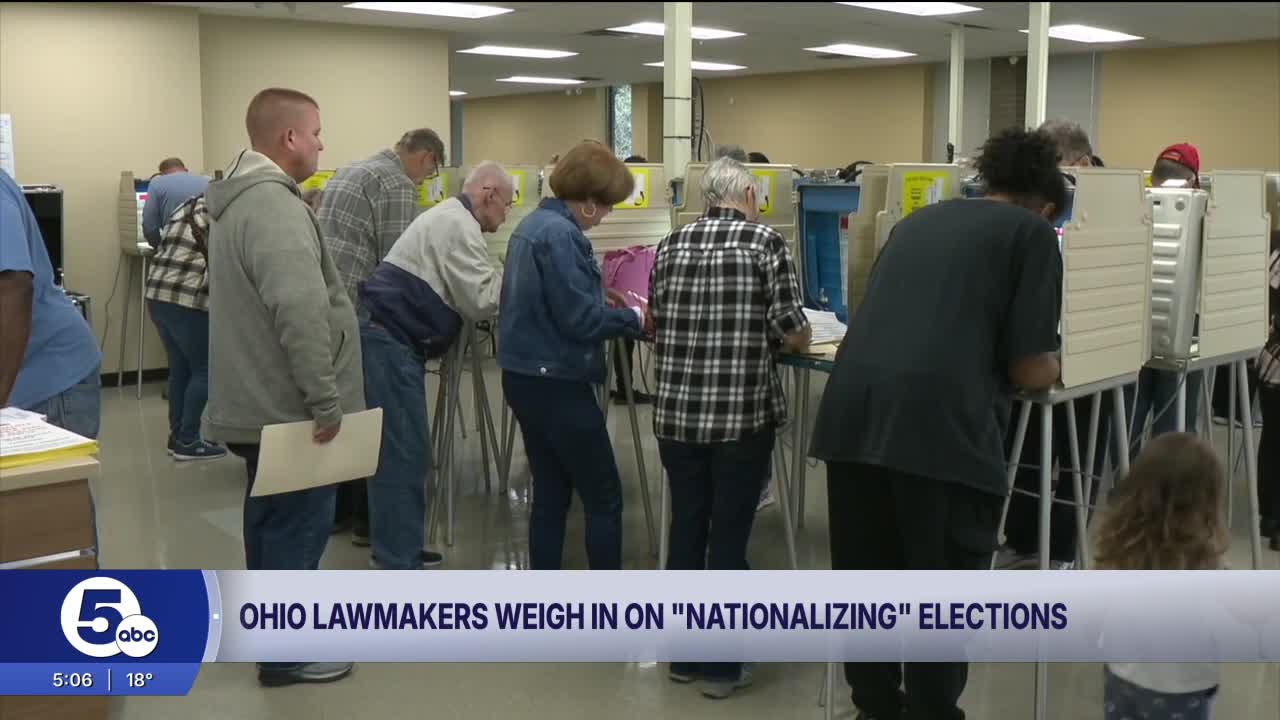


COLUMBUS, Ohio — Ohio's Republican legislative leader is rejecting President Donald Trump's push to federalize elections. House Speaker Matt Huffman, known as the most effective lawmaker in the state, categorically shut down any effort by the president to take over Ohio's elections.
Trump said elections should be "nationalized," complaining that blue states and cities can't run elections honestly.
"A state is an agent for the federal government in elections," he told reporters Tuesday. "I don't know why the federal government doesn't do them anyway."
While on CNN on Wednesday, U.S. Senator Jon Husted (R-OH) said Ohio's elections are run well, but pushed for more oversight of other states.
"They don't have photo ID in California," Husted said. "They don't properly maintain their voter rolls in California."
Both he and Sen. Bernie Moreno (R-OH) are backing federal legislation, nicknamed the 'SAVE Act,' that, among other provisions, would require proof of citizenship to register to vote. Individuals would have to produce their birth certificate or a passport.
RELATED: Ohio advocates file lawsuit against new BMV proof of citizenship requirement to register to vote
“Senator Moreno is a staunch supporter of measures that protect the integrity of our elections," Moreno's spokesperson, Reagan McCarthy, said when we asked what his thoughts were on federalizing elections. "He is a proud co-sponsor of the SAVE Act and will work with anyone to ensure elections are accurate, fair, and secure.”
But stepping out of D.C., Statehouse leaders are pushing back.
"Do you think that Ohio should give up power for the president?" I asked Huffman (R-Lima).
"The state of Ohio should be in charge of the state of Ohio's elections," he said.
While other Republicans danced around Trump's comments, Huffman explicitly said no — and that Ohio knows how to run its elections.
"I don't think that the states, in any way, should give up their elections," he said. "For one thing, is the federal government going to come in and run a township trustee election? Are they going to come in and decide who's running for school board or fiscal officer or the thousands and thousands of other elections?"
The speaker has previously been dismissive of Trump's ideas, such as when he said the president wouldn't pressure him to put out the congressional map the White House wanted.
Huffman has, however, been a part of redistricting lawsuits in which he requested help from a federal court to step in and rule that the legislature could control mapmaking. This federal court decision superseded the bipartisan Ohio Supreme Court's ruling that the Republicans needed to stop gerrymandering.
While answering an unrelated question earlier, Huffman made an aside about the separation of Congress and State.
"There are federal things the federal government does and things the state government does..." Huffman said. "There are lots of things the federal government does that are not federal functions, unfortunately."
Case Western Reserve University elections law expert Atiba Ellis explained that Trump doesn’t have the authority to federalize elections.
"If Congress chooses to make changes regarding federal elections, and federal elections only, Congress can do so," Ellis said. "The president cannot declare that the Republican Party or whoever can take over elections."
What he can do, the professor said, is push the states to mirror federal law.
"Congress can set law in regards to federal elections, which states would have to follow," he said. "When you bring these together, there is a bit of unification in that sense."
House Minority Leader Dani Isaacsohn (D-Cincinnati) warned that this has happened before.
Several months ago, the state got rid of its four-day grace period for mail-in ballots to arrive, since the Supreme Court is also addressing a similar issue. Ohio Republican Gov. Mike DeWine, who tends to disagree with Trump on most controversial issues (alleged election fraud, COVID, vaccines, LGBTQ+ rights, redistricting, Haitian and Somali immigrants, etc.), said he was "reluctantly" signing the bill, arguing that Ohio's elections are safe and the laws are reasonable.
"The current leadership in Ohio has been acting on Donald Trump's orders to restrict the right to vote for people," Isaacsohn said.
Over the past several years, Ohio has passed numerous bills that have impacted voters, including limiting dropbox access and requiring photo ID. Several laws were heard or are currently in federal court.
RELATED: Federal court sides with Ohio voters with disabilities, strikes down state law
"Does it make you feel a little bit assured that Huffman said that 'No, Ohio should not be giving up any power to the feds?'" I asked the minority leader.
"Unfortunately, the leaders in Ohio right now, including and especially the secretary of state, have not shown a willingness and a desire to increase access to the ballot for Ohioans..." he replied. "It does not give me a lot of confidence to hear from the people who've passed bill after bill after bill limiting access to the ballot for the people in Ohio."
Meanwhile, Huffman is adamant that Ohio will keep the reins.
"I don't think it should happen," Huffman said. "I don't think it will happen."
Republican Sec. of State Frank LaRose has touted Ohio as the "gold standard" of elections, with dozens of his audits showing no evidence of widespread voter fraud.
"Ohio is the national model for election administration, but as the President rightly pointed out, some other states are failing to meet minimum standards of election integrity, such as citizenship verification and voter ID," Sec. of State Frank LaRose's spokesperson Ben Kindel said when I asked about letting Trump take over Ohio's elections. "That's why Secretary LaRose is a strong supporter of the federal legislation that sets these minimum standards, especially the SAVE Act."
We reached out to the 2026 secretary frontrunners, ones who have filed campaign finance reports, about Trump's comments.
Future Election Overseer
“There are several states that do not take election security seriously like Ohio does," said Dalton Throckmorton, spokesperson of Republican state Treasurer Robert Sprague. "President Trump has been urging Congress to pass legislation that requires a photo ID to vote, and Treasurer Sprague supports that."
The team did not respond when we asked whether that meant the federal government should selectively take over cities or states.
Republican Marcell Strbich, in a longer response, explained that elections are already federalized, due to provisions like the National Voter Registration Act, the Help America Vote Act and the Uniformed and Overseas Citizens Absentee Voting Act.
"The notion that this is solely a state function is simply wrong. That isn’t what the Constitution says. The Congress retains authority to enact election statutes," Strbich said. "The Voting Rights Acts, the Civil Rights Act all supersede state law. So it’s a myth that the states control the elections. They administer the elections."
He added that Trump is trying to get states to comply with voter rolls maintenance.
Democratic House Rep. Allison Russo couldn't disagree more.
"Our U.S. Constitution specifies that the administration of our election process is a state function. President Trump’s alarming escalation of attacks on election integrity and his comments about federalizing the election process should be a five-alarm fire to anyone who cares about fair, free and secure elections," Russo said. "It is clear that his intent is to seize control of our elections so that he can manipulate the results to whatever he wants, not what the people decide."
Democrat Bryan Hambley said Trump's statements are indicative of a larger problem.
"Politicians have long used their power to manipulate our elections for their own purposes, and this proposal by President Trump is just that: a power grab to attempt to take control of elections from the states," Hambley said. "Ohio’s elections are safe and secure, and should continue to be run by our state officials."
Follow WEWS statehouse reporter Morgan Trau on Twitter and Facebook.
