

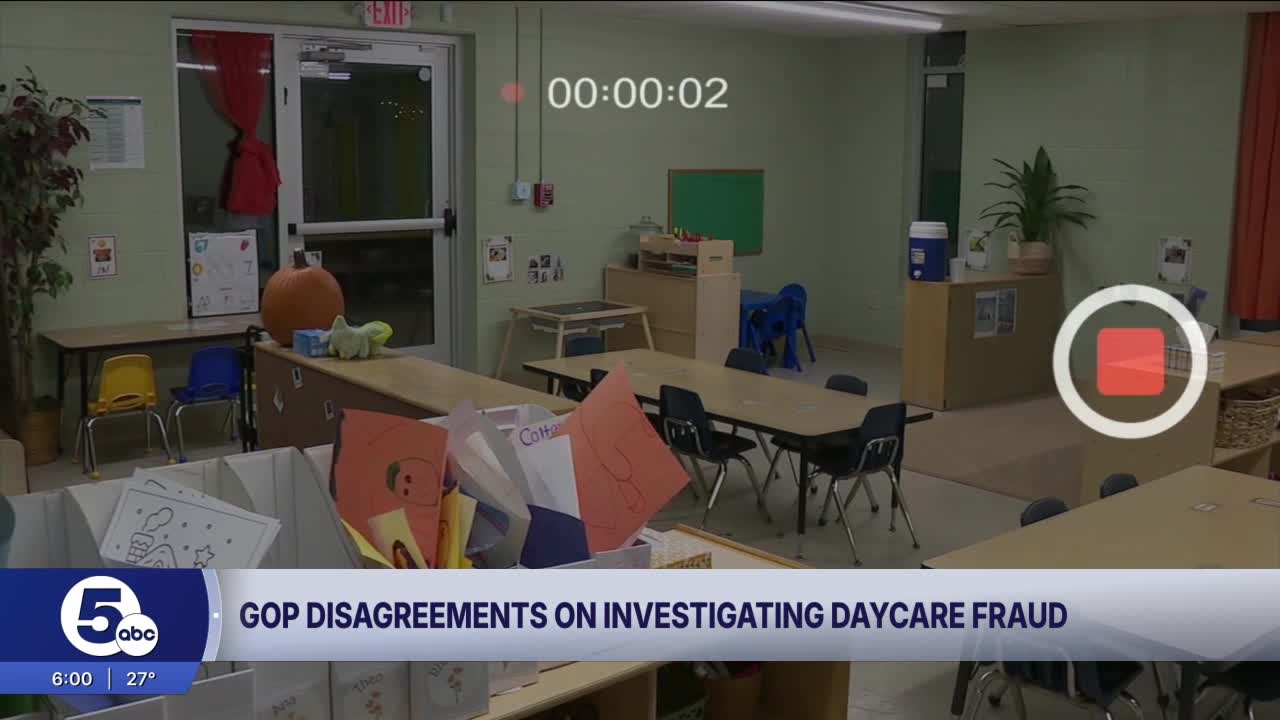


COLUMBUS, Ohio — Ohio Republicans are debating how to handle alleged daycare fraud. In order to combat specific claims, ones that haven't been proven, some lawmakers are pushing to require child care centers to put up numerous cameras and share live footage with the state.
Daycares in Ohio have been inundated with attention.
"I feel like an isolated situation has put a spotlight in a negative way on child care centers and now it's questioning our integrity," Anita Dokollari, owner of My Kids Childcare, said.
It comes from conservative activists online who are attempting to expose fraud. Like Minnesota, they have been scrutinizing the state's Somali population.
Ohio Gov. Mike DeWine has been trying to diffuse the situation.
"We are as vigilant as we can about fraud," he said in early January.
There are 5,200 child care centers in the state, he said, and with their fraud detection, tips from the public resulted in 12 facilities being shut down in 2025 — less than 1% of state-funded centers. There were about 60 cases of the state overpaying daycares $2 million in total, but the department felt that the cases were unintentional, and they got the money back.
RELATED: Ohio Gov. Mike DeWine defends Somali daycares amid viral fraud claims
But state Rep. Josh Williams (R-Sylvania Township) said Ohio — and DeWine — aren’t doing enough.
"It is clear to me that the current system isn't catching the fraud," Williams said during a press conference on Thursday.
He and state Rep. D.J. Swearingen (R-Huron) introduced a bill that would require cameras in the majority of daycare rooms, excluding bathrooms and other private areas. It would allow the state to have instant and live access to the videos. These would be used, in part, to help conduct attendance audits.
"This is going to be restricted to only government employees being able to provide access, and there's going to be records of when they actually have access," William said. "I don't think there are major privacy concerns."
The legislation provides no money for the daycares to buy the equipment.
"I'm a limited government guy," he said. "I'm not going to write a blank check the DCY and say, 'I don't know how much this technology is going to cost you.'"
The bill also allows for the state to terminate funding if there is suspicion of fraud. It gives authority to the state auditor to investigate and to the attorney general to prosecute.
"That is a necessary check and balance," Yost, who helped introduce the bill, said.
Williams came up with the legislation because of the work of the people who were going to daycares with cameras to try to spot fraud, starting in late December. He said those individuals led to the 12 facilities being shut down.
"There's actually been allegations that were raised, and they were proven," Williams said.
But in actuality, the governor's team found that specific fraud before the online outage.
After a back and forth with me in which I asked Williams if he had different information than what the governor gave out, he said no.
"That was from all of 2025, not from the 'citizen journalists,'" I said.
"Not according to the press release — see my markings, I do my job," Williams said, holding up a printout of the governor's press release, one stating that the fraud was from the entire past year.
He then read a portion out loud, which stated that the tips were from before the end of December.
"I don't want to misrepresent the facts on the ground," Williams said. "The facts are what they are."
DeWine’s team confirmed that our interpretation was correct and that these activist tips have not resulted in anything but are being investigated.
RELATED: Ohio looking for potential childcare center fraud by conducting at least 400 random inspections
The "investigators" at the center of the bill have posted videos of themselves being prohibited from entering Somali-owned daycare facilities. DeWine said, "Hell no," people shouldn't be let in to see random children they have no association with.
When questioned, Williams said he wasn't trying to "demonize" the Somali population, but that it's "not a coincidence" that fraud was discovered and allegedly committed by a "particular community" in Minnesota.
The governor rejected accusations solely targeting the Somali community.
"Do you see these claims as being from anti-Somali sentiment?" I asked DeWine in early January.
"Well, look. I think that something, again, the national audience does not understand... is that the vast majority of Somalians have been here for a long time," DeWine responded. "Many of them are citizens. Many of them run businesses. We need to just not fixate on any population."
DeWine's administration is now partnering on a different child care bill proposed by other Republicans.
"We're working on protecting their tax dollars as well as serving the children that need our help," state Rep. Phil Plummer (R-Dayton) said.
Plummer and state Rep. Tom Young (R- Washington Township) have introduced legislation that would give authority to the attorney general to investigate and prosecute alleged child care fraud, allow the state to immediately suspend a license under suspicion of fraud and would provide money for enhanced data analytics for reviews.
Williams is putting federal funding at risk, Plummer argued.
"We can't gaslight this and say, 'Ohio's terrible,' because Ohio is not terrible," he said. "You don't freak out the administration, the federal administration, and then they pull our funding, because then we lose child care centers."
President Donald Trump has frozen federal daycare funds until states prove they are ripe with fraud.
Eventually, Williams acknowledged that the citizen "investigators" may not have found fraud, but he still backs his plan.
"It can make it where their information is less of a factor [in putting the bill forward]," he said.
Follow WEWS statehouse reporter Morgan Trau on Twitter and Facebook.
