

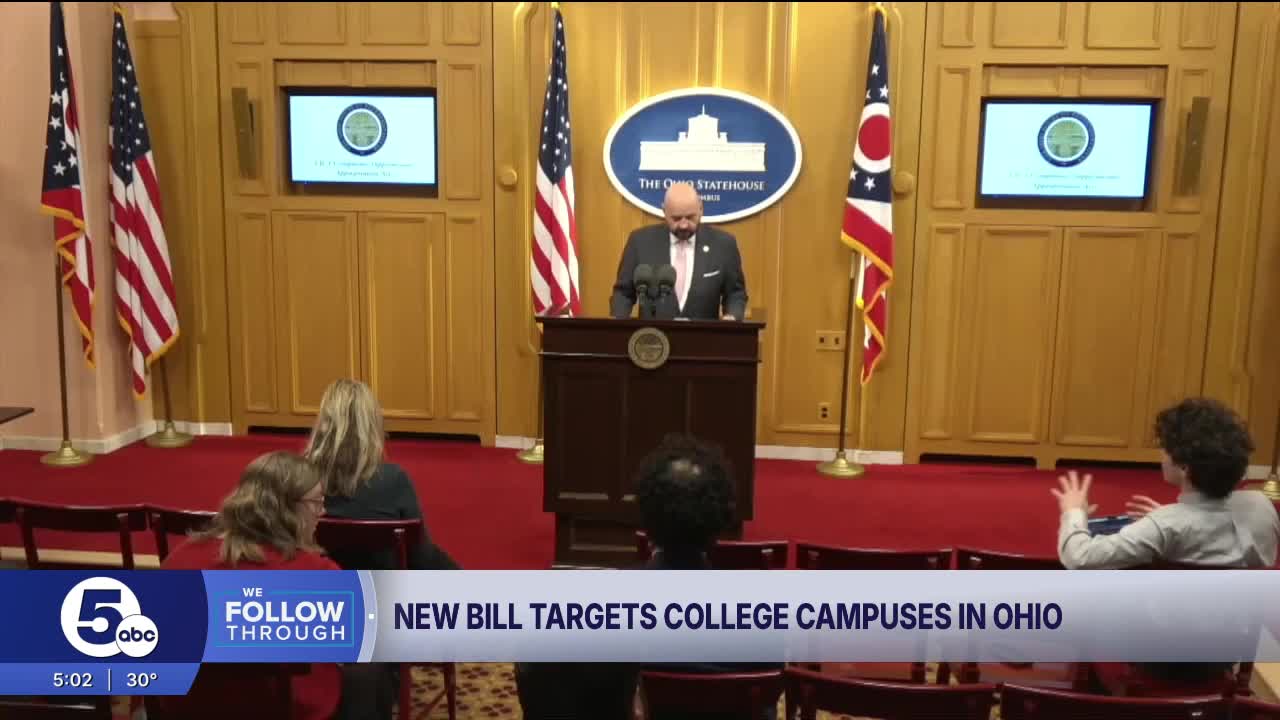


COLUMBUS, Ohio — A bill in the Ohio House would punish public universities by stripping funding from them for not complying with the state's anti-DEI efforts. The architect of the original higher education overhaul bill said the new legislation isn't currently needed.
Ohio Republicans overhauled curriculum at each public university last summer, using Senate Bill 1 to get rid of what they call "liberal bias."
"D-E-I is D-E-A-D," state Rep. Tom Young (R-Washington Township) has repeated for years.
But professors’ union leader Jennifer Price said it’s this bill that won’t D-I-E.
"It's a huge disappointment to see them coming out with another bill that just further undermines and erodes higher education in Ohio," Price, executive director of the Ohio Conference of the American Association of University Professors, said.
Young cosponsored S.B. 1, and his latest bill punishes colleges for not complying with it.
S.B. 1 focuses on what Young calls “free speech,” banning public universities in Ohio from Diversity, Equity and Inclusion initiatives, having “bias” in the classroom and limiting how “controversial topics” can and can’t be taught. "Controversial" under Ohio law includes "belief policy that is the subject of political controversy, including issues such as climate policies, electoral politics, foreign policy, diversity, equity, and inclusion programs, immigration policy, marriage, or abortion."
The elimination of DEI would mean no diversity offices, training or scholarships. The bill also prevents faculty members from being able to strike, and it ends tenure.
"If the university is not in compliance as it goes forward, then there will be a decision on how to hold back funds," Young said during a press conference on Tuesday.
To make sure they keep their state funding, H.B. 698 would require colleges to have additional certification processes in place, such as checks that universities didn’t “disguise” so-called DEI programs to keep them.
"There is no legal definition of DEI, so how are colleges and universities or professors or staff members supposed to know if what they are talking about or what they might say or what opinion they might address could then be considered DEI and a reason for them to be fired?" Price said.
They also must provide a list of each former-DEI faculty member or staff member and justify why they are still employed. This, in turn, creates a registry of individuals who covered diversity-related topics.
"People over the summer who have brought concerns to me... They're afraid to come forward to even say anything," Young responded when asked about who is requesting this bill.
It also expands the ability of retrenchment and cost-cutting to account for declining or even "stagnant" enrollment.
"If everything stays the same in your program, if you have the same number of students that you had last year and the year before and the year before — so no decline — you can trigger retrenchment," Price said.
Young disagreed that his legislation allowed for more retrenchment triggers; however, the bill language directly adds a full section on initiating retrenchment.
"S.B. 1 sets the expectations," Young said. "H.B. 698 ensures that these expectations are verifiable and enforceable."
But professors fighting this bill found an unexpected ally: S.B. 1's main sponsor. Senate Finance Chair Jerry Cirino (R-Kirtland) tried to convince Young it was needed, he said.
"I told Representative Young that I think we should just wait a little bit, see what the data looks like after, let's say a year of it being law, and then we can decide what we need to do, if anything," Cirino told me.
He said he appreciates that Young is passionate about the bill, but said the timing and method are wrong.
"Would you say that this bill is jumping the gun?" I asked Cirino.
"I think it's premature," he replied. "I don't believe there's much of an appetite right now in the Senate to double down on consequences for those who are not in full compliance."
Universities have always had a deadline of March 1, 2026, to be in full compliance, Cirino added.
"I'm getting lots of good feedback that there's a lot of good activity going on to be compliant with the bill," he said. "I never expected that we would turn out a dime here to change the culture in our universities."
Despite Young saying repeatedly in his press conference that what he was doing wasn't a "punitive bill," Cirino explicitly said it was.
"I don't want to put punitive actions in the revised code right now when we're not even sure what the behavior is going to be," he said.
The senator also noted that when the facts come out, he will be the one to "bring down the hammer" if the state needs to.
He mentioned he also just wasn't a fan of some aspects of the bill, including the retrenchment changes and some provisions he said could bring up legal challenges.
Young isn't bothered by Cirino's disapproval, saying that if his bill is too "overbearing," he will cross that bridge when it gets to the Senate.
"Senator Cirino and I get along very, very well. It's the 'Tom and Jerry' show, right?" he said, referencing the animated cartoon in which Tom, a cat, and Jerry, a mouse, are foes — yet happen to share the same names as the lawmakers. "We work very, very well together."
Young argues this is the fiscally responsible path to take, while Price argues it is another way to silence professors.
"It's very much stifling free speech; It's very much eroding academic freedom as well as tenure," Price said. "It's a blow to colleges and universities. It's a blow to Ohio students."
If the lawmakers keep it up, she said, professors and students will choose to work and study out of state.
"They should not be playing politics with education," she said. "The people who lose when there are these types of political games, it's really every Ohioan."
Follow WEWS statehouse reporter Morgan Trau on Twitter and Facebook.
