

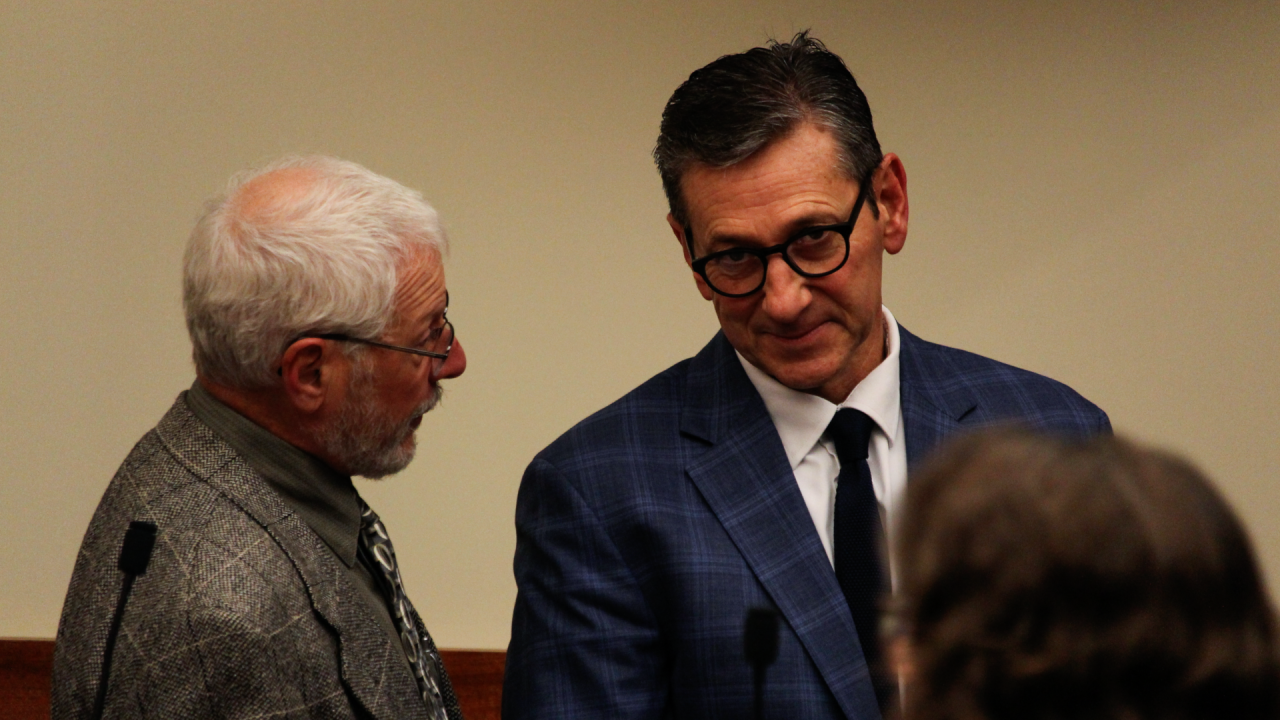


COLUMBUS, Ohio — The chair of the Ohio retired teachers' pension fund board, a former member and a lobbyist will not face criminal charges related to alleged ethics violations after the state referred the case to the Columbus City Attorney's Office.
Through records request, we found that City Attorney Zach Klein's team has decided not to press charges against State Teachers Retirement System (STRS) board chair Rudy Fichtenbaum and former member Wade Steen, saying there is not enough evidence to prove that the men knowingly broke the law by soliciting or accepting money from Ohio Retirement for Teachers Association's (ORTA) Robin Rayfield for their legal defense fund.
Fichtenbaum and Steen are in the center of a legal battle against Ohio Attorney General Dave Yost, who is accusing them of corruption.
In summary, the state is accusing Fichtenbaum and Steen of attempting to contract steer 70% of STRS assets to QED, a startup investment firm. The AG's office says QED's leaders, Seth Metcalf and JD Tremmel, have "backdoor ties" and no track record, clients or capability to invest the $65 billion they were seeking.
A whistleblower document claimed that QED and ORTA had worked together, specifically when it came to elections to get a more sympathetic — or willing — board.
For more of an in-depth recap, please click here.
Their trial ended in mid-December, and Franklin County Court of Common Pleas Judge Karen Held Phipps is set to decide whether or not she should remove Fichtenbaum from his position, and if he and former board member Wade Steen should be banned from ever returning to public pensions.
RELATED: Judge to rule on retired teachers' pension fund corruption trial, ethics investigation continues
Rayfield's legal fund was made to help both Steen and Fichtenbaum's litigation against the state. ORTA has donated more than $215,000, according to financial forms filed.
In 2024, Legislative Inspector General Tony Bledsoe was amazed by the then-only $115,000 spent by ORTA.
“In 23 years of reviewing lobbying expenditures, this is a complete outlier — we’ve seen nothing comparable,” Bledsoe said in 2024.
ORTA had not submitted financial filings until our reporting that year.
The trio of men has insisted on their innocence the entire time. When I previously asked each of them about the fund, they said their attorneys gave them clearance to do it. Klein's Criminal Division Chief Melanie Tobias-Hunter seemed to agree.
"There is ample evidence, including email correspondence and witness interviews, demonstrating that Mr. Steen and Dr. Fichtenbaum acted in good-faith reliance on the advice of their counsel that they were permitted to accept contributions to their legal defense fund from ORTA," Tobias-Hunter wrote in the Jan. 16 letter to the Ethics Commission. "Good faith reliance on counsel’s advice negates the mental state required for the crimes. In addition to negating the mental state element, the advice-of-counsel defense is also a legal defense."
Tobias-Hunter continued that same argument for Rayfield and his belief that he was legally allowed to give the money.
"We do not disagree with [Tobias-Hunter's] conclusion," Ethics Commission Executive Director Paul Nick said.
Working on the advice of their attorney, it would be "unlikely" to prove that they knowingly violated the law, Tobias-Hunter said.
“Let’s be clear: launching an ethics investigation with no factual foundation, and then allowing its mere existence to be used to suggest wrongdoing, is an abuse of power," a spokesperson for Fichtenbaum and Steen said. "In this country, investigations are meant to uncover facts—not to be wielded as political weapons."
Case Western Reserve University law professor Michael Benza explained that getting bad advice is only criminal if the defendants are knowingly seeking to break the law and if the attorney is purposely giving poor counsel to help them.
"When you're getting legal advice in order to be able to commit a crime, that is when you lose that protection of the attorney-client privilege and the reliance on your counsel," Benza said.
But following Tobias-Hunter's letter, the commission issued a formal opinion regarding defense funds. These advisories are meant to interpret the law for courts and law enforcement.
The opinion clarified that while the law does not completely prohibit contributions to a fund, it does put forward significant limitations.
Ethics law states that "a public official or employee may not solicit or accept contributions for a legal defense fund from any individual or entity that is doing business with, seeking to do business with, regulated by, or has matters pending before the public agency the official or employee serves."
“These restrictions are designed to prevent conflicts of interest and preserve public confidence in government decision-making,” Nick said. “Even in the context of a legal defense fund, public officials must avoid situations where contributors could appear to be seeking influence or favorable treatment.”
Moving forward, they added new clarifications to interpreting state law — explicitly saying that someone cannot accept contributions from parties who are doing or seeking to do business with, regulated by, or interested in matters pending before the public agency in both criminal and civil cases.
The commission also said that it prohibits any person who is doing or seeking to do business with, regulated by, or interested in matters pending before the agency from promising or giving a contribution to the public official’s or employee’s legal defense fund in a civil case.
The public figures and the lobbyists also need to file financial disclosure statements. A third-party isn't allowed to get money from prohibited sources, either, and funnel that into the legal defense fund, the opinion continued.
Follow WEWS statehouse reporter Morgan Trau on Twitter and Facebook.
