

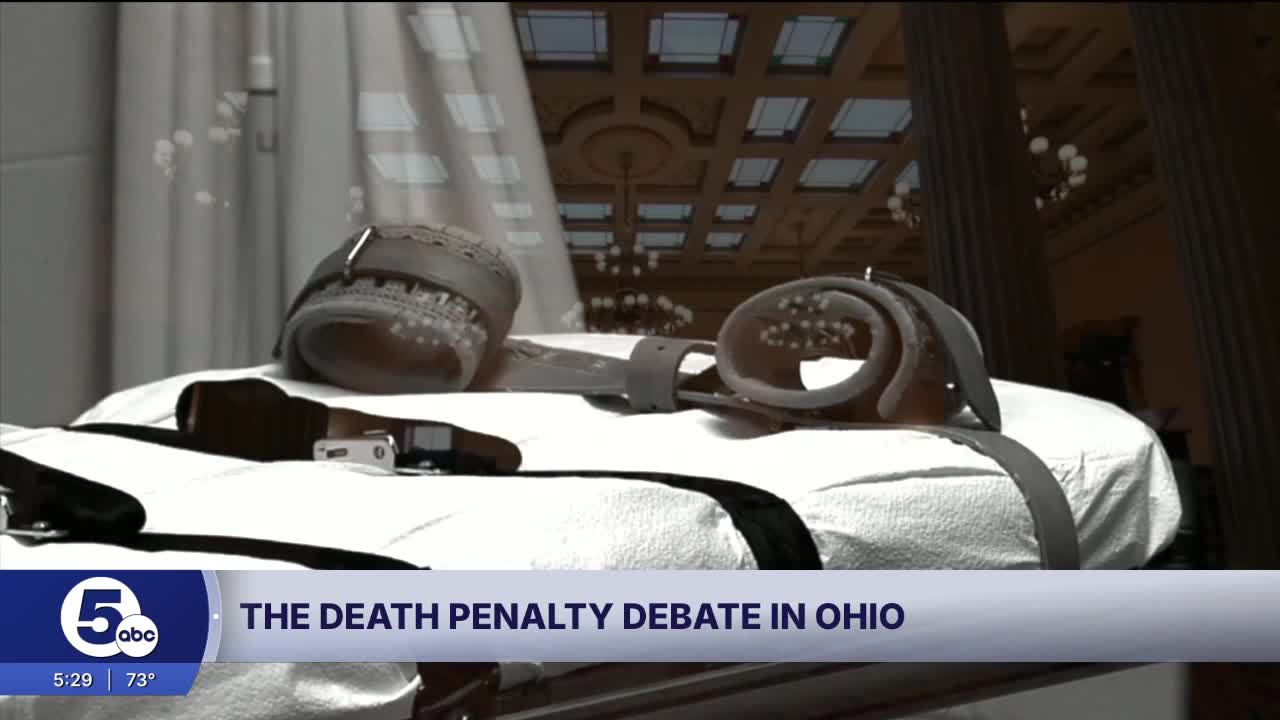


COLUMBUS, Ohio — Ohio Gov. Mike DeWine has had a change of heart on the death penalty, urging lawmakers to abolish capital punishment. The best friend of murder victims is begging politicians not to listen.
This story contains details that may be disturbing and upsetting to some viewers and readers.
"You wake up every morning, and the person is not there," Rhonda Whitelock said during an interview Wednesday. "There's nothing."
Whitelock survives the day through hope alone.
"Okay, well, there's gonna be justice one day, right?" she asked.
That justice has not come.
For nine years, Whitelock has been telling us the story of the brutal murder of her lifelong friend, Suzanne Taylor — who was more like a sister.
"You said that you will not feel relief until he stops breathing. Does that still ring true?" I asked her.
"Yes, why does this man still breathe on this earth after what he did?" she responded.
George Brinkman pleaded guilty to brutally murdering Taylor, 45, and her two daughters in North Royalton in 2017. The details of this case are important for the public to know, Whitelock said.
Brinkman took the family of three hostage and then slit the throat of Taylor in front of her children. He then smothered Taylor Pifer, 21, with a pillow and strangled Kylie Pifer, 18, with a phone cord.
After he killed the family of three, he drove to Stark County and shot and killed Rogell and Roberta John, an elderly couple.
"He's in there watching his TV; he gets to live, he gets to breathe," Whitelock said. "My friend's not here; she doesn't get to breathe. Her children aren't here anymore."
She started writing DeWine years ago, after he had put an unofficial pause on the death penalty. He never responded, and this week, she said she found out why.
"I believe Ohio should abolish the death penalty," DeWine said during a press conference Tuesday.
In 1981, DeWine was the architect of the current capital punishment law in the state. Now, he said it is a broken system, one that costs the state hundreds of millions despite not having executed anyone since 2018. He adds that research shows that the death penalty isn’t a deterrent to crime, plus the punishment draws out the legal process for victims' families.
"Our money and our energies are much better spent focusing on keeping these repeat violent offenders out of society than focusing on the death penalty," he said.
Capital punishment convictions in Ohio are decreasing, he said, noting that even when someone is sentenced to death, it takes years, if not decades, before they are executed.
But the governor, who has about six more months in office, really has no power to extend his moratorium.
"The legislature can take this action," DeWine said. "I believe they should take this action."
Ohio Republican leaders have reacted strongly, disagreeing with him.
"I will vigorously oppose getting rid of the death penalty," House Speaker Matt Huffman (R-Lima) said when asked earlier this year about the governor's long-awaited announcement.
State Rep. Brian Stewart, who has been an advocate of getting the executions back in motion, posted on social media that DeWine hadn't been executing Ohio's laws.
"The legislature is not abolishing the death penalty & warmed over pablum about it isn’t changing any minds," Stewart wrote.
Early in his term, DeWine declared lethal injection was “no longer an option,” citing a federal judge’s ruling that the protocol could cause inmates “severe pain and needless suffering.” He also said that the drugs were hard to get.
The governor is right — to an extent. Major pharmaceutical companies do not want their drugs to be used to kill. However, other states have been able to skirt that by using local pharmacies and putting provisions in law that protect the identities of sellers.
Stewart is one of the lawmakers who says that if the drug companies won’t comply, Ohio could use nitrogen gas for executions, as Alabama has.
The U.S. Supreme Court did just block the state from using the gas to execute an inmate soon, upholding a lower court ruling that it was a "cruel and unusual punishment."
Idaho, on the other hand, is set to start using the firing squad in July.
While the House Republican leadership was adamant against DeWine's idea, the Senate was softer, with President Rob McColley (R-Napoleon) saying that his caucus is split.
"I'm kind of in the middle," McColley said. "I look at some of the most heinous crimes and I look at the crimes where the evidence is very strong against somebody and say, 'Look, under those circumstances where somebody has committed one of some of the most atrocious acts that you ever hear of, particularly against children,' and I say 'Look, the death penalty might be appropriate in those cases,' and I look at other cases where we've seen individuals who are on death row who end up being exonerated later on because there was exculpatory evidence that maybe was withheld — and you'd hate to see somebody go through the entire death row process and wind up being executed."
However, he still doesn't think there are enough votes in the Senate to eliminate it.
It's not just state officials who are pushing to keep the death penalty; local prosecutors have cited our stories with Whitelock as a reason why federal officials need to get involved. In a letter in 2025 to then-U.S. Attorney General Pam Bondi, Trumbull County Prosecutor Dennis Watkins pleaded for help.
"It is my belief that a large majority of the citizens of Ohio support the death penalty and also support President Trump on his clear stance on this issue to make things happen, especially by revoking the federal moratorium on executions and resuming executions," Watkins said. "Ohio must follow by carrying out its law, and I believe that you, as directed by the president, can help Ohio's present and future officials do so."
DeWine has been undeterred and brought up another option: putting the idea on the ballot, which some advocates tell us is welcome news. Others, like Kevin Werner with the coalition Ohioans to Stop Executions, are against it.
"I don't think that's the right approach," Werner said, noting that the topic is extremely complicated. "It's an astronomical feat to try to achieve."
It's not because he doesn't think there isn't enough support, but mainly it is because of how expensive it would be to get the idea on the ballot. Whitelock doesn’t think asking voters about the death penalty will go in DeWine’s favor.
"I do believe the people of Ohio will do the right thing," she said.
Brinkman's execution is scheduled for this fall, but it likely will get pushed back again.
Follow WEWS statehouse reporter Morgan Trau on Twitter and Facebook.
