

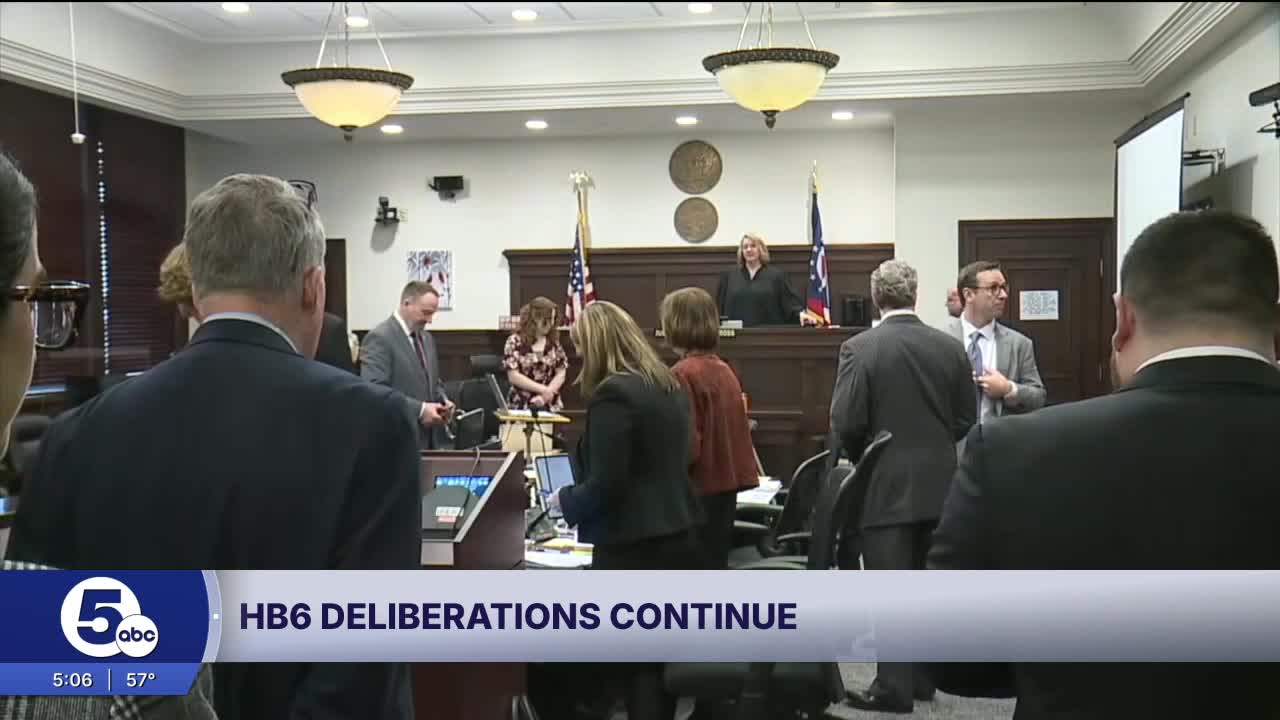


AKRON, Ohio — Jurors in the FirstEnergy corruption trial have spent five days wrestling over whether top executives participated in the largest bribery scheme in state history, with their questions signaling a possible mistrial.
The Summit County jury has been deliberating for five days, trying to decide on whether former FirstEnergy CEO Chuck Jones and former SVP Mike Dowling are guilty of bribing former Public Utilities Commission Chair (PUCO) Sam Randazzo with $4.3 million to get beneficial rulings. Randazzo was previously indicted with Jones and Dowling, but killed himself after pleading not guilty in 2024.
“If we cannot agree on the charge of bribery, do we evaluate the other charges?” the jury wrote to Summit County Judge Susan Baker Ross on Monday evening.
That question showed that they are struggling to come to a decision in the bribery case, former U.S. Attorney David DeVillers said.
“The last question that came in kind of goes to the heart of the jury deliberations,” Baker Ross said.
RELATED: What the jury doesn't know while deliberating the FirstEnergy corruption case
This deliberation period is telling for DeVillers, who worked with the FBI to get indictments of former Ohio House Speaker Larry Householder and former GOP leader Matt Borges, who had a joint six-week trial in 2023.
"The jury's out, right?" DeVillers said. "It's been out for quite a while, so it looks like at least both sides have done some pretty good work."
More in-depth information about each of the arguments can be found by clicking here.
In March of 2023, a federal jury found that Householder and former GOP leader Matt Borges, beyond a reasonable doubt, participated in this $61 million racketeering scheme. Householder is nearly three years into his 20-year prison sentence for accepting the bribe from FirstEnergy, while Borges is out after serving half of his five-year sentence.
That case was decided in just nine hours, with the jury foreman Jarrod Haines telling us at the time that the prosecution and its witnesses laid out the case clearly from the start.
"When the FBI agent was on the stand, it just kind of caught my interest," Haines said in an exclusive interview in 2023. "Then from there on, I just felt like everything fell into place."
DeVillers noted some key differences between this trial and the one involving Householder and Borges, including FBI special agent Blane Wetzel's ability to narrate the case and explain the process to the jury.
The state didn’t have that type of expert because one of the main investigators resigned after DeVillers, coincidentally, investigated him for misconduct unrelated to H.B. 6, he said. But that individual wasn't the only case agent who could have testified, DeVillers said.
"They could have done it if they thought it was necessary," the former prosecutor said. "They, apparently, did not think it was necessary."
"Would you have thought it was necessary?" I asked him.
"I don't know enough about the case," DeVillers responded, giving a cheeky smile. "I have a day job, so I'm not watching as much as you are."
The feds were able to show that Householder spent bribery money on personal expenses, like renovations to a home in Florida and credit card debt, whereas DeVillers pointed out that the state didn’t show exactly where Jones and Dowling spent money from their rising stock prices.
"It's a lot easier when you can prove it went to their pockets, 100%," he said.
Householder taking the stand made the case simple, both DeVillers and Haines said.
"I think that it helped him," Haines said about Householder testifying in his own defense. "Until the prosecution had their chance."
Assistant U.S. Attorney Emily Gladfelter’s brutal takedown of Householder was a defining moment for all jurors, he added. For every major — and minor — claim Householder made on the stand, Gladfelter had evidence that showed the opposite.
Another staggering difference between the federal case and the state case rests with the attorneys. Householder and Borges had a few local lawyers each with them in the trial. Jones and Dowling's attorneys are being paid for by FirstEnergy, and the courtroom was full of pricey partners from both local and Chicago firms.
If the jury continues to be stuck, DeViller isn't surprised that this may be a mistrial.
"They're doing their best right now," Baker Ross said.
The jury asked for specific details on Monday about a FirstEnergy meeting from 2018. Originally, the judge originally told them to use their memory. On Wednesday, she gave them the details they requested.
"It could be after days of deliberation of the parties, that is, the prosecution and defense, that they came to a decision, like, 'Here's what we think you should [answer] to get things rolling,'" Devillers said.
Still, if there is a mistrial, the state will be able to retry the case.
Regardless of the outcome, it's not over yet. Jones and Dowling are facing federal racketeering charges for bribing Householder. Because of the sovereignty doctrine, which allows both federal and state entities to file charges separately, double jeopardy, for the most part, doesn't exist.
What will have to happen is that the PUCO and more Randazzo-leaning angle of the federal case will probably not be able to take center stage in their court case, DeVillers said. But the Householder and $61 million portion of the H.B. 6 scheme is fair game, he added. If DeVillers were prosecuting the case, he said that he would have made Householder's involvement a bigger deal.
But if acquitted in the state case, DeVillers says they may move to dismiss the federal charges.
"Do you think that that's a failure of justice?" I asked him.
"No, it's a frustration of justice, right?" he responded. "Sometimes people can't come to a decision."
He said he is confident that the FBI can convince a jury that the men did commit bribery. Glatfelter and Wetzel will be back on the case, and so will some star witnesses.
When he was still the U.S. attorney, he secured guilty pleas from two of the original five men he charged: Householder's top political aide Jeff Longstreth and FirstEnergy lobbyist Juan Cespedes. The fifth individual, Neil Clark, also killed himself after pleading not guilty. I referenced how Longstreth and Cespedes haven't been sentenced yet.
"It is very likely—" the attorney started before cutting himself off. "Well, I've got to be careful what I say here, because I do know more about that."
"Is there anyone else? Is there more coming?" I asked DeVillers.
"I don't know," he laughed, dodging the question. "I'm out of the game, sister."
Follow WEWS statehouse reporter Morgan Trau on Twitter and Facebook.
