

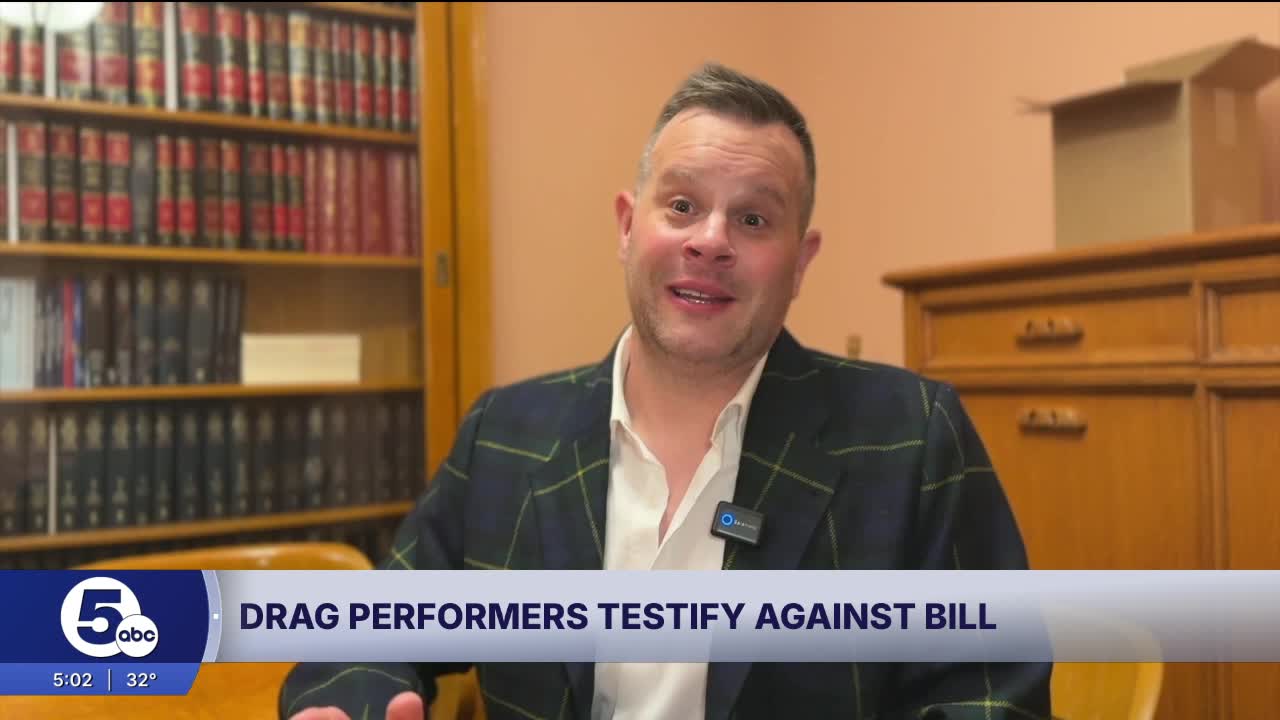


COLUMBUS, Ohio — Performers, including Nina West, testified against an Ohio bill that would ban public drag shows.
Growing up in a conservative family, Andrew Levitt said he hid himself for years.
"I was also worried that if people truly knew who I was, I would no longer belong or fit in," Levitt said.
But in college, he says he found his identity.
"Drag is something that saved my life," Levitt said. "When I met entertainers who are drag queens, they gave me a place to call home when I didn't have a place to live, when I didn't have the familial support that I was just so desperately needing."
When Levitt gets on stage, he transforms into nationally-awarded drag queen Nina West.
"I'm an entertainer who's proudly worked with incredible companies like Disney," Levitt said. "I've written a children's book. I have released a children's album. I have done library readings."
But he is worried about a newly introduced bill that would impact his art.
State Rep. Josh Williams (R-Sylvania Township) introduced a bill that would ban drag performances in any places other than “adult cabarets,” which include nightclubs and sex shops. The bill lumps drag performers in with acts that are “harmful to juveniles or obscene,” such as exotic dancers.
House Bill 249 prohibits "adult cabaret performances in locations other than adult cabarets," and adds to the definition of adult cabaret performances "Performers or entertainers who exhibit a gender identity that is different from the performer's or entertainer's biological sex using clothing, makeup, prosthetic or imitation genitals or breasts, or other physical markers."
This bill has a specific carve-out to say that it wouldn't "prohibit or restrict a bona fide film, theatrical, or other artistic endeavor or performance that is not obscene or harmful to juveniles," meaning musicals at local theatres would not be impacted.
"This statute simply says you can't perform that obscene performance with a minor being present," Williams said.
RELATED: Ohio GOP wants to require ‘biological sex’ on driver's licenses
The obscenity law is relatively vague, ranging from something that shows lust — like a kiss or a character having a crush — to intercourse.
"We've seen performances at public parks that cross the line," Williams said.
In recent years, GOP-led states have started to ban drag, arguing that the LGBTQ+ community is inherently sexual and shouldn't be around children. Levitt said this was absolutely false.
"Drag is something that gives people agency and hope, and it makes them feel seen, which is important; it's important to tell people that they matter," Levitt said. "We're providing validity to people's existence and I think that's important and valuable."
Williams says that the bill wouldn’t apply to “appropriate drag,” and it’s written in a way that obscenity could be determined by individual law enforcement.
People found guilty of performing in the presence of someone under 18 would get a misdemeanor of the first degree. If the performance involved is obscene, a violation is a felony of the fifth degree. If it is obscene and someone under 13 watches, that would be a fourth-degree felony with up to 18 months in prison.
"Drag is not a crime," Levitt said. "This is a slippery slope to put us in a specific venue or area or part of town where [you're] basically compartmentalizing and dangerously placing people in boxes."
Previously, House Speaker Matt Huffman said he wasn’t sure if this bill was constitutional under the First Amendment, but he has changed course.
"I think local governments, through enabling legislation, have the ability to control these kinds of things exactly where the line is drawn," he said when I asked if he still thought it could be unconstitutional. "It might be unconstitutional depending on how the language is drawn... I think the committee that it's in and the sponsors of it have drawn the lines where I think it should be appropriate."
This type of law has been blocked in other states for violating freedom of speech.
Levitt doesn’t want any kid to feel like he did growing up, and says this bill could prevent people from finding their circle.
"What happens if this community goes away?" I asked him.
"This community's never going away," he responded. "We will fight this, and we will overcome. Love always overcomes hate."
Follow WEWS statehouse reporter Morgan Trau on Twitter and Facebook.
