



AKRON, Ohio — Closing arguments have begun in the FirstEnergy corruption trial, with the state arguing that two former executives need to be convicted for their role in the largest bribery scheme in Ohio history. The defense argued there has been a "misunderstanding" with the state, and that the "only" corrupt man died.
For six weeks, jurors listened to the state make its case, accusing former FirstEnergy CEO Chuck Jones and VP Mike Dowling of bribing former Public Utilities Commission Chair Sam Randazzo.
On Monday, Assistant Attorney General Matthew Meyer spoke to the jury about how the men paid off Randazzo with $4.3 million to get beneficial PUCO rulings.
"Their corruption here was using power, influence and money for personal and corporate greed," Meyer said.
The defendants have also been accused of spending $61 million to help create and pass House Bill 6. H.B. 6 was legislation to provide a billion-dollar bailout for the struggling company.
For a more in-depth recap, please click here.
"The CEO of First Energy can manipulate and influence the chair of the PUCO to make favorable decisions, so Chuck Jones can buy his retirement home in Naples, Florida," Meyer said, referencing an email Jones sent where he explains his plan to sell 200,000 FirstEnergy shares once Randazzo's decisions help bring the stock up.
Outlining each of their witnesses, the state went through a dozen texts between the defendants, showing their awareness of the scheme, warnings they ignored and how excited they were to see their stock go up.
RELATED: US Senator Jon Husted testifies in FirstEnergy corruption trial
One of the benefits that FirstEnergy received was not having to file a new rate case before the PUCO due to the 2024 numbers. Meyer explained that the company was seemingly overearning through their current electricity rates, and the PUCO would likely have ordered it to lower the costs. Jones, after bribing Randazzo, told his team not to worry about this, Meyer said.
"I can almost guarantee you we will not have to go in for a rate case in May of 2024,” Meyer said, quoting a comment Jones had allegedly said to a colleague.
Dowling was the guy in the field, making the bribe happen, the prosecution continued.
"They rigged a process that was supposed to be fair for everyone," Meyer said.
They were able to get away with the bribe thanks to what Meyer calls the "magic" consulting agreement. The settlement deal was a sham document "designed to confuse and conceal" money to flow from FirstEnergy to Randazzo's shell companies. It was a relatively blank document that no one had signed, the prosecution said.
Dowling had nothing to do with that settlement, his defense attorney said.
RELATED: Everything you need to know about the FirstEnergy trial if you haven't been paying attention
Dowling's Defense
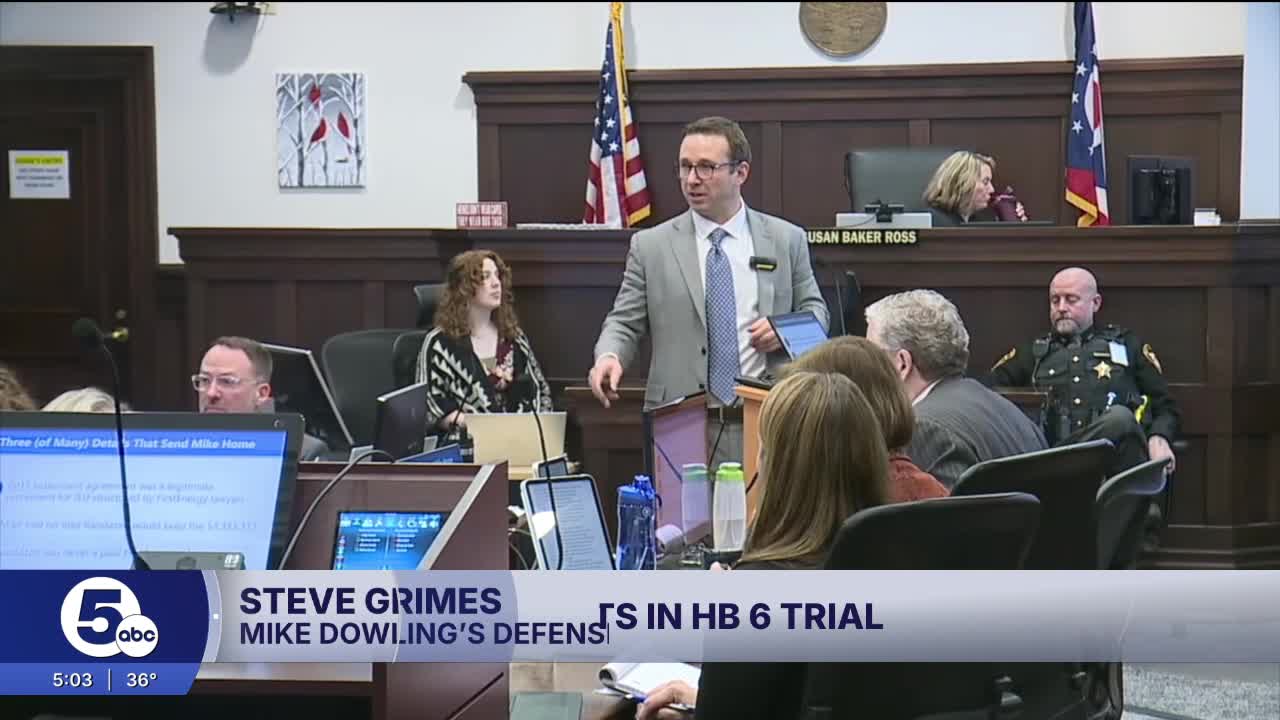
After Meyer finished in the morning, Dowling's attorney Steve Grimes closed his case in the afternoon.
"Everything that Mr. Meyer just suggested to you was not true," Grimes said.
Randazzo, who is now dead, was the corrupt one, not the former executives, he argued.
The former utility regulator, facing dozens of charges in federal and state court, became the second defendant in this scheme to kill himself. He died by suicide in 2024, after his joint arraignment with Jones and Dowling, and after pleading not guilty.
"Mike had no idea that Sam Randazzo was going to keep that $4.3 million; we've seen the extensive evidence of his theft," he continued.
Before Randazzo was the top regulator, he was a consultant for clients who worked with FirstEnergy and wanted to get a better deal from them (he was also a consultant for FirstEnergy, as well). Randazzo ran the books for the Industrial Energy Users-Ohio, a legitimate trade group.
The defense said that FirstEnergy was simply paying the former PUCO chair settlement funds owed to IEU-Ohio clients, but Randazzo stole that money.
Dowling has been misrepresented this entire trial, Grimes said, adding defending why FirstEnergy never disclosed this "side deal" with Randazzo to the PUCO.
"This isn't some big scheme," he said. "This is a complete misunderstanding by the state of Ohio about what was happening here."
It was structured in a "strange" way, so it wouldn’t have to be disclosed in discovery, and thus it could remain confidential, which isn't inherently fraudulent or illegal, Grimes said.
Plus, the executives never even wanted Randazzo in a position of power, showing how they were originally pushing another chair.
"They continued to back [Jason] Rafeld, even though the state says we had Randazzo corrupted," Grimes said. "That doesn't make any sense. If you've got your guy, push for him — or at least don't get in the way."
Prosecutors said when it was clear Randazzo was the top candidate, FirstEnergy moved quickly to back him, but knew they had to pay up.
"Plan B, Plan Bribe," Meyer said.
What's next
Jones's attorney, Carole Rendon, will finish her case on Tuesday morning. After that, Meyer will get time for a rebuttal.
More jury instructions will take place, but the fate of the men will start being deliberated that afternoon.
The jury will go into deliberation without key pieces of evidence that could bolster the prosecution's case, ones that weren't allowed to be brought up during the trial. Not only were they not told that FirstEnergy, as a company, already admitted to this bribery, but they weren't informed that former Ohio House Speaker Larry Householder is currently sitting in prison due to accepting FirstEnergy's bribes.
Even if Jones and Dowling are found not guilty in the state case, they still have federal racketeering charges to face revolving around the $61 million given to Householder.
Follow WEWS statehouse reporter Morgan Trau on Twitter and Facebook.
