

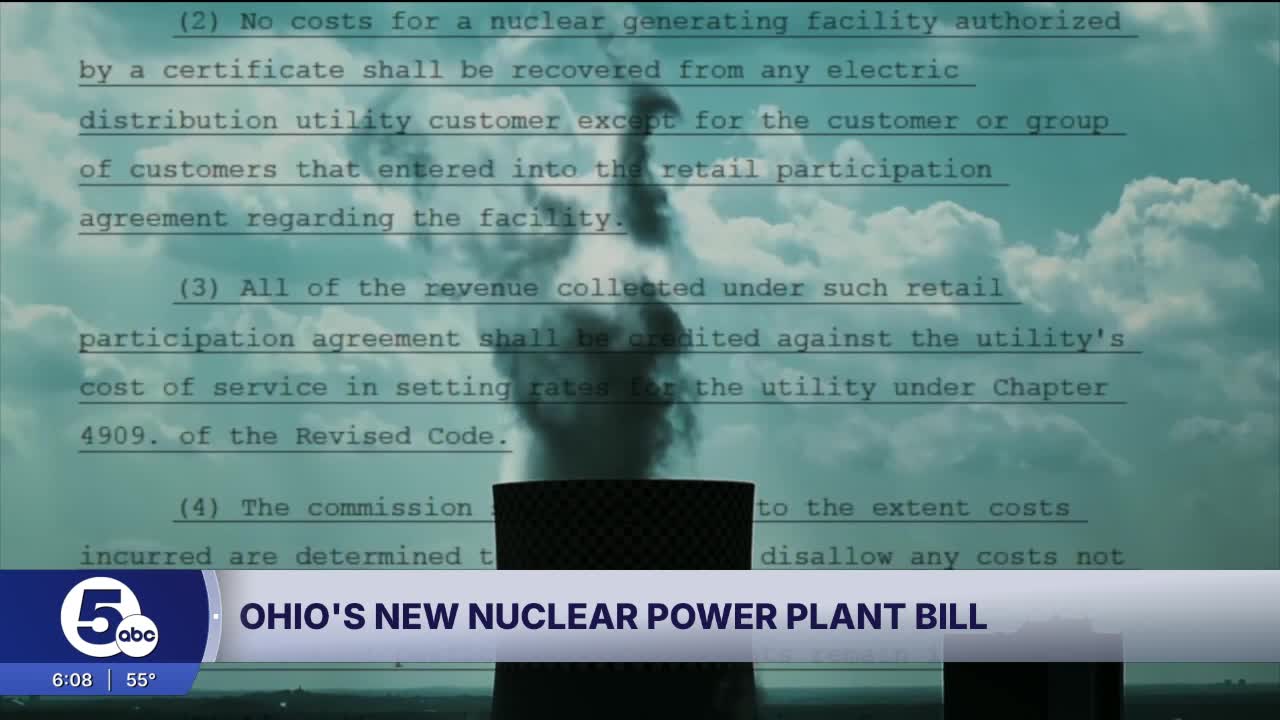


COLUMBUS, Ohio — Ohio is moving to allow electric utilities to own nuclear power, according to a leaked bill draft. The legislation, allegedly co-written by an energy company, surfaced as utility executives are on trial for the largest public corruption scheme in state history.
Ohio electric customers have paid for corrupt legislation for years.
"If we're not able to see how the moneyed interests are influencing us, we're just going to keep being ripped off," Catherine Turcer, a government watchdog with Common Cause Ohio, said.
Turcer points to the legacy of House Bill 6. Former FirstEnergy executives are currently on trial due to their $65 million scheme to pass House Bill 6, which provided a billion-dollar bailout for their struggling nuclear facilities. They passed this legislation at the expense of ratepayers, hiking their utility prices.
Although FirstEnergy was the main beneficiary, American Electric Power (AEP) also benefited.
Last year, the company was fined $19 million for its role in the scheme, one that took place behind closed doors and within secret dark money PACs — funds that don’t need to disclose who donated to them.
"If we don't have more transparency, we're just going to have an ongoing cycle of different corruption scandals," Turcer said.
While the trial is happening, I was leaked a draft of new legislation which would allow electric utilities, like FirstEnergy and AEP, to own nuclear plants.
Although there is no indication of this online or on the bill, I learned that state Rep. Adam Mathews (R-Lebanon) is the soon-to-be sponsor.
"We need to allow more players in the field to make sure that ratepayers are protected as generation comes online," Mathews, a former nuclear engineer, said in an interview.
Ohio is close to an energy deficit, he said. Under the draft, nuclear plants could be built on brownfields and former coal mine sites. The facilities would also get a streamlined regulatory approval process.
The legislation also declares nuclear energy as a priority for the state.
"Nuclear power is one of the greenest, most efficient forms of power," Mathews said, noting that it doesn't have the same emissions that fossil fuels do. "It's incredibly safe, and it is a way that Ohio really should be powering the next generation."
Mathews repeatedly emphasized how he wants to protect the consumers, but one of the utility companies isn't helping with optics.
AEP's input
AEP's lobbyists have been less than secretive about their role in the bill.
"Why is AEP telling people that they wrote this bill?" I asked Mathews, who took a pause to think.
"Any bill that's gonna come out is going to be written by LSC," he said, referencing the nonpartisan Legislative Service Commission that helps lawmakers draft their bills. "We are working to make sure that what is finally introduced has total practice and guardrails for the ratepayers."
Mathews, who has not been attached to any prior Statehouse scandals, said he has been taking lots of meetings.
"We have been talking to a lot of resources, whether that's stand-alone people or others, and really appreciate all the resources that have come with that type of knowledge," the lawmaker said.
In a long statement, a spokesperson for AEP defended the company when I asked if it was ethical for them to be writing legislation that could directly benefit them.
"We provide technical information to policymakers when asked, which is standard practice," the email said, in part. "Any legislation will move through the full public process, where all stakeholders can weigh in."
I also obtained an AEP-written document that explains what the bill does, where it says "all project costs are paid by voluntarily participating customers" for the first 20 years.
Data within the document file showed it was written by one of AEP's lobbyists.
AEP, in their email statement, continued to discuss how the bill would "make large new users, such as data centers, responsible for the upfront development costs for at least 20 years, with no costs passed on to other customers during that period."
What happens to the customers after that 20-year-period? Well, AEP said that would be "decided in a future public regulatory process."
Still, Turcer believes that AEP could try to push costs onto ratepayers through other avenues, like through bill riders.
"Sadly, the House Bill 6 scandal could be a blueprint for any number of entities to figure out how to work the system and then how to do it legally," she said.
Active nuclear power plants are expected to last between 20 and 40 years, according to the U.S. Department of Energy. However, new data shows that some are able to go up to 80 years. Plants are costly, the nonpartisan think tank Institute for Progress reported, with development being in the billions. Decommissioning those reactors is also expensive, between $500 million and $2 billion for one reactor, the International Atomic Energy Agency reported.
When I asked Mathews why there was a 20-year deadline, he said he wanted to change that.
"Make sure that ratepayers are held harmless and protected, not just for the 20 years, but for the entire of the generation," he said, adding that he would want decommissioning to also fall on the major company that is funding the development of the plants.
Nuclear could help, energy experts on each side of the debate say, but a new policy was just signed into law, Turcer explained.
H.B.15 was debated and passed in mid-2025. It was a major energy overhaul bill that encouraged investment in new power generation, where natural gas won, and companies like AEP and Duke lost.
Up until then, ratepayers had still been paying a subsidy that funded two Ohio Valley Electric Corporation coal plants — one in Southern Ohio and one in Indiana. The main beneficiaries of OVEC were AEP and Duke. Still, FirstEnergy collected payment for it.
H.B. 15 repealed the OVEC subsidies.
Following this, utility companies tried to hike their prices, and are still trying to.
Turcer is skeptical of that, she said, adding that H.B. 15 should get time to play out to see where we stand with needing nuclear.
Money, money, money
Utility companies have routinely donated to PACs, but sometimes, the money is traceable.
Mathews explained that AEP has never donated to him, but through campaign finance reports, we found out that their lobbyists and other electric companies have given him $12,000 since 2022.
AEP has publicly donated more than $420,000 to lawmakers since 2020. In 2025, a non-election year, they donated $60,000, with the majority of the money going to leadership or members of the energy committees.
Duke Energy has been in conversations about the bill. However, their spokesperson declined to comment since the legislation isn't on the floor.
Duke has spent about $400,000 since 2020, with more than $100,000 in 2025. Like AEP, their funds mainly went to leadership and energy committee members.
Although they used to be the big spenders, FirstEnergy has been exiled from the conversation.
"Through this entire process, we have not talked or contacted FirstEnergy whatsoever," Mathews said. "I wanna make sure that this is scandal-proof."
FirstEnergy has become somewhat of a pariah to accept money from, and they haven't donated publicly to a state lawmaker in years, according to their campaign finance filings.
A spokesperson for the company confirmed that they have played no role, adding that "FirstEnergy remains focused on delivering safe, reliable power to the customers and communities we serve."
Transparency
Getting a clear picture of how legislative action may be influenced has gotten harder. In 2025, Ohio lawmakers put even more restrictions on the public when trying to access legislative records.
"Sadly, the lack of transparency sets us up to be taken advantage of," Turcer said.
Mathews said the draft bill is good policy, but it isn't ready yet. I asked him how he can assure consumers that they aren't going to get taken advantage of.
"What we do is have the types of conversations that we're having before introduction, that everyone's at the table to make sure that the ratepayers are protected, and we keep a watchdog eye on this to close any loopholes that may happen," Mathews said.
But all of this makes Turcer wonder.
"Is this the new House Bill 6?" I asked her.
"It could be," she responded.
The legislation is still being worked on — out of the public’s eye.
Follow WEWS statehouse reporter Morgan Trau on Twitter and Facebook.
