

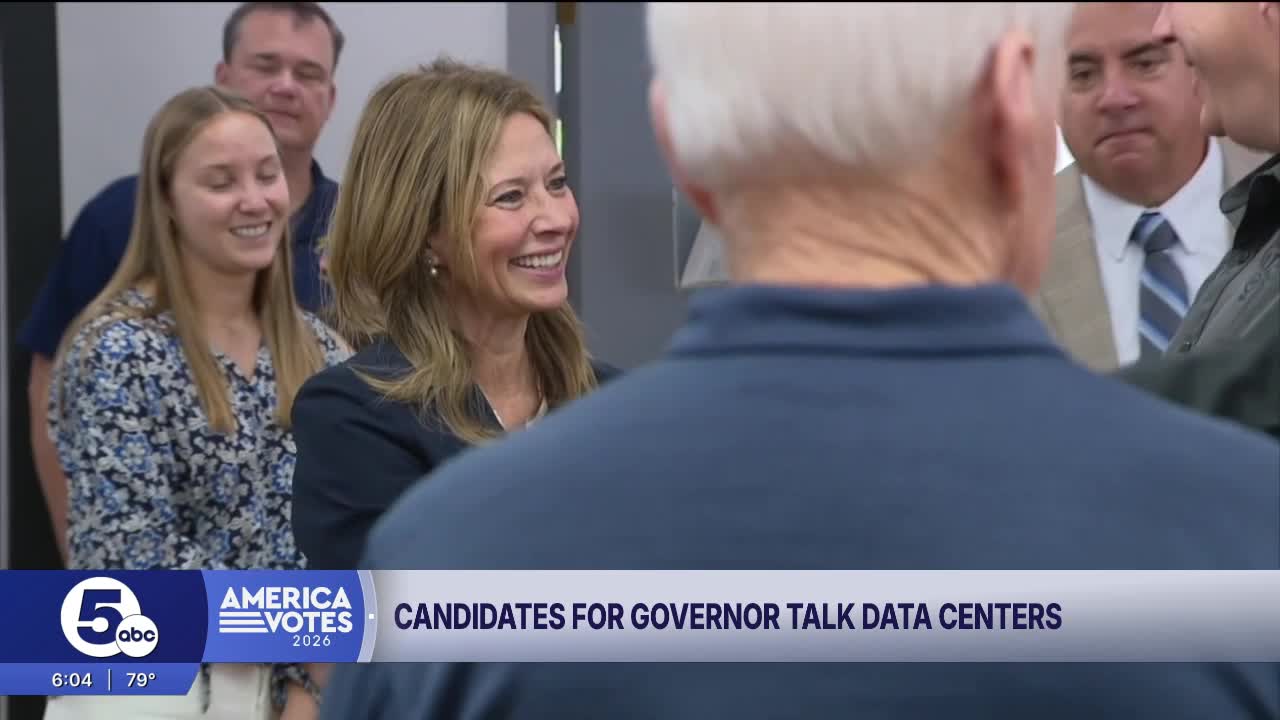


COLUMBUS, Ohio — Each of the candidates for Ohio governor now wants to restrict the data center boom, all proposing some form of moratorium unless certain guidelines are met.
Within two weeks of each other, they announced their proposals. Democrat Amy Acton announced hers in July, Libertarian Don Kissick in August, and several days later, Republican Vivek Ramaswamy unveiled his.
Republican Vivek Ramaswamy
Ramaswamy said the state needs more data centers to store and process data. Previously, he said a total ban would be bad for the economy.
But this week, he laid out an extensive plan to regulate the tech hubs.
"Free electricity for local communities paid for by the data centers combined with lowering property taxes as a condition, I think it's going to be something that sets Ohio up as a national model for how we deal with this issue," Ramaswamy told me Friday.
His plan prohibits new data centers until a list of requirements is met: a company will pay electric bills for the community it is in; new hubs must pay full property taxes, which could provide some relief for homeowners; and there will be strict standards for environmental protection. He also wants to prioritize using brownfields over farmland.
Much of the criticism of data centers centers on energy use and environmental concerns.
"Air and water quality is no worse off, and that we're prioritizing brownfield sites that are abandoned rather than interrupting fertile farmland," Ramaswamy added.
On his first day in office, he said he would sign an executive order immediately halting the approval of any new center until the legislature passes his vision.
RELATED: Data centers have become a political issue. Here's where the gubernatorial candidates stand.
Democrat Amy Acton
Acton announced that she wants a conditional moratorium on data centers.
"We are absolutely open, but we're not for sale," Acton told me Friday. "We have conditions."
To get a data center in the state, the companies would be held liable for all costs associated with their project, must protect the environment, and be transparent about building plans.
"The community should have a lot of say about what comes into their community," Acton said. "That's why we don't think you should be coming in secrecy."
She also would require assurance that the construction jobs will all go to union workers. New data centers would also be required to be built on brownfields and previously developed industrial sites, not farmland.
She also made a requirement for community benefit agreements so that the centers bring something positive to the residents.
Data center opposition is also being fueled by reports that tax breaks handed out by the state have reached $1.6 billion. She wants to rein those in, and would add clawback provisions to protect Ohio taxpayers, she said.
And while she wants to bring down costs, she explained she doesn’t think free electricity can logistically work for everyone.
"I can't speak to no one ever having an electric bill," Acton said. "I think the math doesn't quite add up on that."
Governor's reaction to Ramaswamy and Acton
Gov. Mike DeWine is glad data centers are a focus for the candidates.
"I think everyone agrees with the basic principles, and it's just a question of how you implement it," DeWine told me Friday.
RELATED: Is a data center a blessing or a curse? It depends on the community.
While he hasn’t supported many of Ramaswamy’s other plans, especially those related to taxes and bills, he is interested in the free electricity proposal.
"Electricity to people in that immediate area, that's, I think, a good way to go," he said.
DeWine also encouraged local governments to be more aggressive with data centers, putting conditions on them for local community benefits. Acton had also brought this up.
"I think it would be bad if we said, 'Well, we don't want any data centers,'" DeWine said. "I think that's not helpful to the economic future of the state, but doing it the right way, I think, makes a lot of sense."
Libertarian Don Kissick
Kissick is "against data centers," he said, and announced his version of guidelines in early August.
"Ohioans need room to breathe, and the land rush to stop, until permanent statewide standards are in place," Kissick said in a statement. "The rules should be clear before construction begins, not negotiated project by project."
As broken by us, a new proposal by a business trade group is causing Ohio farmers to fear that the state and utility companies could take private property to build data centers. This idea would also allow entities to take the land before the owner gets paid. Kissick's proposal would ban that.
RELATED: Ohio farmers fear new proposal would allow data centers to take property
Under his policy, there would be no non-disclosure agreements, no special tax incentives for developers, centers would have to generate their own energy, and facilities would have to use closed-loop cooling systems to conserve water.
"If a project cannot succeed without secrecy, eminent domain, taxpayer subsidies, or shifting its infrastructure costs onto Ohio families, then it shouldn't be built here in the first place," Kissick said.
Like Acton, the libertarian also cast doubt on Ramaswamy's proposal for free electricity.
"Ohioans deserve policy, not a sales pitch,” Kissick said.
Current law and failure to meet the finish line
There aren't a ton of guardrails around the developers, citizen-run advocacy groups say. They have been arguing at the Statehouse for months.
RELATED: Ohio lawmakers unveil data center regulations
Legislation was proposed to create new rules and standards for data centers, but lawmakers were unable to pass it.
H.B. 646 limited the size of new sales tax breaks for projects. Currently at 100%, it would go down to 50%.
"We don't think we should be granting tax exemptions to multi-billion dollar corporations, especially when many of them are already coming here to build these data centers anyway, because of the contract that was entered into several years ago," House Speaker Matt Huffman (R-Lima) said, referencing a popular sentiment from his caucus.
One of the major complaints from environmental groups was the water usage. The bill requires that facilities utilize a closed-loop water system or use “best practices for water conservation and efficiency.”
Additionally, data centers are required to report any "anomalies" detected by their water-quality monitoring systems.
Another big topic is transparency, and companies asking public officials to sign non-disclosure agreements. It didn't do anything major to tackle that.
One of the provisions that everyone seemed to like was a regulation that created an electric rate class for data centers, trying to ensure that the cost of generation, transmission and distribution is paid by the companies.
Whichever candidate wins the governor's race, they will still need the help of the lawmakers to accomplish their plans.
Follow Statehouse and Columbus bureau reporter Morgan Trau on X, Instagram and Facebook. Email her at Morgan.Trau@wews.com.
