



CINCINNATI — In the wake of the Catholic Church abuse scandal in 2002, roughly 400 people in Southwest Ohio came forward to report being sexually molested by priests during their childhood.
Almost 200 of them filed lawsuits, mostly in Hamilton County, but judges dismissed them one by one, without anyone coming to the courthouse or any evidence being presented, because according to state law, they were simply too old to proceed.
But their resurrection may be coming.
Ohio Sen. Bill Blessing announced last week that he will sponsor legislation to remove the criminal and civil statute of limitations in childhood sexual abuse cases and open a lookback window for victims to revive cases from decades ago.
WATCH: How abuse survivors may get a day in court
“I’ve seen really small monetary settlements have a tremendous healing effect,” said attorney Konrad Kircher, who filed 25 lawsuits on behalf of clergy abuse victims between 2002 and 2005, at the height of the scandal.
When asked if these survivors, who never got a day in court, would want to revive their old cases if the law were changed in Ohio, Kircher firmly responded, “Yes.”

Nearly 40 Catholic dioceses have sought bankruptcy protection from the costs of lawsuits and settlements triggered by states passing similar revival windows for abuse survivors.
“And not a single one of them is out of business; it’s just a way to marshal their assets and insurance claims. They have insurance,” Kircher said.
Blessing predicted that his bill would encounter strong resistance from the Catholic Church, because historically their lobby has been powerful and well-funded.
“What are we saying here? That justice cannot be done because somebody might go bankrupt or might lose money?” Blessing asked. “I’d like to think most people would view that as not the best reason to avoid reform.”

The bill is currently being drafted, and Blessing, a Republican, is expected to introduce it this fall during the shortened lame duck session, and again in early 2027 if necessary.
The legislation faces an uncertain future, despite Blessing’s optimism. Many Democrats have introduced similar bills during the past decade, but they stalled.
The last serious attempt to create a lookback window in Ohio occurred in 2005 and 2006, a few years after the Archdiocese of Cincinnati became the first in the nation to be criminally convicted for failing to report abusive priests.
It unleashed fierce lobbying by the Catholic Church and a lawsuit over an alleged backroom deal at the statehouse to strip the lookback window from the bill before the vote.
“I know they were targeting Catholic legislators … and so I was an obvious target of the archbishop and the Catholic lobby,” former Ohio Rep. Steve Driehaus said. “There was a lot of pressure being placed on us.”
Driehaus, a Democrat, was in the Ohio House of Representatives in 2006 when it took up that bill, which had unanimously passed the state Senate a year earlier. The most controversial aspect was a one-year lookback window that would have allowed survivors to revive their time-barred lawsuits against abusers and the church.

I remember this being a very heated debate in Columbus when it came forward, and there was a lot of lobbying certainly on behalf of the church … trying to influence the outcome,” Driehaus said. “From the church’s standpoint, clearly, they were more concerned about bankrupting the church. They were concerned about financial settlements.”
Driehaus, who is Catholic, represented the heavily Catholic District 31 on the west side of Cincinnati.
“I got a call from the archbishop, and the archbishop wanted to meet me and share his perspective on this legislation,” Driehaus said. “I remember this because he wanted to meet me at the archdiocese in his office and I said, ‘No thank you, I’m not going to meet in your office.’”

Instead, Driehaus met then-Archbishop Daniel Pilarczyk, who died in 2020, at his alma mater, an all-boys Catholic high school on the west side.
“I said we can meet there and we talk about who some of the perpetrators were and how you protected them, and I can talk about some of my classmates who were the victims,” Driehaus said.
Driehaus remembered their conversation did not end well.
“I said, you know my understanding of the church, my relationship with Jesus, is that if Jesus were here, if Jesus were embodied in the Catholic Church, he would fall on his knees and embrace the victims, and protect the victims, and what you the archbishop, are doing is exactly the opposite. You’re protecting the perpetrators. You’re protecting the abusers. Which is exactly the opposite of what I know Jesus would do,” Driehaus said.

"And he said we’ll agree to disagree, and I’m like no, there’s no agreement to disagree, we disagree, and we disagreed very strongly,” Driehaus said. “And it was very clear that the archbishop was protecting the financial interest of the church.”
Other Catholic lawmakers who spoke at the Ohio House of Representatives on March 29, 2006, also said they had been contacted by Catholic leaders.
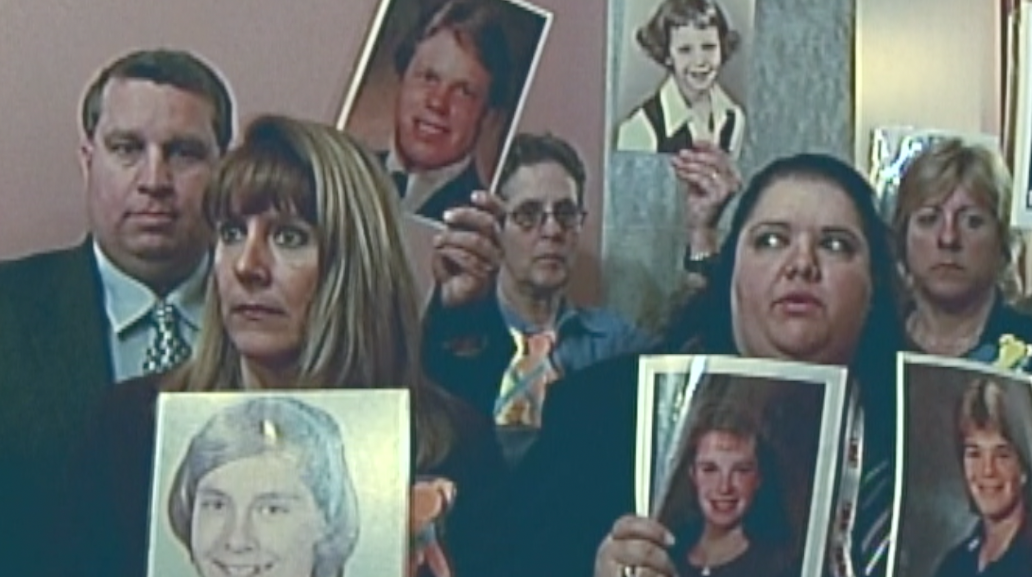
Meanwhile, survivors stood in the hallways of the statehouse holding photos of themselves as children.
Just before the vote, Republican lawmakers amended the bill and stripped out the lookback window and instead created a civil registry for sexual offenders. The bill overwhelmingly passed.
“All of the survivors had been to the statehouse so many times to personally talk to their representatives, and we expected that bill to be passed that day in the form that passed the Senate,” Kircher said. “It was just a dirty trick that happened in the committee room right before the vote.”

Kircher filed a lawsuit in 2006, on behalf of survivors, accusing some lawmakers, including then Speaker of the House Jon Husted and then Assistant Majority Whip Rep. Bill Seitz, of violating the Ohio Open Meetings Act by changing the bill in a closed-door meeting ahead of the vote. The lawsuit sought to stop the legislation from becoming law.
But a magistrate, and later the Ohio 10th District Court of Appeals, sided with lawmakers, citing insufficient evidence.
Soon after it passed, a judge found the childhood sexual abuse civil registry unconstitutional. It was revised in 2024 but is still not being used. Advocates believe it isn’t used because it usually requires victims to hire an attorney to sue their abuser, just to add their name to a list.

"That registry, I’d be interested to know why it hasn’t been used,” Seitz said. “Do you think it’s because these people really want money after all? … I have to wonder if they have an avenue to out the sexual offender regardless of the passage of the statute of limitations; well, why wouldn’t this registry work?”
Seitz retired at the end of his 2024 term, after 24 years at the statehouse. He now works as a lobbyist and lawyer for Dinsmore & Shohl, which represented the Archdiocese of Cincinnati in cases of alleged sexual abuse by clergy.
However, Seitz, who is not Catholic, worked for the Taft law firm until the end of 2014, when Dinsmore did most of that work and when the statute of reform bill was being debated.
"I have never billed a tenth of an hour to the archdiocese, never done any work for them, never worked on any of their cases,” Seitz said. “But we do represent them, the firm does, but I don’t.”

Seitz blocked statute of limitations reform at the statehouse for years, believing strongly that it was unfair to force institutions to defend themselves 30 to 40 years after abuse happened.
“It’s a matter of fairness to the defense, and particularly in this context, because the institution that hired or failed to adequately supervise the offender. They did not commit any sexual abuse whatsoever,” Seitz said.
But he did relent somewhat during his final years in office.
Seitz co-sponsored the “Scout’s Honor” bill in 2023. It opened a five-year window for the limited purpose of allowing Ohioans to receive bigger payments from a national sex abuse settlement with the Boy Scouts of America.
Seitz and Rep. Cindy Abrams also sponsored a bill to criminalize the grooming of a child for sexual abuse, which Gov. Mike DeWine signed into law in 2025.
Seitz is unsure how Blessing’s bill will do in the legislature, without him there. But retirement hasn’t changed his views on statute of limitations reform.
“Is there really a good purpose served by taking these venerable institutions that have done so much good in these communities and bankrupting them? I don’t think so,” Seitz said.
While Driehaus is happy that Blessing is introducing the statute of limitations reform, he is uncertain how it will fare at the statehouse.
“It will be interesting to see the appetite in Columbus for this legislation, and whether or not it will even be brought forward,” Driehaus said.
While the 2006 law increased the statute of limitations in child sex abuse cases to age 30 in criminal cases, and to age 43 for lawsuits, advocates say Ohio is still one of the worst laws in the nation, because most states have abolished time limits for all or some of these crimes.
Kircher doesn’t believe the Catholic Church lobby is as strong as it was 20 years ago, despite still being well-funded, so perhaps the bill will have a better chance of passing.
“I don’t think they have the credibility they used to have,” Kircher said. “Now I think people realize the Catholic Church has done a lot wrong and maybe they aren’t advocating in the best interest of everyone; they’re advocating in their own best interest, they’re still trying to protect the church.”
Meanwhile, a spokesperson for the Catholic Conference of Ohio, which lobbies for dioceses statewide, could not comment or take a position on Blessing’s proposed bill because it had not been introduced, but noted the church “does not oppose all reform efforts on this issue.”
