



SPRING GROVE VILLAGE, Ohio — A few days before we meet for the first time, Jaz Herbers sends me a text.
Touch you soon!!
It wasn't a typo.
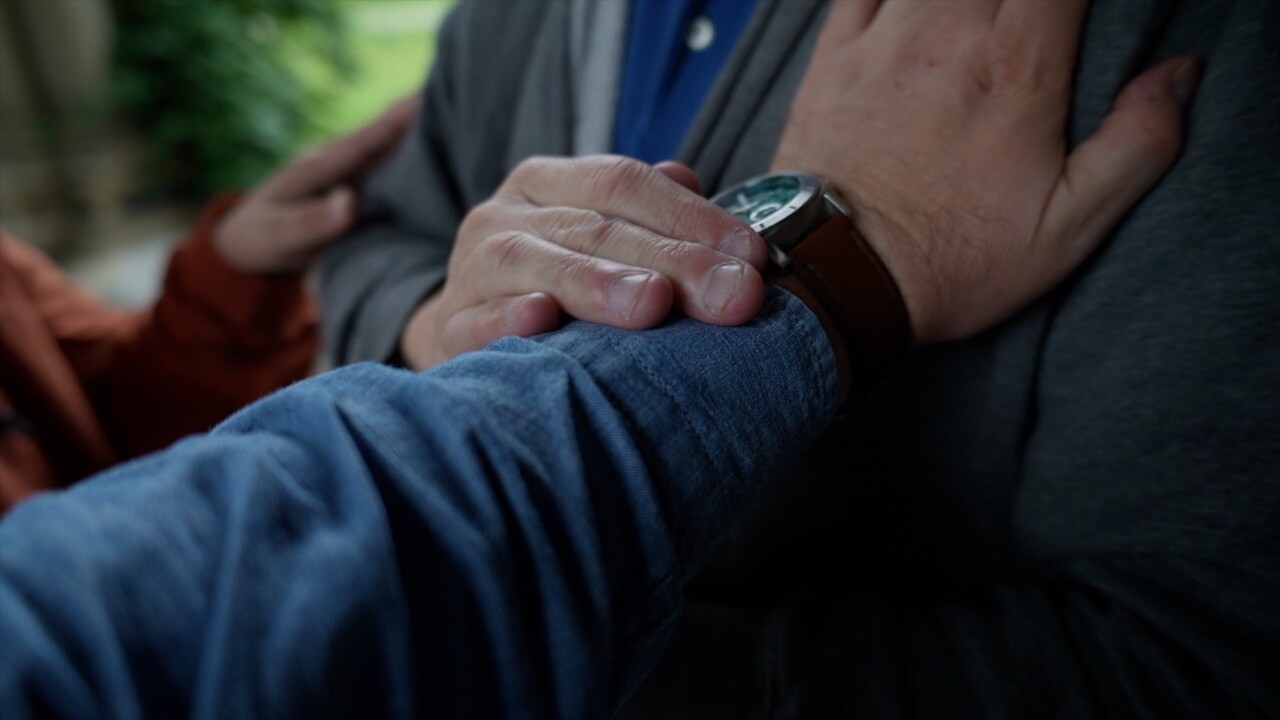
Because when we meet in the lobby at Spring Grove Cemetery, Herbers shakes my hand. Then, he touches my glasses and places my hand on his shoulder. Through an interpreter, he asks a question.
“Where’s the camera?”
He wants to show me how he prefers to communicate, and he wants to make sure the camera catches it. Because he can't see where it is.
"If we're talking, keep your hand on my shoulder," Herbers said. “And if you’re following me, I want you to tap."
He tells me I can squeeze him if I connect to what he’s saying, or I can draw a smiley face if I feel happy. Quick scrunchy finger movements mean laughter and taps offer acknowledgment.
I draw a frown on his shoulder when he says people like him are often isolated.
“We don’t need pity because we’re deafblind. We don’t want that,” Herbers said. “Deafblind people are still people.”
Herbers was born with hearing loss and read lips for much of his childhood. He learned American Sign Language in high school. Then, when he was a professor at Cincinnati State Technical College, he lost his vision and had to learn how to communicate all over again.
See how he does it in the video below:
“Growing up, everything is based on the sighted world,” Herbers said. “With protactile, that is based on feeling. Not sight.”
He's telling me about protactile communication, sometimes called PT. It's a relatively new way to communicate created by deafblind people. It focuses on sensory touch, not just using ASL into someone’s hand.
“I have experienced what it feels like to be deafblind without PT,” Herbers said. “And that is not a good feeling.”
It’s why we’re walking through the cemetery, one of Cincinnati's most beautiful landmarks, where a former student helps interpret for him — both what I'm saying and the 750 acres of land around him.
Tori McCarthy wanted to be a nurse, but quickly took another path after her first chemistry class. McCarthy is now an ASL interpreter and what’s called a co-navigator for people who are deafblind.
She recruited Herbers to help her with an event at Spring Grove Cemetery, one she hopes will bring people like Herbers together.
"Deafblind people don't have community naturally around them," McCarthy said. "It's definitely made me focus on the accessibility of our world."
McCarthy walks with Herbers to a garden, where the director of horticulture clips off a flower for him to smell. On the way there, he moves his cane along the ground and holds McCarthy's hand.
“She is giving me information on my hand, telling me there is a pond or a bank on one side,” Herbers said.
He grabs my hand and shows me.
“I’m trying to teach people — deafblind people — how to get their autonomy back,” Herbers said.
By the time this article is published, he's in Oregon doing just that — teaching deafblind students how to communicate like him. In the cemetery, he apologizes for cursing when talking about how important it is for him.
Then, he curses again.
“I enjoy my life,” Herbers said. “And I want to show them that you can enjoy your life, too.”
Event details
For more information about the event at Spring Grove Cemetery, click on this link.
June 14
10:30 a.m. - 3 p.m.
Spring Grove Funeral Home Event Center
4389 Spring Grove Ave.
Cincinnati, Ohio
