

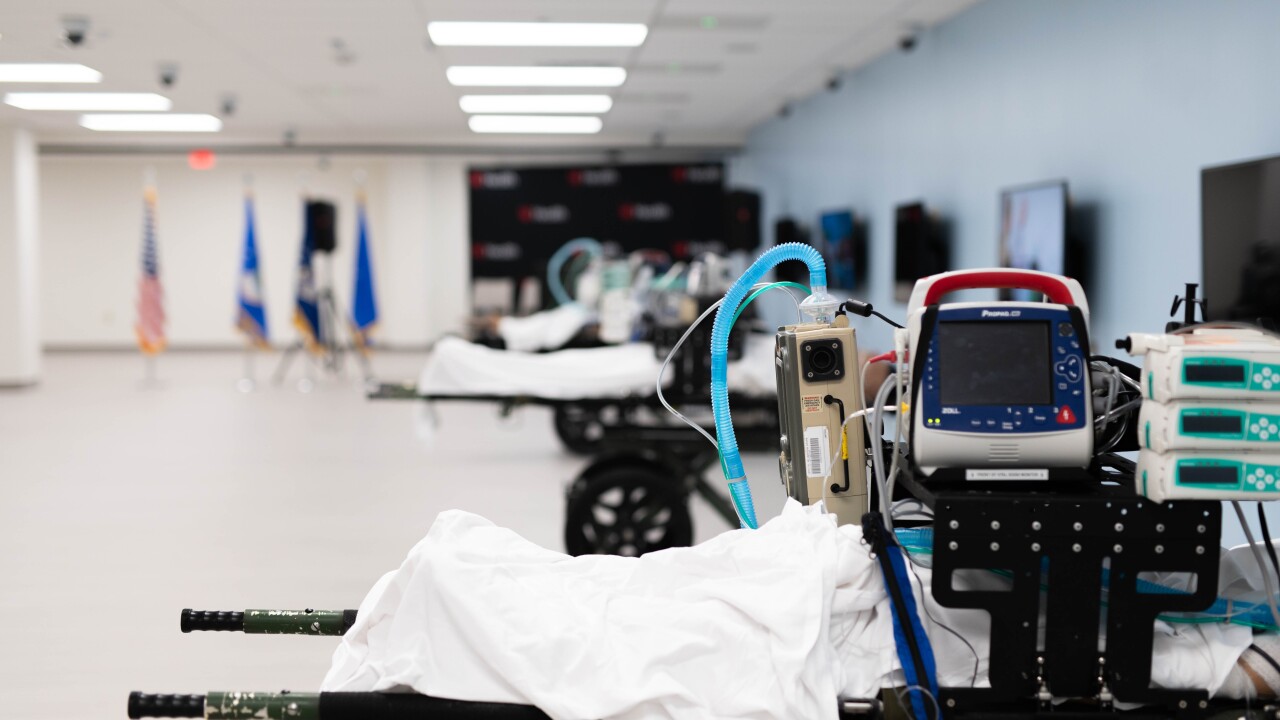



CINCINNATI — A training program in Cincinnati is preparing military medical teams for one of the most demanding assignments in the U.S. Air Force — caring for critically ill patients in the back of a military aircraft, sometimes 30,000 feet above the ocean.
C-STAR Cincinnati is a critical care air transport training platform and a partnership between the U.S. Air Force and UC Health. The program trains teams of doctors, nurses and respiratory therapists to do a job that comes with strict requirements: it is the only course in the U.S. Air Force that students must pass before they can perform the mission.
The program recently moved into a new, larger simulation center equipped with high-fidelity patient simulators and a control room where instructors watch and grade students in real time.
WATCH: Get an inside look at C-STAR Cincinnati's new training facility
Air Force Col. Valerie Sams, the director of C-STAR Cincinnati, said students arrive at the program as trained specialists — but the course pushes them into an entirely new environment.
"They've got to bring that skill set into this operational environment where the resources might be limited. They're doing it in the back of an aircraft, very noisy," Sams said.
Resources are limited in that environment, and there is no calling in a consultant or getting extra hands. It is just the team.
The two-week course begins by building familiarity with the space, the equipment and the mission. In the second week, students are tested every day in validation simulations. Sams said watching teams improve day by day is one of the most rewarding parts of the program.
The partnership with UC Health is central to how the program operates.
"I just don't think we could do this any other way," Sams said.
She said the collaboration also benefits the instructors themselves.
"Our instructors, you know, are all active-duty instructors, and they really are able to maintain their own skill set to be proficient in critical care and proficient in this job set so that when they come to teach, they are at the highest level," Sams said.
The new facility allows C-STAR to train bigger teams, handle sicker patients and expand the course — all under one roof.
This story was reported on-air by a journalist and has been converted to this platform with the assistance of AI. Our editorial team verifies all reporting on all platforms for fairness and accuracy.
