



CINCINNATI — Standing by a large window, Reilly Dolan looks at the photo. It's the only one from this session, and it can't be edited.
At first, you can’t see anything other than the large plate of glass it's being developed on.
“Oh my gosh, that’s so cool,” Dolan said. “I have no idea what’s going on, but I love it.”
This particular picture is called an ambrotype. It's one of the oldest forms of photography in the world.
And a Cincinnati artist is trying to bring it back.
WATCH: Go inside a tintype photography studio
“It’s a whole dance,” said Alex Lippert, a photographer with Blue Creek Tinworks. “We never know exactly what we’re going to capture.”
After taking a picture, Lippert tells me a lot of people want to watch how it works. Her Instagram is full of examples. In a dark room, she pours a liquid developer onto a tin piece of glass. An image slowly begins to appear.
Dolan takes out a phone and records it.
Lippert always wanted to be an artist — she even once drew caricatures at Kings Island — but tells me she talked herself out of it as a career. She eventually got her master’s degree and worked in pharmaceutical research.
She gave it all up to do this.
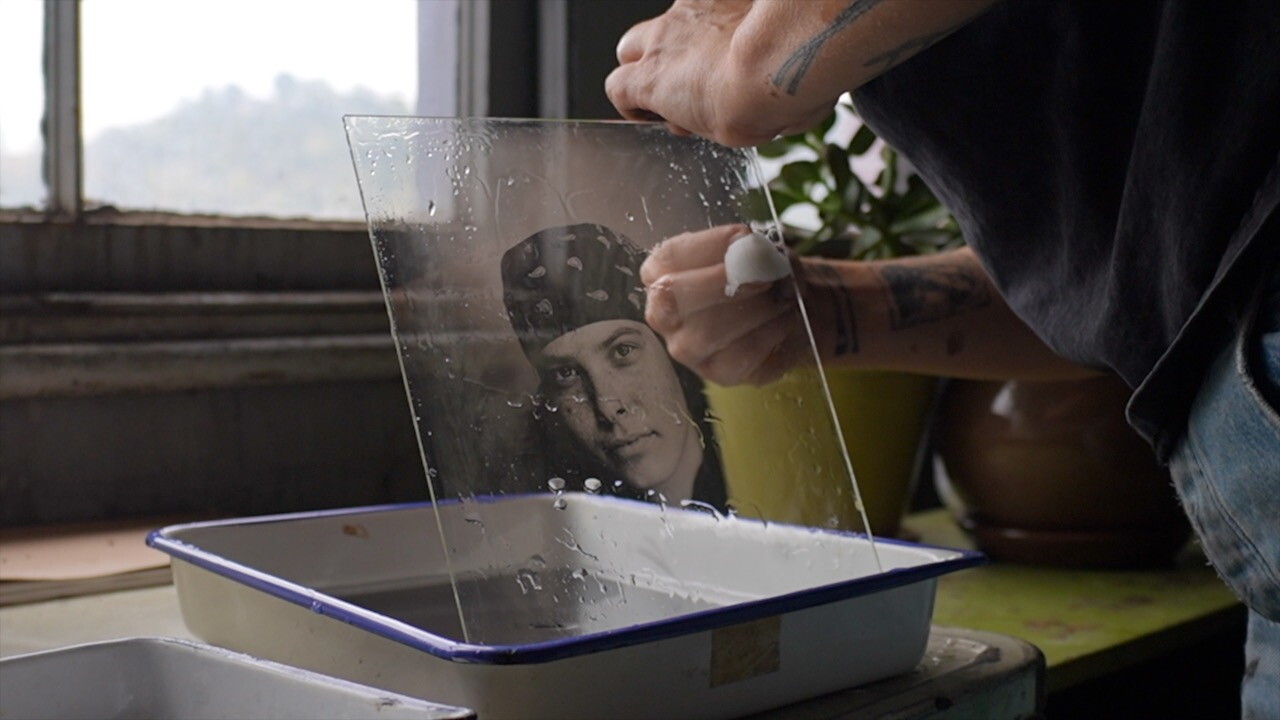
Lippert is a tintype photographer, creating photos that can't be edited, but will last for decades.
“It will survive a flood,” Lippert said. “What I’m giving people is an heirloom, that gets to be passed down and passed down and passed down.”
Lippert shows me a few examples in her studio. Pictures taken more than 100 years ago. Pictures that she says clearly weren't taken care of well. But pictures that are still in her hand today all the same.
When she started learning how to do this, Lippert thought it would just be a hobby. Now, she's part of a resurgence in this type of photography — and her work is part of an exhibit at the Cincinnati Art Club.
But for Lippert, this isn’t just about nostalgia. It’s about taking pictures of people who might not have had their pictures taken back when this type of photography was popular.
“While I’m not telling their stories, I get — through tintype — to document them in a place and time that, historically, they were not allowed to be documented in,” Lippert said. “And I think that is every photographer’s duty in a way. To make sure we’re documenting everyone.”
After emerging from the dark room, Dolan smiles.
“With an iPhone picture, I look at it and I’m like, ‘I guess that’s kind of me,’” Dolan said. “But when I see that picture, I’m like, ‘that is me! That’s a picture of me.’”
They laugh. Because even though Dolan watched the process, they still don’t completely understand it.
But they know how it makes them feel.
“I can’t even explain the happiness that it brings me to look at myself — looking like a lesbian,” Dolan said through more laughter. “So happy.”
Want to see more pictures?
Lippert is part of an exhibit that can be viewed through Saturday, Oct. 31 at the Cincinnati Art Club. For more information, click on this link.
