

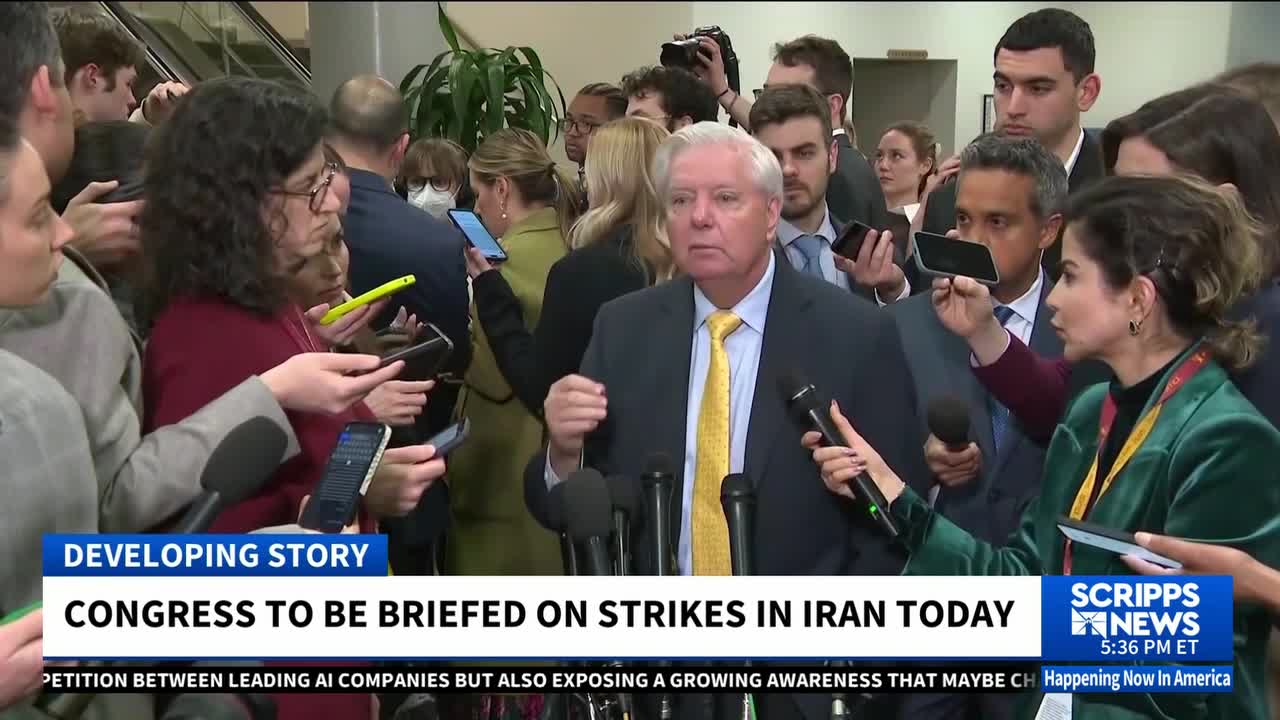


Tensions flared as questions mounted at the U.S. Capitol on Tuesday over the Trump administration’s shifting rationale for war with Iran as lawmakers demand answers over the strategy, exit plan and costs to Americans in lives and dollars in what is quickly becoming a widening Middle East conflict.
Trump officials arrived at the Capitol for a second day of closed-door briefings, this time with all members of the House and Senate as the administration tries to stave off a looming war powers resolution vote intended to restrict Trump’s ability to continue the joint U.S.-Israel campaign against Iran.
"The president determined we were not going to get hit first. It’s that simple,” Secretary of State Marco Rubio said in a testy exchange with reporters at the Capitol.
RELATED STORY | Rubio walks back claim that US strikes on Iran were influenced by Israel
Rubio pushed back on his own suggestion a day earlier that Trump decided to strike Iran because Israel was ready to act first. Instead, he said Trump made the decision to attack this past weekend because it presented a unique opportunity with maximum chance for success.
“There is no way in the world that this terroristic regime was going to get nuclear weapons, not under Donald Trump’s watch," he said.
The sudden pivot to a U.S. wartime footing has disrupted the political and policy agenda on Capitol Hill and raised uneasy questions about the risks ahead for a prolonged conflict and regime change after the killing of Iran's Supreme Leader Ayatollah Ali Khamenei. At least six U.S. military service personnel have died so far.
The turn of events has intensified the push in Congress for the war powers resolution — among the most consequential votes a lawmaker can take, with the war well underway — as administration officials are telling lawmakers it will need supplemental funds to pay for the conflict. It comes at the start of a highly competitive midterm election season that will test Trump's slim GOP control of Congress.
Senate Democratic Leader Chuck Schumer left the closed hearing said he was concerned of “mission creep” in a long war.
Senators demand answers, and some cheer Trump on
Senators spent the morning grilling Trump officials during an Armed Services Committee hearing over Rubio’s claim Monday that the president, believing that Israel was ready to act, decided it was better for the U.S. to launch a preemptive strike to prevent Iran's potential retaliation on American military bases and interests abroad.
RELATED STORY | Trump suggests 'somebody from within' Iranian regime could succeed Khamenei
Sen. Angus King, the independent from Maine, said it’s “very disturbing” that Trump took the U.S. to war because Israel’s Prime Minister Benjamin Netanyahu wanted to bomb Iran. Past U.S. presidents, he said, “have consistently said, ‘No.’”
Defense official Elbridge Colby told senators the president directed the military campaign to destroy Iranian missiles and deny the country nuclear weapons.
Trump himself disputed the idea that Israel had forced his hand. In his own Oval Office remarks, he said, "I might might have forced their hand.”
Sen. Markwayne Mullin, a Trump ally from Oklahoma, said the president “did the world a favor.”
“How about we say, ‘Thank you, Mr. President, for finally getting rid of this nuisance,’” he said.
But Sen. Elizabeth Warren, D-Mass., demanded to know how this fits into Trump’s “America First” campaign promise not to commit U.S. troops to protracted military campaigns abroad.
Trump has suggested the war could drag on, and has not ruled out sending American troops into Iran.
“’America First’ and ‘peace through strength’ are served by rolling back — as the military campaign is designed to do — the threats posed,” Colby responded. “This is certainly not nation-building. This is not going to be endless.”
What’s next for the Iranian regime and its people
Questions are growing over who will lead Iran after the death of Khamenei, who has ruled the country for decades, as are worries of a leadership vacuum that creates unrest.
Democrats warned against sending U.S. military troops into Iran after more than two decades of war in Iraq and Afghanistan in the aftermath of the Sept. 11, 2001, attacks.
“I am more fearful than ever we may be putting boots on the ground,” said Sen. Richard Blumenthal, D-Conn., after the closed briefing.
“The reason why there’s so much consternation on our side is because President Trump has not given us a clear reason why he is in Iran,” said Sen. Kirsten Gillibrand, D-N.Y. “If he wants to declare war on Iran, that is the job and responsibility of Congress under the Constitution.”
Republicans insist it’s not for the Americans to decide the future of Iran.
“That's going to be largely up to the Iranian people,” said Senate Majority Leader John Thune, a Republican.
Sen. Tom Cotton, the GOP chairman of the Senate Intelligence Committee, pointed to the aftermath of the U.S. attacks on Venezuela in January that ousted President Nicholas Maduro and elevated his vice president, Delcy Rodriguez, to power.
Cotton said on CBS over the weekend that he imagines “some leaders inside of Iran who might be jockeying to audition for the role of Iran’s Delcy Rodriguez.”
Trump, in calling for Iranians to use this opportunity to take back their country, has acknowledged the uncertainty.
“Most of the people we had in mind are dead,” Trump said Tuesday. He also panned the idea of elevating Reza Pahlavi, the exiled crown prince of Iran’s last shah, to take over in Iran.
Sen. Lindsey Graham, a Trump confidante, said over the weekend, “It’s about the threats, not about who’s in charge. If the next group in Iran continues to threaten America, they will meet the same fate.”
War powers resolutions become a consequential vote
Both the House and Senate are preparing to vote on war powers resolutions that would restrain Trump's ability to continue waging war on Iran without approval from Congress.
Under the U.S. Constitution, it's up to Congress, not the president, to decide when the country goes to war. But lawmakers often shirk that duty, enabling the executive branch to amass more power to send the military into combat without congressional approval.
“Why are we spending billions of dollars to bomb Iran?” said House Democratic Leader Hakeem Jeffries, who said there would be strong support from Democrats for the resolution.
But House Speaker Mike Johnson has said it would be “frightening” to tie the president's hands at this time, when the U.S. is already engaged in combat.
Other lawmakers have suggested that if Congress does not vote to restrain Trump, it should next consider an Authorization of the Use of Military Force, which would require lawmakers to go on record with affirmative support for the Iran operation.
Former President George W. Bush sought, and received, authorization from Congress to launch the post-9/11 wars.
