

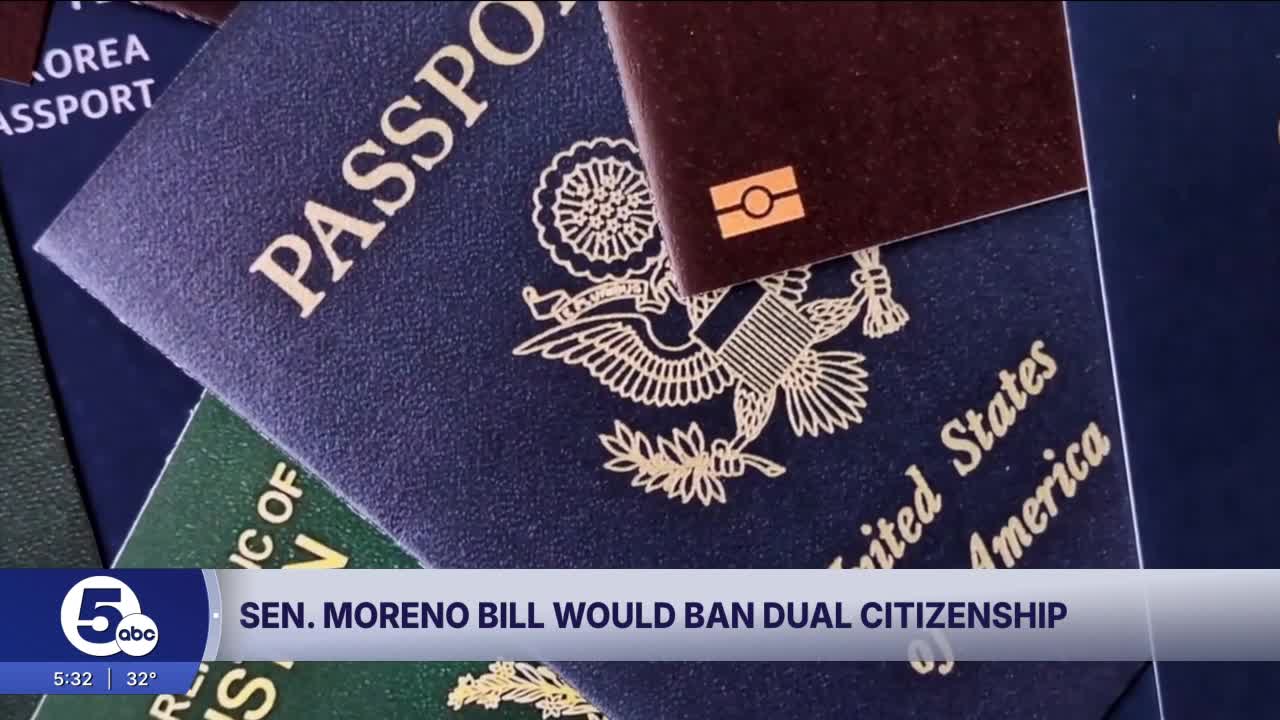


Ohio's Republican U.S. Senator Bernie Moreno wants to ban dual citizenship, arguing that it could raise questions about where someone's loyalty lies. One triple citizen disagreed, warning that this would be a mistake.
The United States of America is often called a melting pot of culture and ideas. Dr. Brian Edmiston said it's for good reason.
"You've got people who have experience from other countries who can compare," Edmiston said.
Born in Northern Ireland, he automatically gained dual citizenship with the United Kingdom and the Republic of Ireland. But he emigrated to the United States in the 1980s and became a U.S. citizen two decades ago. Now, the triple citizen is a professor at The Ohio State University.
"I wanted to be fully participant in the work of living in this country," Edmiston said. "I have family who live in Britain, I have family in Ireland, and I go back and forth between both countries."
IN OTHER NEWS | Birthright citizenship in question as Supreme Court takes up Trump’s case
Does he consider himself an American?
"Yes, definitely," he responded. "I consider myself an American because I pledged allegiance to the U.S. Constitution and was very pleased to do that."
But if Edmiston is so pleased to be a citizen of the U.S., Ohio College Republican leader Gabe Guidarini said he and other dual citizens should prove their allegiance.
"If you're an American, you're an American citizen — you're only an American citizen," Guidarini said.
A First Hand Look At The U S Citizenship Process:
He is supporting Moreno's new legislation. The Colombian-born lawmaker introduced a bill that would outlaw dual citizenship.
"If you're going to come to this country and use our resources and seek the American dream, then that has to be a full-term commitment to the American dream," Guidarini said. "Otherwise, how can we trust you?"
The college student said dual citizens should denounce their other citizenships, just like Moreno did when he became a U.S. citizen at 18.
“Existing law allows certain United States citizens to maintain foreign citizenship, which may create conflicts of interest and divided loyalties,” the legislation states. “It is in the national interest of the United States to ensure that United States citizenship is held exclusively.”
The senator was unavailable for an interview, but provided a statement:
“It was an honor to pledge an Oath of Allegiance to the United States of America and ONLY to the United States of America!" Moreno said. "Being an American citizen is an honor and a privilege—and if you want to be an American, it’s all or nothing. It’s time to end dual citizenship for good.”
RELATED NEWS | Trump shows off $5M 'gold card' that provides path to citizenship for foreigners
Guidarini argued that dual citizens "exploit" the system by spending money in their other country.
"It's not about policing people's money, it's about making sure that America is the sole commitment," he responded.
He said that if it's just transactional, like a business from China investing in the U.S., that is different than a dual citizen taking money earned from their job and sending it to relatives out of the country.
When asked if he had seen dual citizens exploiting the system, he responded that college students with visas — a temporary pass to stay in the U.S. and not full citizenship — will get a local job and not participate in the American economy.
"I think that there should be a bare minimum commitment here to where, if you're coming to America, if you're using our services, if you're using our taxpayer dollars... your financial advancement should also be for the collective benefit of America," Guidarini said. "You should not be able to simply use America's resources and take it to your country where you came from."
These are non-arguments, Edmiston said.
"I see no conflict between being a citizen of three different jurisdictions," Edmiston said.
"How would you feel if there was a choice that you had to make, choosing between your three different citizenships? What would you do?" we asked the professor.
"I don't know... It's upsetting," he responded. "Loyalty is not something that is unitary, and it's not exclusionary."
This is a way to make all immigration, but specifically legal immigration, more difficult, he added.
"I legally emigrated here and went through the process and was proud to do that," the professor said. "This is putting people into categories, saying, 'These are the real Americans.'"
And for Edmiston, his three passports tell a story — one that exemplifies the American dream.
"You should be encouraging people to stay, not pushing them out, not giving them a false choice," he said.
The United States won’t be better off, he said, if the melting pot runs dry.
This article was written by Morgan Trau for the Scripps News Group in Cleveland and Cincinnati.
