



CINCINNATI — Over-the-Rhine was once considered one of the most dangerous neighborhoods in the United States, a stigma bolstered by the 2001 riots and the refusal of suburbanites to go into Cincinnati’s urban center.
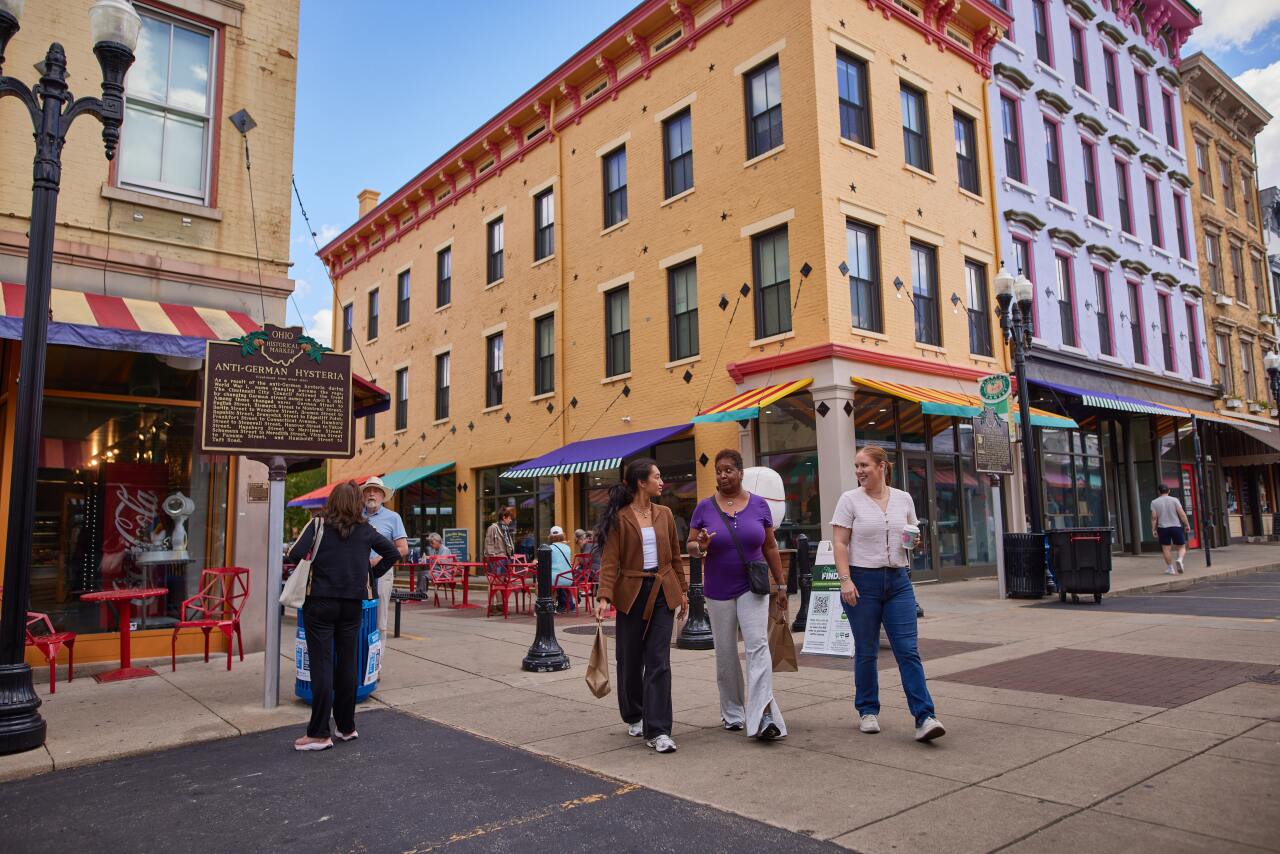
Today, the streets in southern OTR are unrecognizable, a slew of chef-owned restaurants in 19th-century storefronts, parks with morning yoga, flea markets and jazz, and loft-style condos with exposed brick that can easily top $400,000.
“Pride.”
That’s how former Cincinnati Mayor John Cranley described his feelings about Over-the-Rhine now.
“Knowing how bad it was then, and knowing how vibrant it is now, great restaurants, great parks, Music Hall, Memorial Hall, the outdoor dining … it feels like a European city, especially in good weather,” Cranley said. “Now obviously it still needs more work, and there are some rougher edges that are re-emerging, but I think that it’s a thousand times better today than it was in 2001.”
In the aftermath of the 2001 riots, when images of a burning and broken Cincinnati were broadcast across the nation, the city was at a crossroads.
“It just looked like a war zone,” Urban Sites CEO Greg Olson said. “Every façade was beaten down, it was either boarded up, no glass, painted over, there was graffiti everywhere … there was prostitution, drug dealing. I would get asked if I wanted to buy drugs almost every day in 2002. It was certainly not safe.”
Watch: How has Over-the-Rhine changed in the years since the Cincinnati riots?
Major companies considered moving out of downtown, Cranley said.
“Everybody felt that our city … was on a precipice and it could fall off, permanently,” Cranley said. “We were at a turning point. It would either get worse or better.”
The city created a task force driven by Mayor Charlie Luken and comprised of corporate leaders to brainstorm how to bring vibrancy to the urban core.
“George Schaefer, who was then the CEO of Fifth Third Bank, was the chairman of the task force,” Cranley said. “Their number one recommendation … was to create a nonprofit development corporation that would have the power to buy land, redevelop property, that would be funded in large part by the business community. That, of course, became 3CDC.”
The Cincinnati Center City Development Corp., or 3CDC, was created in July 2003. Steve Leeper became CEO of the private, nonprofit development corporation the following year, and soon tackled its first major project: the revitalization of the Fountain Square District.
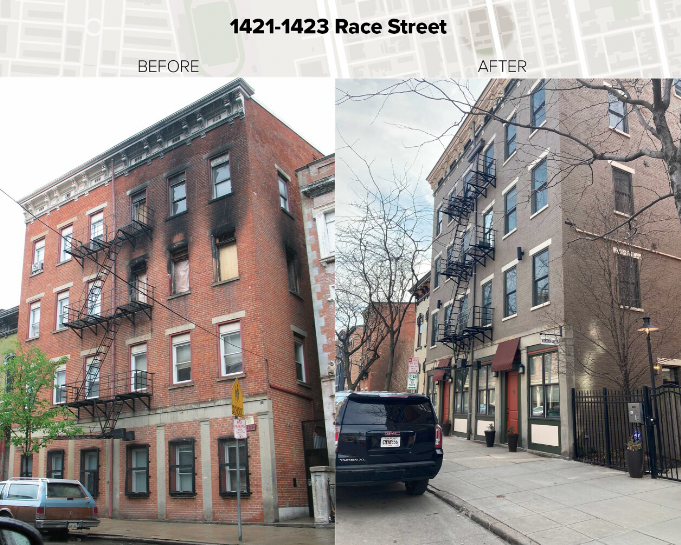
Simultaneously, 3CDC was also focused on Over-the-Rhine. It began buying distressed and nuisance properties there in 2005, and held onto them until redevelopment could begin.
“Quietly at that time, the business community, through 3CDC, started buying up a bunch of vacant property in Over-the-Rhine,” Cranley said. “When other cities couldn’t raise capital because nobody was lending money anymore, Cincinnati had the resources, the deep-pocketed resources of the business community to reinvest and revitalize property when nobody else could. I give a lot of credit to Procter & Gamble and Kroger for their visionary leadership to put tens of millions of their own dollars in to save their city.”
The Gateway Quarter
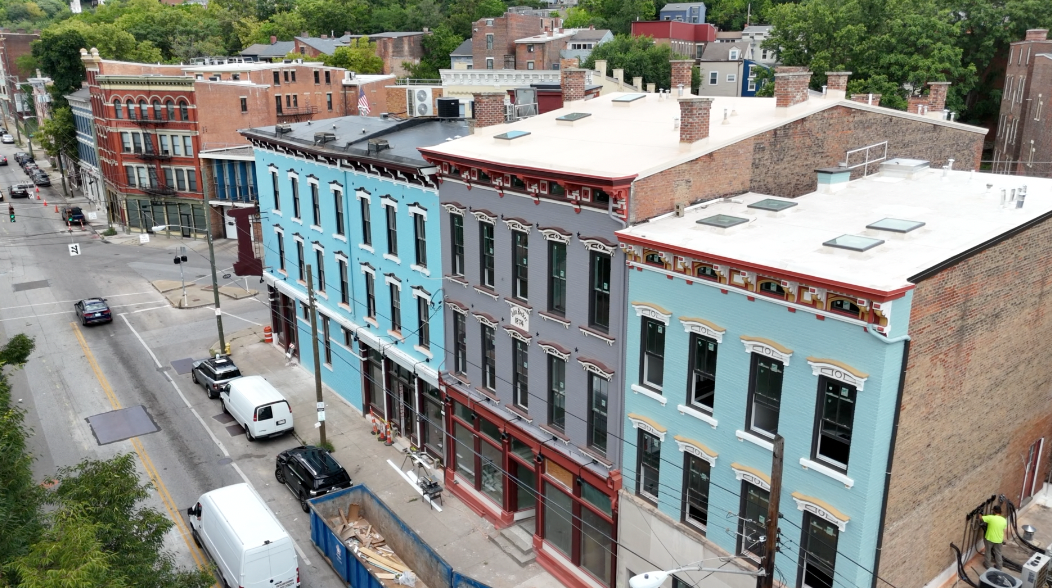
Urban Sites was one of the first developers to take a risk in Over-the-Rhine, restoring 1200 Race Street in 1993, across from Washington Park. The historic building has apartments on the upper floors and Teak Sushi & Thai restaurant on the street level.
“It’s the largest collection of Italian and Greek revival architecture in the whole country, … that’s what makes it so special,” Olson said.
Olson’s crews have discovered Thomas Edison light bulbs, old medicine bottles, and newspapers with stories about the Civil War in the basements of buildings during restoration.
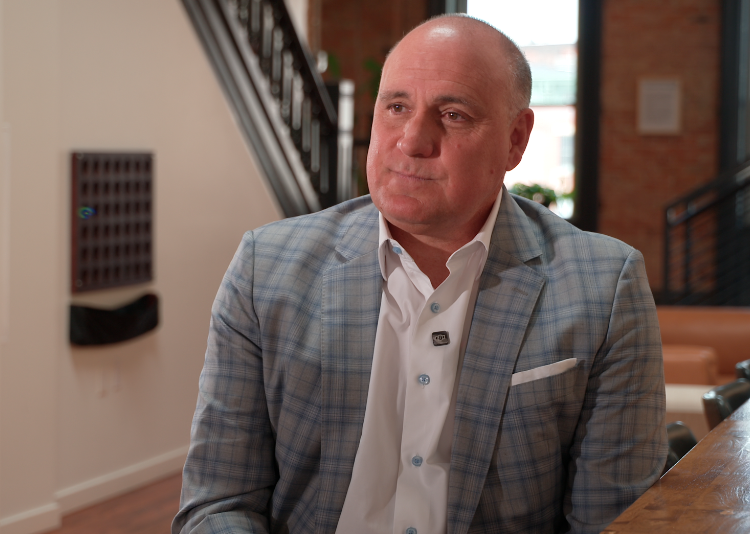
“My father-in-law (the late Ed Hubert) always had a massive love for Over-the-Rhine and helping to revitalize and bring things back to life,” Olson said. “Our family had started with Bill Baum in the early 1990s, renovating historic buildings along Main Street and 12th and 13th … Bill Baum created the industrial loft style look here, and he made it famous here in Cincinnati.”
In the years that followed, other developers such as the Model Group, City Center Properties and the NorthPointe Group made bold, early investments in Over-the-Rhine, restoring historic buildings.
“We decided to focus on Vine Street to begin with … and the development just incrementally moved up the street to Liberty,” 3CDC Chief Operating Officer Paula Boggs Muething said.
That redevelopment began just north of Central Parkway in the blocks known as the Gateway Quarter.
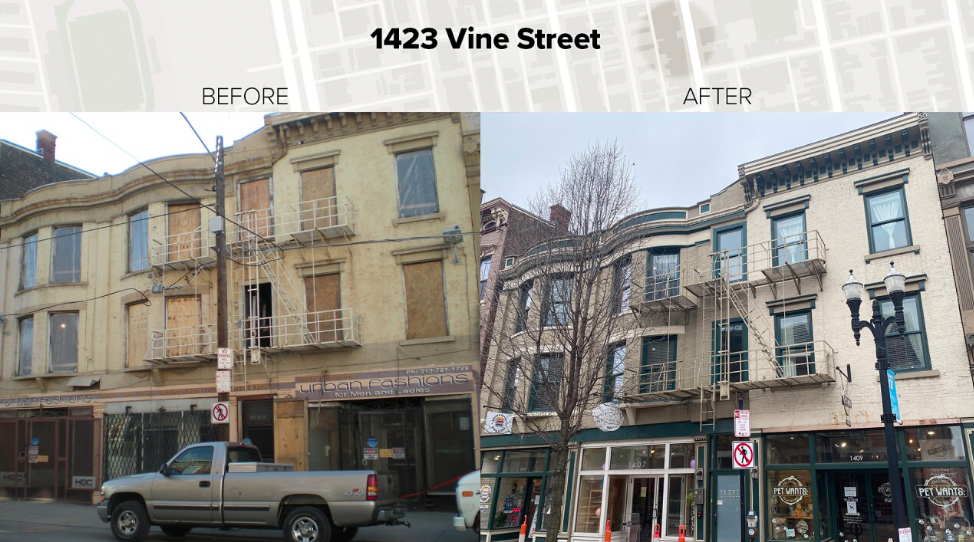
“That’s what we called it then, at 12th and Vine Street … because we didn’t want to call it Over-the-Rhine … because no one would want to come there,” Olson said.
“When I met Steve Leeper, I want to say in the fall of 2004, we were working on a project called the Lofts on Broadway … right across the street from where the casino is now,” Olson said. “And we started imaging what Over-the-Rhine could be like if we started doing some work on Vine Street, so we started partnering with 3CDC.”
But Olson’s friends and family warned against it, saying, " You should not be doing this, this is not safe, it’s not a great investment.”
Then the Lavomatic wine bar and restaurant opened in February 2008 in an old laundromat at 1211 Vine St. Chef Jean-Robert de Cavel brought French cuisine to the up-and-coming neighborhood, and suburbanites got curious enough to visit.
“I remember when Lavomatic opened. My friend and I were so excited to see what had happened to this little corner,” Muething said. “It was so busy, I remember we waited to get in; it was really exciting.”
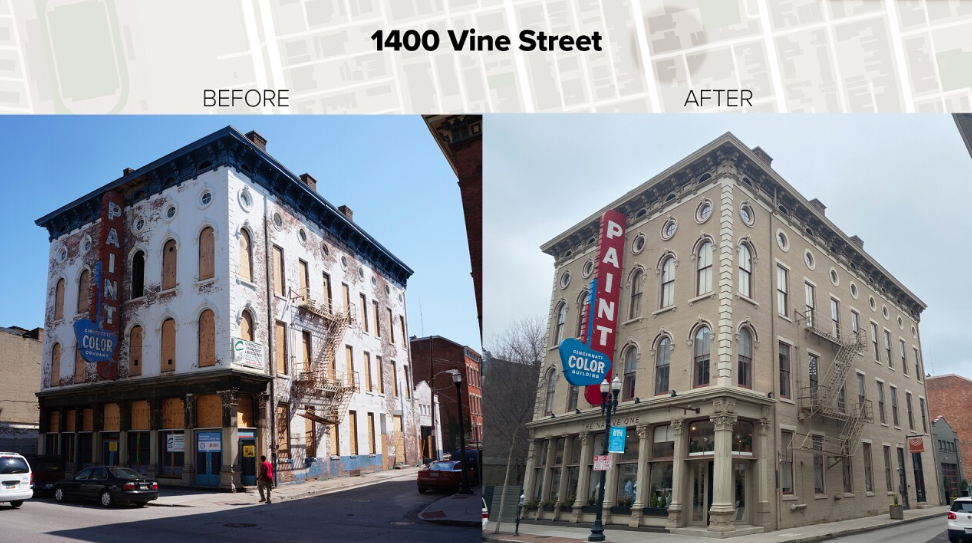
At first, 3CDC hired an outside company to manage its first-floor commercial spaces, such as restaurants and bars, in its renovated buildings, but then decided to bring that control in-house, Muething said.
“Being able to control what is on the street from a commercial perspective as well as have the residents above that give you that foot traffic, that was an early pivot in the strategy for redevelopment,” Muething said. “You can really see now that with control over those commercial spaces, we are able to take a risk on new businesses or an entrepreneur who has never had a business before.”
The real turning point in Over-the-Rhine was the redevelopment of Washington Park in 2012, creating a seamless connection between Music Hall and Vine Street, Muething said.
“Washington Park before these changes was a scary place,” Cranley said. “In those days, if you were going to Music Hall, you would park where WCET is, in that garage, and take the skywalk over Central Parkway to get to Music Hall. It was a place you definitely wanted to avoid at night, and most people avoided it during the day. It was scary.”
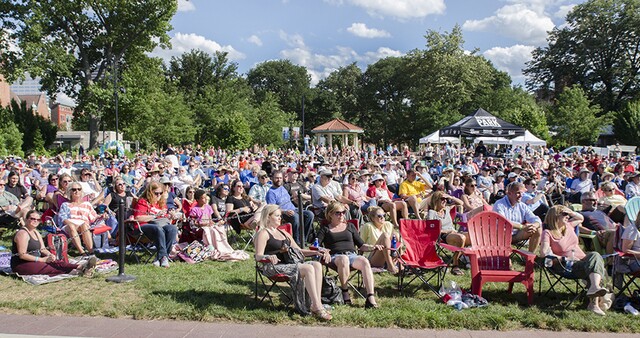
The $48 million Washington Park restoration included an underground parking garage, a performance stage, a public lawn and event plaza, a water feature with lights and sound, a playground and dog park, a restored bandstand, planting beds and garden pathways.
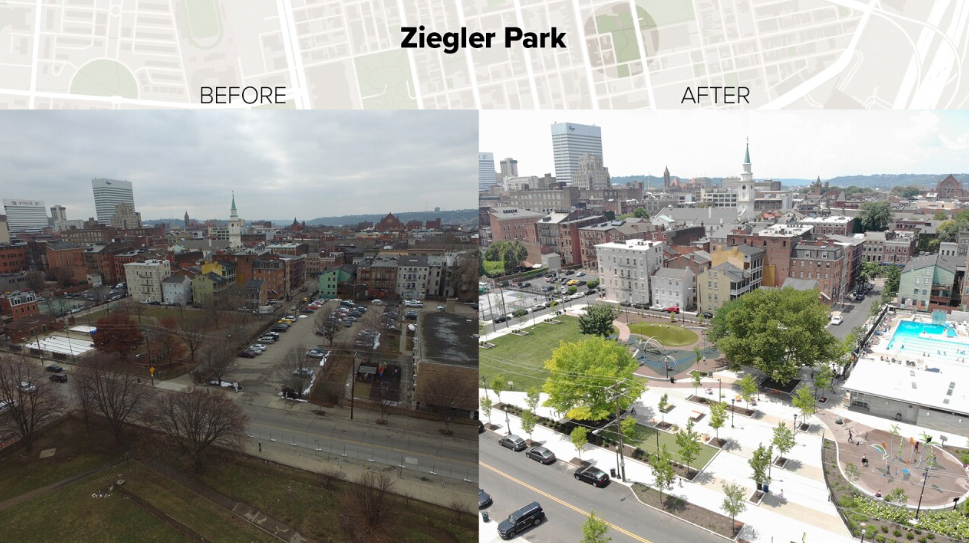
In the years that followed, 3CDC continued its work in Over-the-Rhine with a series of massive renovations and expansions to Ziegler Park, Music Hall, Memorial Hall, and the creation of Imagination Alley.
The city’s financial contribution to those big projects came from the new TIF districts that Cranley had created in 2002, he said, blending the neighborhood with downtown to spur development.
“I did something radical that was opposed by the business district at the time, which is I created TIF districts that combined downtown with Over-the-Rhine,” Cranley said. “The business community at the time was very angry at me … they said it’s not fair to take our taxes to subsidize this ghetto. I’m proud to say that I overruled their advice and got city council to go along.”

Better or worse?
Recently, developers and 3CDC have shifted their attention to a rougher section of vacant buildings in the blocks north of Liberty Street.
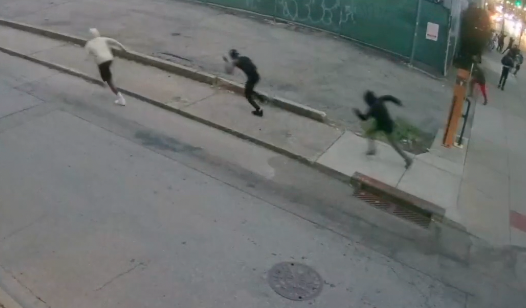
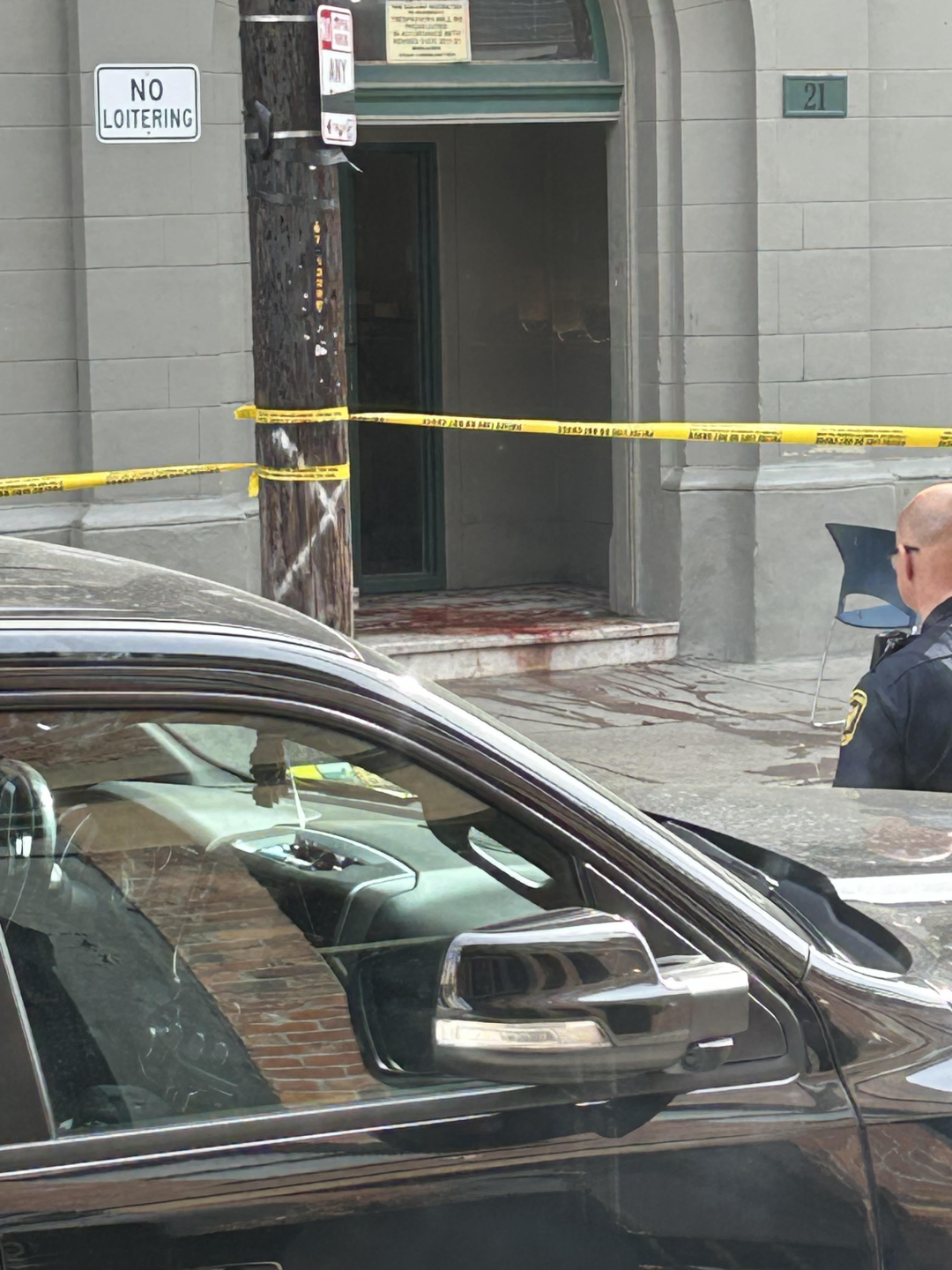
Many of these streets have open-air drug markets, homeless people who sleep on sidewalks and steps, shootings, vandalism and nighttime rowdy crowds — especially during summer evenings.
“That’s how south of Liberty used to look,” Olson said. “What I’m seeing up there is 2.0 of what happened south of Liberty. It’s not going to happen overnight. It’s going to take 15 years.”
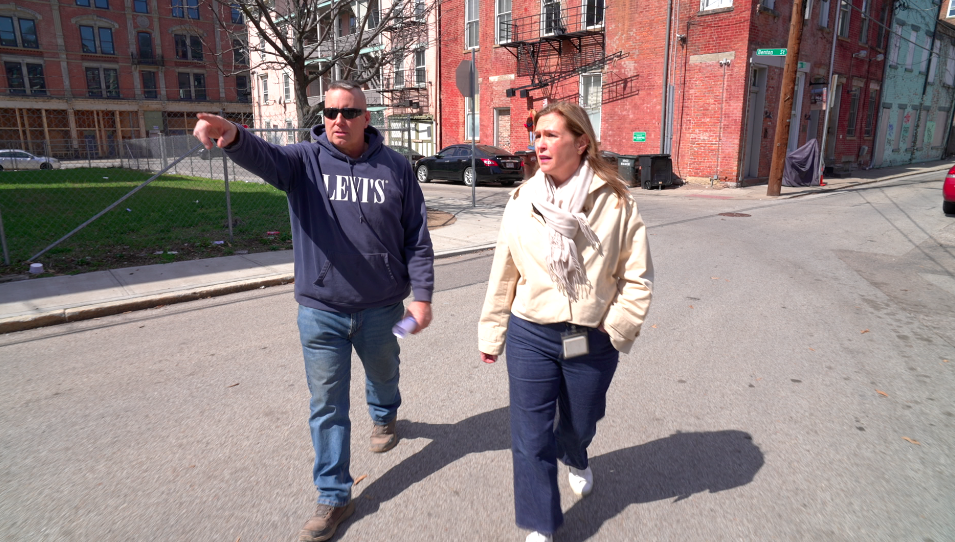
But John Donaldson has been waiting for that turnaround since before the riots. He’s lived in Over-the-Rhine since 1999 and has owned property around Grant Park since 2003.
“I look at the crime in the area, and I would say it’s gotten worse,” Donaldson said, noting the number of homicides in the area before the riots was much lower than it is now.
“Right now, it’s Mayberry,” Donaldson said, during an interview with WCPO 9 I-Team reporter Paula Christian on March 19. “But at 7 o’clock when it's 80 degrees outside, it won’t be … it’s easy to let your guard down now because it feels this way, but then we’ll have a drive by (shooting). That doesn’t happen in Mason. That doesn’t happen in Hyde Park.”
Donaldson acknowledged some improvements to his neighborhood.
“One thing that has gotten better is the amount of dumping that we had back then, which has significantly gone down,” Donaldson said. “Back then, it would not be uncommon to see couches, chairs, beds just lying in the street, loose trash floating all around. It was really pretty bad.”
He’d like to see improvements made to Grant Park, which is often the site of shootings and large nighttime crowds that gather along the perimeter.
“I would like to see city cameras in the park, I would like to see city lighting, for it to look a little more pleasant. This ground is pretty beat up,” Donaldson said. “I think we need to reimagine the park. I think it needs some investment.”
Meanwhile, Muething, of 3CDC, said there are plans to renovate Grant Park.
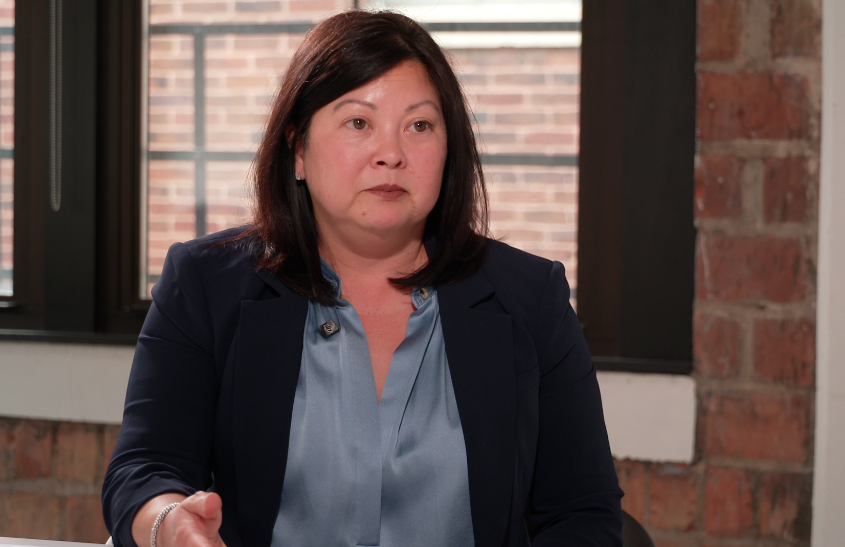
“I think our work in North Over the Rhine has to include work in Grant Park,” Muething said. “It’s been a park that has seen a lot of violence and disinvestment, but there is a lot of promise in that part of the neighborhood.”
The first large project by 3CDC in north OTR is the Findlay Community Hub, with 60,000 square feet of fitness and community center space, a swimming pool, a roller rink and a child care center. Construction is expected to finish in November, and the hub will open in January 2027.
A few doors down from the hub, the new Crossroads Health Center is expected to open in May. 3CDC plans to redevelop the old health center building on Liberty Street, but Muething said there are no plans yet.
“Then we are going to break ground on Findlay Flats, which will be another residential project that will have ground-floor commercial right in that area; it will be a little bit of a scattered site right along Vine Street,” Muething said.

“We will also have the Rust Alley Flats project that will come … we are currently securing financing for that, but we do have plans, and those will be really good projects for the neighborhood that will have a mix of affordable and market rate.”
Grant Park will be part of the second phase of the Findlay Community Hub project, Muething said, “the reimagining of that so children can play in the park, but that there will be amenities for people of all ages so and really to make it a welcoming space for visitors and for residents and to program it so that we have good activity there.”
Meanwhile, the Model Group, which has worked for years to revitalize the area around Findlay Market, continues to redevelop historic buildings and create more apartments and office space.
Urban Sites has a groundbreaking set for April 17 for a new $34 million project at the old Grammar’s bar at Walnut and East 15th streets, which is the oldest bar north of Central Parkway, built in 1872. The historic site will reopen as a mixed-use development called The Lockard with 129 units, 4,000 square feet of retail, and 71 parking spaces.
‘You’re never really done.’
When Muething was asked when Over-the-Rhine would be finished, she didn’t have a clear answer.
“You’re really never done,” Muething said.
Cranley agreed and described the neighborhood north of Liberty Street as “the frontier.”
“Today, despite all the progress we’ve made, the population in Over-the-Rhine is still at 10,000, maybe at 11,000,” Cranley said. “We’re not even a third of the way back to where Over-the-Rhine was before the decline of the 70s and 80s and 90s, so there is still an enormous opportunity to bring in new people without displacing the old, and in the process giving all people greater opportunity.”
Cranley hoped that 3CDC continues to be aggressive in its efforts to buy, develop, program and oversee property and community spaces.
“What I want is 3CDC to be as ambitious as it was for the last 20 years for the next 20 years. To go north of Liberty. To continue to fill out pockets,” Cranley said. “Then go … into other areas of concentrated poverty in the city, whether it’s on the West Side, or the Mill Creek Corridor, and work with the Port Authority, and the Cincinnati Development Fund, and organizations like that to have the same kind of public-private partnership that worked so well for Downtown and Over-the-Rhine.”
But the one variable is crime.
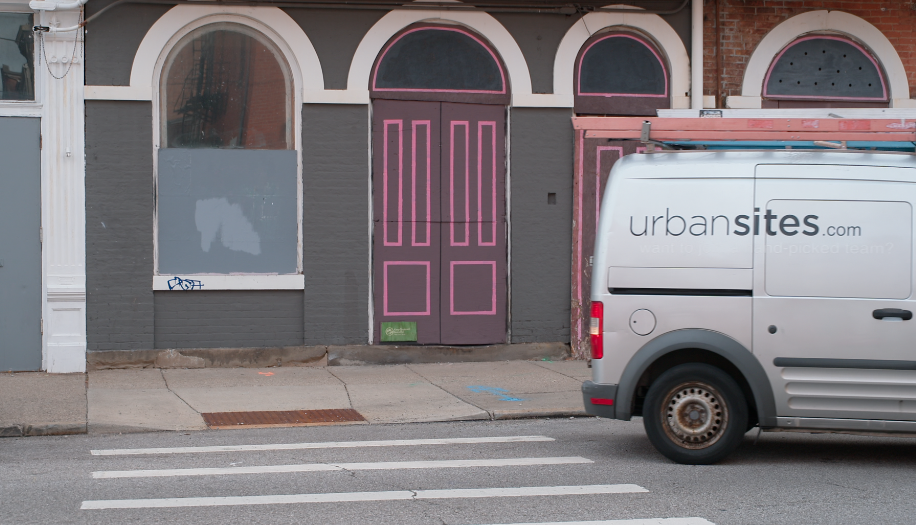
While some blocks north of Liberty are busy with construction crews beautifying historic buildings, just a block or two away, the vibe quickly shifts to graffiti-covered vacant buildings and street drug sales.
“The underlying currents that caused the problems in 2000 are still here today,” Donaldson said. “If you measure it by the way buildings look, we’ve made significant progress. If you measure it by the underlying crime and violence and community relationships with the city, I would say we’ve gone in the wrong direction.”
He would like to see more proactive policing and Hamilton County Sheriff’s deputies patrolling here, as they did in 2006 to assist Cincinnati Police. So would Olson of Urban Sites.
“I would love to see their presence here,” Olson said. “I voice it, I share that, but it’s not my call for sure.”
Meanwhile, 3CDC continues to work with the city on public safety. Muething said they have to provide a real sense of safety, whether it's the reality of crime or just how people feel about it.
"We try to provide as much safe, secure parking as we possibly can. We have been working on providing the valet options, so the Over-the-Rhine valet is a new amenity that we’ve offered," Muething said.
Olson believes the city is working hard to solve crime problems here, along with residents and owners.
“It’s not like conversations aren’t being had by the property owners and all the restaurant and business owners,” Olson said. “We are always texting and emailing and calling each other trying to figure out how it can be better."
Cranley said the city must return to proactive policing.
“And specifically, what I mean by that is getting back to group and gang activity,” Cranley said. “You have a lot of young people in the city who don’t have father figures in their lives and humans are social animals and so the lack of father figures, you’re going to coalesce around your peers … and breaking up some of those behaviors that lead to the open air drug dealing and violence and the culture of drug violence, I think we’ve got to reinvigorate that.”
But Olson remains optimistic as he looks to the neighborhood’s future.
“How is Over-the-Rhine doing? It certainly doesn’t look like how it did in 2002,” said Olson. “I think people need to continually remind themselves that we’re not how we used to be. And remind ourselves that we have made massive progress, $2 billion worth of investment.”
