

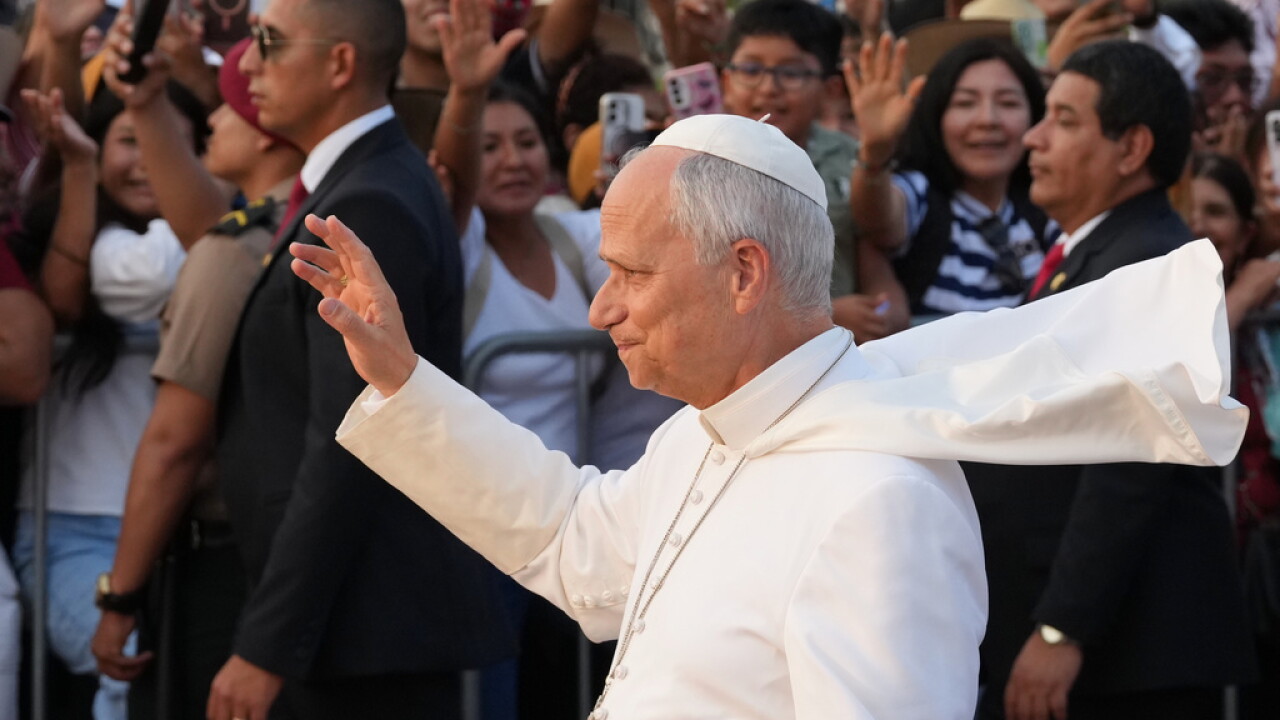

The plight of Indigenous peoples and the protection of the Amazon take center stage Sunday as Pope Leo XIV travels across Peru to visit communities high in the Andes and deep in the rainforest.
On the penultimate day of his visit to his adopted homeland, Leo is expected to echo Pope Francis, emphasizing Catholic teaching that links care for the most vulnerable with care for God’s creation.
He travels first to Cusco, the former capital of the Inca empire, before flying to the Amazonian city of Pucallpa, where illegal mining, deforestation and threats to Indigenous communities will be central concerns.
“The church in Peru perceives the continuity of his commitment to accompany Indigenous peoples in the defense of life and the care of the territory, which is increasingly threatened by deforestation and illegal mining,” Peruvian Cardinal Pedro Barreto, president of the Amazon bishops conference, told The Associated Press.
“Leo is clearing the path laid out” by Francis on environmental protection and human rights, Barreto said. He added that the pope would hear about violence affecting children and young people.
From the Andes to the Amazon
The visit to Cusco, 3,400 meters (more than 11,000 feet) above sea level, will test the stamina of the pope, who is recovering from lung cancer surgery.
His schedule begins at the historic Sacsayhuamán fortress, where he will speak about local religious devotion. In the Plaza de Armas, he will present a shroud from the Holy See for the image of the Lord of the Earthquakes, a focus of devotion in a country prone to seismic activity. He will then deliver a message to the sick before leaving for Pucallpa.
In the rainforest city of 434,000 people, Leo is expected to reinforce Francis’ teachings on protecting the environment and Indigenous communities threatened by illegal mining and other forms of exploitation.
The Rev. Luca Zanta, one of the visit’s organizers, said Leo would “primarily listen to the Amazonian Indigenous peoples, including the Shipibo, Asháninka, and Kukama communities” gathered beside Lake Yarinacocha.
Zanta said Leo would lead a symbolic planting of a shihuahuaco, a native rainforest tree that can live for more than 1,000 years and grow dozens of meters tall.
“That is a symbol of how we want our common house to be. We want the Catholic Church to live long, protect those who need it and see its values and beauty admired by generations and generations,” Zanta told local radio Saturday.
Indigenous communities face mounting threats
The Rev. Peter Hughes, an 84-year-old Irish priest who has lived in Peru for more than six decades, said the visit reflects the church’s concern for the poor.
“In Latin American terms, the Indigenous peoples, or what is left of them, are the most important collective representing the truly poor,” he said. “That is what makes leaders like Pope Francis and Pope Leo speak the language of the Gospel in very human terms, putting a premium on justice and peace. In the Christian sense of justice, the most important people are the poor, the marginalized, and those who have no voice.”
Illegal gold mining has become an increasingly lucrative business in the Amazon, devastating forests and polluting rivers. Miners use makeshift suction dredges and mercury, a toxic metal, to extract gold.
“This global context of war and conflict has contributed to gold prices rising to historic highs, and the direct impact of this is that gold — which is present in all Amazonian rivers — can be extracted using mercury, particularly if you want to do this on a large scale,” said Raphael Hoetmer, Western Amazon program director at Amazon Watch.
“It’s causing pollution, health issues, and environmental degradation,” he said.
On Saturday, police reported three operations against illegal mining in Madre de Dios, one of the country’s most biodiverse regions. They said they destroyed extraction equipment, including rafts and motors, valued at $4.1 million.
Illegal mining also drives deforestation and encroaches on Indigenous territories, threatening ancestral lands and exposing communities to violence and organized crime.
Isolated peoples are especially vulnerable
Leo is also expected to address sexual violence against women and girls. Barreto said the pope would likely pay particular attention to a recent case in Condorcanqui province in the northern Amazon, where teachers sexually abused Indigenous Awajún and Wampis girls.
There is particular concern in Peru for Indigenous peoples living in isolation, including the Mashco Piro in the forests of southeastern Madre de Dios.
Images released by Survival International in 2024 showed dozens of Mashco Piro people near logging concessions. Clashes between Indigenous people and loggers that year left at least two loggers dead.
Concerns also extend to Kakataibo communities living in isolation or initial contact.
“They have reservations that should protect them. But the Peruvian government is increasingly unwilling to acknowledge the existence of these peoples,” Hoetmer said. “And their reserves are also being invaded by drug cartels because, of course, they’re ideal places for them to operate since no one can get in.”
