
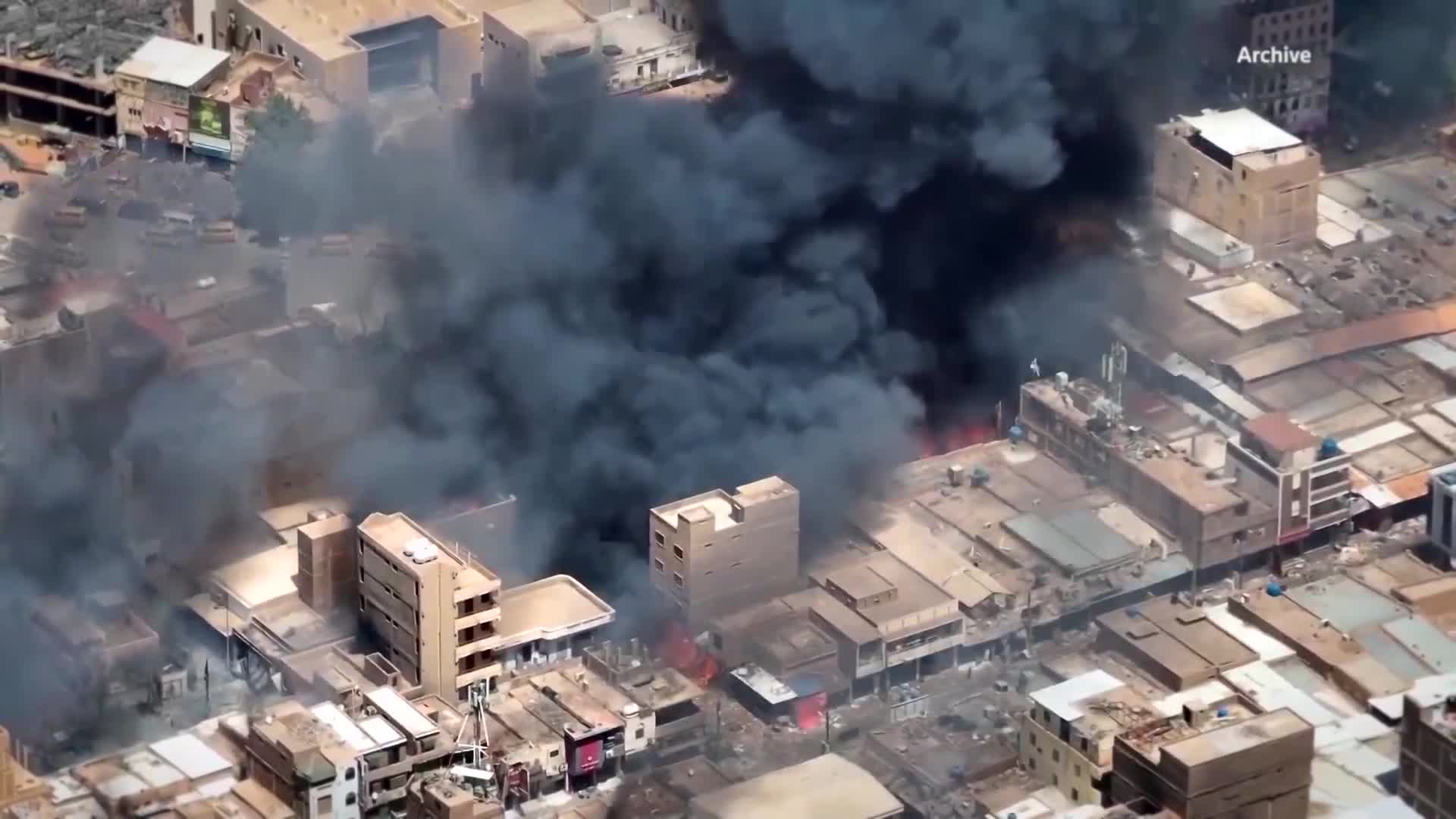


Sudan's civil war — now in its fourth year — began as a power struggle between the Sudanese Armed Forces and the paramilitary Rapid Support Forces. It has evolved into something else. Something more precise, and in its precision, more terrifying.
It has become a drone war.
The United Nations put a figure on it in May. Between January and April of 2026, drone strikes killed at least 880 civilians in Sudan — more than 80% of all conflict-related civilian deaths in that period. U.N. Human Rights Chief Volker Türk called armed drones "by far and away the leading cause of civilian deaths" in the conflict.
The Armed Conflict Location & Event Data Project found that drone-related deaths in 2025 alone marked a 600% increase over the previous year.
Most of the carnage has concentrated in Kordofan and Darfur — regions that have already seen the worst of what this war can do. Markets. Hospitals. Aid convoys. Schools. The pattern, human rights groups say, signifies strategy.
To understand how Sudan got here, you have to understand where its paramilitary force came from.
The RSF grew out of the Janjaweed militias — the horseback raiders accused of mass slaughter in Darfur two decades ago. In those days, the violence was intimate. Up close. Men with rusty AK-47s.
Now there are drones.
Nathaniel Raymond, executive director of the Humanitarian Research Lab at Yale's School of Public Health, has spent years building forensic evidence of what's happening in Sudan from satellite imagery and open-source intelligence. What his lab found in El Fasher — the last major city in Darfur still contested before the RSF's final assault — reveals a level of operational sophistication that rewrites what we thought we knew about this conflict.
IN CASE YOU MISSED IT | Inside Sudan's hidden genocide: Eyewitness accounts from the world's worst humanitarian crisis
The RSF, Raymond says, used Chinese-made fixed-wing drones — CH-95 or FH-95 models — launched from Nyala Airport in South Darfur, roughly 150 miles to the south. Those drones flew north to El Fasher and loitered. They didn't strike immediately. They gathered. Sucking up communications data to locate where people were hiding. Blocking residents from calling for help. Preventing videos from getting out of the city.
Then came the quadcopters — small, camera-equipped, packed with explosives — deployed from along the berm the RSF had built to prevent escape. Targeting people in bomb shelters, mosques, community kitchens, and schools.
"They were hunters," Raymond told me.
In October, they hunted at the Al-Safiya Mosque in El Fasher's Al-Daraja Awla neighborhood. Raymond described the strike with the grim precision of a forensic investigator: the drone came in at an angle, hit the corrugated metal roof, shrapnelized it, and funneled the fragments down into the body of the building. Seventy-eight people were killed.
"The arc was so precisely planned," Raymond told me, "that if it wasn't horrific, it would be elegant in terms of the thought that went into how the drone hit."
IN CASE YOU MISSED IT | The Yellow Floor Room: A glimpse into Sudan’s hidden war on women
The RSF is not the only party raining death from above.
Both sides, human rights groups say, are acquiring increasingly sophisticated drone technology through their respective foreign backers. The RSF is supplied primarily through the UAE. The Sudanese Armed Forces have drawn on Turkey, Iran, and Egypt.
On March 20th — the first day of Eid al-Fitr — a drone struck the El Daein Teaching Hospital in East Darfur. Twice. The WHO confirmed 70 people killed, including 13 children, seven women, and three medical staff. One hundred forty-six wounded. The hospital — the primary referral facility for the entire East Darfur state — was rendered completely non-functional.
Sudanese rights group Emergency Lawyers reported the strike was carried out by a Sudanese Armed Forces drone. The army denied targeting the hospital. Two military officials, speaking anonymously, told the Associated Press the intended target was a police station nearby.
Yale's researchers looked at the police station. It was untouched.
"By being able to watch the presence of the weapons on the ground before they're launched," Raymond explained, "we can really get crime scene level data — like we're dealing with a handgun in a homicide."
In older wars, culpability could be argued. A mortar goes astray. A missile hits a building in error. Accidents, in the fog of war, are at least plausible.
Drones are different. A drone is piloted. It goes where someone directs it. It strikes what someone chooses.
"When we're talking about drones," Scripps News Senior International Correspondent Jason Bellini told Raymond, "there's no deniability there."
"This is so crucial," he replied. "Attribution falling away as you start to use drones — that is the critical point."